
Chucky (Child's Play)
Serial killer who inhabits a Good Guy doll via voodoo, seeking a soul transfer into a human body.

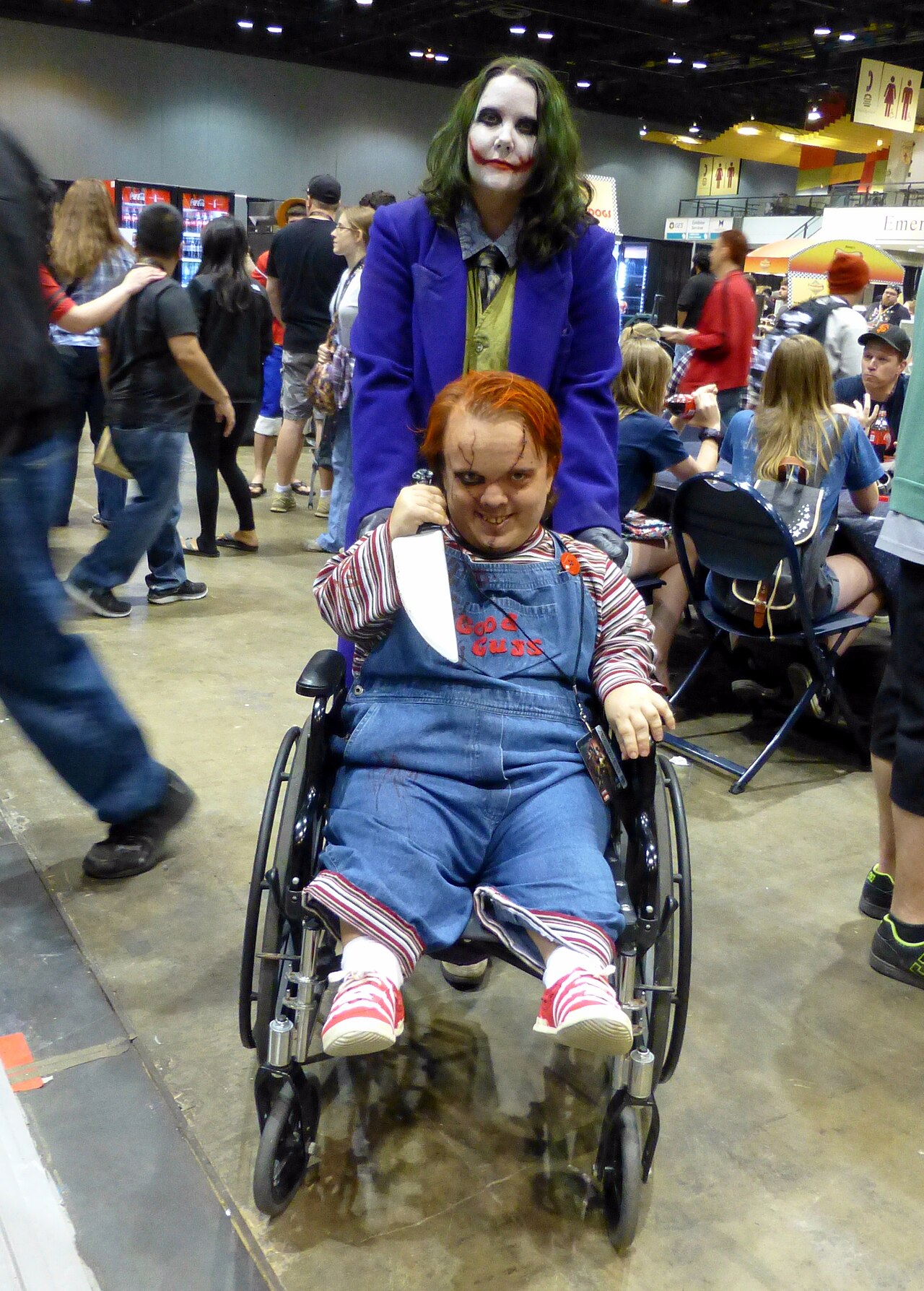
GabboT · CC BY-SA 2.0
Chucky, whose original name is Charles Lee Ray, serves as the primary villain in the *Child's Play* series. He makes his debut in the 1988 film *Child's Play*, where he is a brutal serial killer who uses voodoo to move his soul into a "Good Guy" doll. The character was invented by writer Don Mancini, and Brad Dourif is the main actor providing his voice. Beyond the films, Chucky has appeared in novels, video games, and comic books.
- first_appearance
- Child's Play (1988)
- creator
- Don Mancini
- primary_voice_actor
- Brad Dourif
- known_for
- Serial killer who transfers his soul into a Good Guy doll using voodoo magic
- field
- Horror film antagonist
Quick Facts
- Series
- Child's Play
- First
- Child's Play (1988)
- Full Name
- Charles Lee Ray
- Nickname
- Chucky / Charlie
- Alias
- The Lakeshore Strangler
- Spouse
- Tiffany Valentine
- Children
- Glen Tilly / Glenda Tilly
- Relatives
- Elizabeth Ray (mother) / Peter Ray (father)
- Voice
- Brad Dourif / Various · Mark Hamill (Reboot film and Robot Chicken)
- Religion
- Haitian Vodou
- Lbl1
- Performed by
- Creator
- Don Mancini / John Lafia
Facts from the source article.
Lore & Background
Chucky first appeared in the 1988 film Child's Play as a serial killer named Charles Lee Ray, known as 'The Lakeshore Strangler' and also by the nickname 'Chucky'. After being shot by Detective Mike Norris, he uses a voodoo ritual to transfer his soul into a Good Guy brand doll. Pretending to be an inanimate object, Chucky is given to young Andy Barclay by his mother and begins terrorizing the family. He learns that he must transfer his soul into Andy's body to escape the doll, with the first person he told his real name to being the key to the soul transfer. The Barclays and Norris eventually kill Chucky by setting him on fire and shooting him.
Chucky is repeatedly resurrected in subsequent films. In Child's Play 2 (1990), he is repaired by Play Pals Inc., leading to his resurrection and continued pursuit of Andy. In Child's Play 3 (1991), he is inadvertently resurrected when a splash of his blood is mixed with molten plastic used to produce new Good Guy dolls. In Bride of Chucky (1998), he is reconstructed by his former girlfriend Tiffany Valentine, who he later kills and transfers her soul into a female doll. In Seed of Chucky (2004), Chucky and Tiffany's gender-confused living-doll child resurrects them using the Heart of Damballa. In Curse of Chucky (2013), Chucky reveals his past obsession with Nica Pierce's mother and frames Nica for murders. In Cult of Chucky (2017), he reveals a spell that allows him to split his soul and possess multiple bodies, eventually possessing Nica.
The television series Chucky (2021–2024) follows the events of Cult of Chucky. In the first season, Chucky is purchased by 14-year-old Jake Wheeler at a yard sale and completes a voodoo ritual to possess an army of Good Guy dolls. In the second season, the original Chucky possessing Nica is removed through an exorcism and escapes in a new doll body. In the third season, Chucky infiltrates the White House to perform ritualistic murders to regain Damballa's favor, eventually reproposing to Tiffany and driving away with Caroline.
Reader's Guide
Chucky is a significant figure in horror cinema, representing a shift from human serial killers to supernatural, doll-based antagonists. His persistence across multiple films and a television series demonstrates the franchise's enduring appeal. The character's ability to be repeatedly resurrected and his evolving methods—from voodoo soul transfer to soul-splitting spells—allow for continuous storytelling. Chucky's blend of horror and dark humor, particularly in later installments like Bride of Chucky and Seed of Chucky, has broadened his audience. The 2019 reboot, featuring a high-tech artificially intelligent 'Buddi' doll voiced by Mark Hamill, shows the character's adaptability to modern fears. Chucky's legacy includes appearances in novels, video games, and comic books, cementing his status as a horror icon.
Did You Know?
- Chucky was created by writer Don Mancini and is primarily voiced by Brad Dourif.
- In the original film, Chucky is a serial killer known as 'The Lakeshore Strangler' who uses voodoo to transfer his soul into a Good Guy doll.
- In Cult of Chucky, Chucky reveals a spell that allows him to split his soul and possess multiple bodies.
- The 2019 reboot features Chucky as a high-tech artificially intelligent 'Buddi' doll voiced by Mark Hamill.
Origins and the Birth of a Villain
Charles Lee Ray, a serial killer nicknamed the Lakeshore Strangler, is the human soul trapped inside the Good Guy doll that audiences know as Chucky. Writer Don Mancini conceived the character for the 1988 film, and actor Brad Dourif provided the voice that gave the doll its snarling, profane personality. In the original story, Ray is shot by Detective Mike Norris and, desperate to avoid death, performs a voodoo ritual to pour his consciousness into a mass-produced toy. The doll is then handed to a young boy named Andy Barclay by his mother, Karen, and what follows is a household siege disguised as a child's new plaything. Crucially, the film establishes a rigid supernatural rule: Chucky can only reclaim a full human body by possessing the very first person he ever whispered his true name to, which locks his fate to Andy. This marriage of folk-magic, domestic invasion, and a child at the center of a killer's obsession gave the franchise a voice unlike any other slasher of the late 1980s.
The Unbroken Stalking of Andy Barclay
From the 1988 debut through the 2017 finale, Andy Barclay remains the single thread that stitches every installment together. In the first film, the doll masquerades as a harmless toy while methodically terrorizing the Barclay household. By the 1990 sequel, Andy has been shuffled into foster care, and a repaired Chucky—reconstructed by Play Pals Inc., the very company that manufactures Good Guy dolls—stalks him through his new home and classroom, killing his teacher, his social worker, and his foster parents. In the 1991 entry, a teenage Andy at a military academy must stop Chucky from possessing a young boy named Tyler. Even in the 2013 film, Chucky makes a direct attempt on Andy's life, only for Andy to spring a shotgun ambush. In the 2017 conclusion, an institutionalized Andy makes one last stand against the doll. This unbroken pursuit transforms what could be a series of random murders into a deeply personal, decades-long vendetta between a child who will not be left alone and a killer who refuses to let him grow up.
Death, Resurrection, and Escalating Stakes
Chucky's narrative engine is a cycle of increasingly creative destruction followed by equally creative resurrection. In 1988, the Barclays and Norris set the doll ablaze and shoot him. In 1990, Andy and Kyle partially melt him in molten plastic and then blast his head off with an air-hose. In 1991, a mere splash of his old blood mixed into fresh molten plastic at the factory accidentally brings him back eight years later, and he is ultimately shredded to pieces by an industrial fan. In 1998, Tiffany Valentine rebuilds him from parts, but he is eventually shot dead by Jade. In 2004, the Heart of Damballa—a magical amulet buried with his original body in Hackensack, New Jersey—restores him, only for Glen to split him open with an axe, leaving a disembodied arm that later attacks Glen. By 2017, Chucky has discovered a new spell that lets him fracture his soul across multiple living bodies at once. Each killing method is more inventive than the last, and each return raises the supernatural ceiling, turning a simple slasher premise into an ever-expanding mythology in which the villain is, for all practical purposes, immortal.
A Multimedia Legacy and Evolving Mythology
Chucky's reach extends well beyond the silver screen. The character, born from Don Mancini's imagination and brought to life vocally by Brad Dourif, has been adapted into novels, video games, and comic books, cementing his status as a cross-platform horror icon. The film franchise itself spans nearly three decades, from the 1988 original to the 2017 entry, and along the way it has shifted tone from straightforward slasher to darkly comic family saga, introducing Tiffany Valentine, the gender-ambiguous child Glen/Glenda, and a growing constellation of victims. The 2013 installment recontextualized the 1988 events by revealing that Chucky had previously taken Sarah Pierce hostage and stabbed her pregnant belly, explaining Nica's lifelong paralysis and adding a layer of prequel backstory. The 2017 film's soul-splitting spell opens the door to even further expansion. Blending a childlike exterior with foul-mouthed dialogue and relentless supernatural persistence, Chucky has become one of horror's most enduring and instantly recognizable antagonists, a figure who has transcended genre to become a genuine cultural touchstone.
Gallery


Frequently Asked Questions
Who is Chucky (Child's Play)?
Chucky is the central antagonist of the Child's Play horror franchise, originally the serial killer Charles Lee Ray who uses voodoo to relocate his soul into a Good Guy doll. He first appeared in the 1988 film and has since become one of horror's most recognizable villains.
What are Chucky's powers and abilities?
Chucky's primary supernatural ability is voodoo-based soul transfer, which lets him move his consciousness between bodies or objects. He also retains the physical strength and combat skills of a full-grown adult man despite being housed in a small doll's body.
How does Chucky's story end in the original film?
In the 1988 Child's Play, Chucky is ultimately shot multiple times by Andy Barclow, destroying the Good Guy doll and killing him. However, the franchise continues with sequels in which he returns, so his death is never truly final across the broader series.
Why is Chucky important in horror cinema?
Chucky is widely credited as the first major horror villain to be a possessed toy, setting a template that later properties borrowed from. Created by writer Don Mancini, the character helped define the haunted-object subgenre and has spawned numerous sequels, novels, comics, and video games.
Who created and voices Chucky?
The character was created by screenwriter Don Mancini for the 1988 film, and Brad Dourif has provided Chucky's voice for the majority of the live-action entries. Mancini has also served as the primary writer across most of the franchise, shaping the character's evolution.
More in Film supervillains 1-24
Spotted an error? Know more?
This is a living reference — every entry is fact-audited, and reader corrections feed straight into our audit queue. Suggest an edit · See this site's audit record