Parry (fencing)
A defensive bladework maneuver that deflects an opponent's attack.
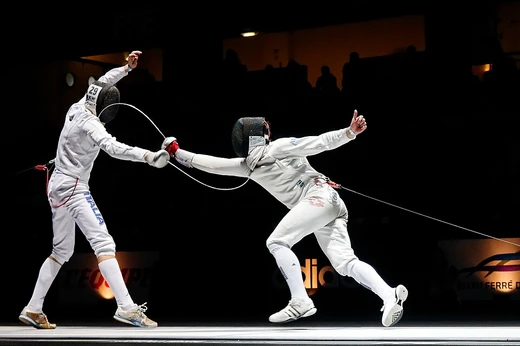
A parry is a fencing bladework maneuver intended to deflect or block an incoming attack. It is a fundamental defensive action that protects the fencer and sets up a counterattack. The parry is notable for its role in both physical defense and tactical priority in certain weapons.
Quick Facts
- Number of classical parries
- eight
- Parry numbering system
- one to eight
- French terms for parries
- prime
- seconde
- tierce
- quarte
- quinte
- sixte
- septième
- octave
Facts from the source article.
Execution
To execute a parry, a fencer strikes the opponent's foible (near the tip) with their own forte (near the bell guard). This deflects the incoming blade, protecting the fencer and positioning them for a riposte. Approximations of precise parries are common but usually accurate enough to be classed as parries. In épée, any deflection that prevents a hit can be considered a parry.
Use
The primary function of a parry is to prevent an opponent's attack from landing. Parries are initiated from the en garde position when an attack is threatening. A parry is typically followed by a riposte. Advanced fencers may instead perform a prise de fer, moving the opponent's blade to a different position before striking. In foil and sabre, the parry has tactical significance due to right-of-way rules: the first attacker gains priority, but a successful parry transfers priority to the defender, who then has the best position to riposte.
Classification
There are eight parries in classical épée and foil fencing, classified by three attributes: blade direction (up or down), position relative to the fencing line (inside or outside), and wrist rotation (supinated or pronated). They are numbered one to eight, with French names: prime, seconde, tierce, quarte, quinte, sixte, septième, octave. For a right-handed fencer, inside parries (prime, quarte, septime) deflect left; outside parries (seconde, tierce, sixte, octave) deflect right. A counter-parry responds to an opponent's parry, while a contra- (circular) parry uses a semicircular motion from the opposite side. Sabre parries differ slightly because they defend against cuts and thrusts; notably, quinte defends against a head cut.
More in Fencing
Spotted an error? Know more?
Reader corrections go straight into our review queue. Suggest an edit · How this site is sourced