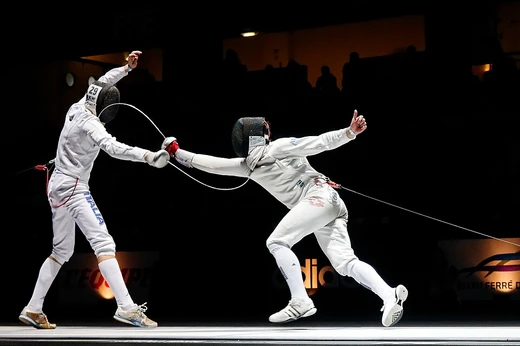
Outline of fencing
Overview and topical guide to the sport of fencing.
Fencing is a family of combat sports using bladed weapons. It is one of four sports that have been featured at every modern Olympic Games. The following outline provides an overview of and topical guide to fencing.
Fencing
Fencing can be described as a form of combat, specifically hand-to-hand combat that does not involve firearms or other distance weapons. It is a martial art, a codified system of combat practices pursued for self-defense, competition, physical fitness, entertainment, and mental and spiritual development. As a sport, it is a competitive physical activity that improves fitness and provides entertainment. It is a contact sport involving player-to-player or player-to-object contact, and a combat sport where two combatants fight under specialized rules simulating hand-to-hand combat. Fencing is a competitive, amateur, individual, recreational, and spectator sport.
Equipment and gear
The épée has a triangular cross-section blade and a large bell guard; it is also a light dueling sword popular in the mid-19th century, called an 'Épée de Terrain.' The foil has a rectangular cross-section blade and a small bell guard; more generally, any sword with a buttoned or turned-back point for safer practice. The foible is the top third of the blade, weaker in leverage and used for beats and presses. The forte is the bottom third, providing strength in leverage; parries should always be performed with the forte. The guard, also called bell or bell guard, is a cup-shaped metal part protecting the hand; foils use small concentrically mounted guards, épées larger offset-mounted guards, and sabres have a knuckle guard. The hilt consists of guard, grip, and pommel. Maraging steel is a special alloy used for blades rated for international competition; it is stronger and more durable than conventional carbon-steel blades and breaks less frequently because micro-crack propagation is about ten times slower. The breakage patterns are identical between maraging and non-maraging blades; the requirement for maraging steel is to reduce blade breaks and potential injury. The pistol grip is a modern orthopedic grip shaped vaguely like a small pistol, with varieties known as Belgian, German, Russian, and Visconti; it was introduced to aid fencers who lost fingers. In foil and épée, the point is the only part of the blade used to score; the point may also be used in sabre.
Bouting
An assault is a friendly combat between two fencers where score may or may not be kept and is generally not part of a competition. A bout is an assault at which score is kept, usually referring to a match in a competition. Corps-à-corps is the action of two fencers coming into physical contact with any portion of their bodies or hilts; it is illegal in foil and sabre but allowed in épée if not accompanied by brutality. A double is a double touch in épée where two attacks arrive within 40–50 ms of each other, handled by scoring machines; double touches are not allowed in foil and sabre. Dry (USA) or steam (UK) refers to fencing without electric scoring aids. A match is the aggregate of bouts between two fencing teams. A salute is a gesture of respect performed with the weapon at the start and end of a bout or lesson; failure to salute an opponent and shake hands at the end of a bout is punishable by removing a touch. Salut des armes is a choreographed demonstration of arms. Avertissement is a warning for a minor rule infraction. A black card is a severe penalty expelling the offending fencer from the event for the most serious offences.
Tactics and techniques
The advance is the basic forward movement: the front foot moves first, lifting the toes, straightening the knee, landing on the heel, then bringing the back foot to en garde. An advance-lunge is an advance followed immediately by a lunge. An appel is stamping the front foot to distract or startle the opponent, sometimes called a half-advance. A balestra is a jump forwards immediately followed by a lunge, faster than a step lunge, changing rhythm and timing; 'balestra' is Italian for crossbow. A cross over is an advance or retreat by crossing one leg over the other. A flèche means 'arrow' in French; the rear leg is brought in front of the front leg and the fencer sprints past the opponent; this action is not allowed in sabre. A forward recovery is a recovery from a lunge by pulling the rear leg up into en garde rather than pulling the front leg and body backwards. In quartata is an evasive action with a quarter turn to the inside, concealing the front but exposing the back, often executed with opposition parry. The lunge is a forward movement made by advancing the front foot and straightening the back leg, one of the most basic attacking movements.
More in Fencing
Spotted an error? Know more?
Reader corrections go straight into our review queue. Suggest an edit · How this site is sourced