
Columbian exchange

Warren LeMay from Chicago, IL, United States · CC BY-SA 2.0
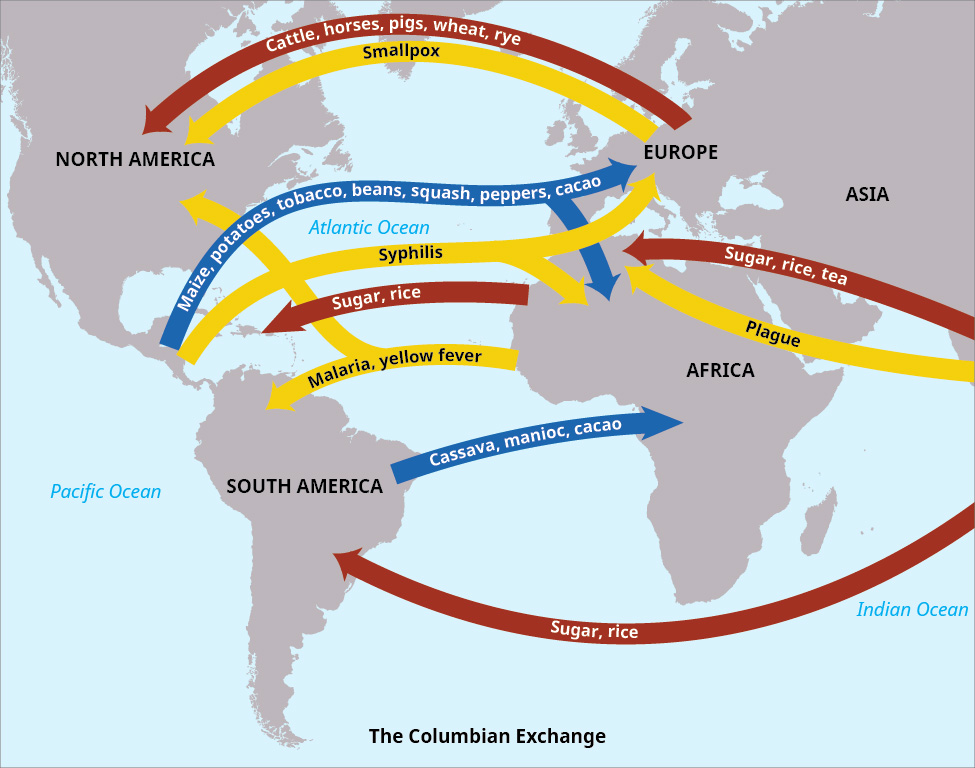
The Columbian exchange—sometimes called the Columbian interchange—describes the large-scale movement of plants, animals, and diseases linking the Americas (the New World) with Afro-Eurasia (the Old World), beginning in the late 1400s. The term honors Christopher Columbus, the Italian explorer, and connects to the European colonization and global trade that followed his 1492 voyage. Some transfers happened on purpose; others were accidental. Diseases from the Old World wiped out between 80 and 95 percent of the Indigenous population in the Americas starting in the 15th century, nearly erasing those communities in the Caribbean. Both hemispheres felt deep cultural shifts as people moved—some free, many enslaved—from the Old World to the New. European colonists and enslaved Africans gradually replaced Indigenous populations in many parts of the Americas. In the first three centuries after Columbus, far more Africans were brought to the New World than Europeans. New global contacts allowed many crops and livestock to spread. In the Old World, food production and population grew thanks to American staples like potatoes, maize, tomatoes, tobacco, cassava, sweet potatoes, and chili peppers, which became important worldwide. Meanwhile, Old World crops such as rice, wheat, sugarcane, and various livestock became key in the New World. The phrase "Columbian Exchange" was first used in 1972 by American historian Alfred W. Crosby in his environmental history book of the same name. Other historians and journalists quickly adopted it. **Etymology**
Alfred W. Crosby, a historian at the University of Texas at Austin, published *The Columbian Exchange* in 1972, inventing the term. He focused on mapping the biological and cultural transfers between the Old and New Worlds, especially how Columbus’s voyages led to the global spread of crops, seeds, and plants that radically changed farming on both sides. His work reshaped how scholars understand the modern ecosystems that emerged from these exchanges. His 1986 book *Ecological Imperialism* expanded on this research. **Background**
Scientists agree that humans first reached the New World from Siberia thousands of years ago. Aside from that, evidence of contact between Old and New World peoples is scarce, though speculation about pre-Columbian ocean crossings is plentiful. The first New World settlers brought domestic dogs. Norse explorations and brief settlements in Greenland, Newfoundland, and Vinland in the late 10th and 11th centuries left no known impact on the Americas, though sheep’s sorrel (*Rumex acetosella*) appeared in Greenland around that time. Many scientists accept that Polynesians likely contacted coastal South Americans around 1200, resulting in genetic similarities and the adoption of sweet potatoes by Polynesians. Still, the Columbian exchange truly began with Christopher Columbus’s 1492 voyage, triggering major transformations in cultures and livelihoods across both hemispheres. **Biological exchanges**
*Of plants*
New trade from the Columbian exchange spread several American plants worldwide, including potatoes, maize, tomatoes, and tobacco. Before 1500, potatoes grew only in South America. By the 1700s, they were widely farmed and eaten in Europe and had become important crops in India and North America. Potatoes eventually became a staple for many Europeans, contributing an estimated 12 to 25 percent of Afro-Eurasia’s population growth between 1700 and 1900. Their introduction to the Old World accounts for 47 percent of the urbanization increase during that same period. Portuguese colonizers brought cassava from South America in the 1500s, and it gradually replaced sorghum and millet as Africa’s most important food crop. Spanish colonizers in the 1500s introduced maize and sweet potatoes to Asia, boosting population growth there. On a larger scale, potatoes and maize improved nutrition across Eurasia, allowing more varied and abundant food production. The Americas offered new farmland for sugarcane and coffee. Coffee, introduced to the Americas around 1720 from Africa and the Middle East, and sugarcane, brought from the Indian subcontinent to the Spanish West Indies, became the main commodity crops of large Latin American plantations. Portuguese traders introduced chili peppers and potatoes from South America to India, where they became essential to Indian cuisine and helped turn curry into an international dish. Because crops traveled without their native fungi at first, yields in new regions were temporarily higher—a kind of ecological release or “yield honeymoon.” But as pathogens continued to spread with globalization, crop yields eventually declined back toward their original levels. The Spanish were the first Europeans to grow cacao, in 1590.
- coined_by
- Alfred W. Crosby
- field
- Environmental history
- nationality
- American
- known_for
- Mapping biological and cultural transfers between Old and New Worlds
Lore & Background
Crosby in his book The Columbian Exchange. Crosby focused on mapping the biological and cultural transfers between the Old and New Worlds, studying the global diffusion of crops, seeds, and plants that radically transformed agriculture in both regions.
Reader's Guide
The Columbian exchange significantly impacted cultures and livelihoods in both hemispheres. American crops such as potatoes, maize, tomatoes, tobacco, cassava, sweet potatoes, and chili peppers became important worldwide, while Old World rice, wheat, sugar cane, and livestock became important in the New World. The exchange also involved the migration of people, both free and enslaved, with the number of Africans taken to the New World far greater than the number of Europeans moving there in the first three centuries after Columbus. The exchange of pathogens has continued alongside globalization, affecting crop yields over time.
Did You Know?
- Old World diseases caused an 80 to 95 percent reduction in the Indigenous population of the Americas from the 15th century onward.
- Enslaved Africans brought knowledge of water control and milling that made rice a staple food in the New World.
The Demographic Catastrophe
The single most devastating consequence of the Columbian exchange was not a crop or a commodity but a wave of communicable diseases carried from Afro-Eurasia to the Americas. Old World pathogens, to which Indigenous peoples had no prior exposure, triggered a catastrophic population collapse. From the late fifteenth century onward, the native population of the Americas suffered a reduction estimated at eighty to ninety-five percent. In the Caribbean, the situation reached the point of near-total extinction of the original inhabitants. This was not a deliberate act of biological warfare but an unintended byproduct of contact, yet its scale reshaped the entire demographic landscape of the Western Hemisphere. In the vacuum left by this depopulation, European colonists and, in far greater numbers, enslaved Africans moved into the Americas, fundamentally replacing the Indigenous human fabric of the continent. The exchange of people—both voluntary and coerced—became inseparable from the exchange of organisms, and together they rewrote who lived where, and under what conditions, for centuries to come.
Agricultural Transformation Across Hemispheres
Before 1500, the potato existed only in South America. By the eighteenth century it had become a staple across Europe, India, and North America, contributing an estimated twelve to twenty-five percent of Afro-Eurasian population growth between 1700 and 1900 and accounting for forty-seven percent of the increase in urbanization over that same span. Maize and sweet potatoes, carried by Spanish colonizers into Asia in the sixteenth century, fueled parallel population booms on that continent. In Africa, Portuguese traders introduced cassava from South America during the 1500s, and it gradually displaced sorghum and millet as the continent's principal food crop. Chili peppers and potatoes, also brought by the Portuguese, became so embedded in Indian cooking that they helped turn curry into a global dish. Meanwhile, Old World staples—rice, wheat, sugarcane, and livestock—moved in the opposite direction, anchoring New World agriculture. Sugarcane, originally from the Indian subcontinent, and coffee, arriving from Africa and the Middle East around 1720, became the backbone of Latin American plantation economies. A temporary yield honeymoon gave introduced crops higher initial productivity before endemic pathogens caught up and yields declined back toward their native levels.
The Human Dimension: Migration, Enslavement, and Labor
The Columbian exchange was never purely biological; it was equally a mass movement of human beings. In the first three centuries after 1492, the number of Africans forcibly taken to the New World vastly exceeded the number of Europeans who settled there. These enslaved people were not merely laborers but carried agricultural knowledge that proved indispensable. In the American South, European planters depended heavily on the rice-cultivation expertise of African slaves to grow both Oryza glaberrima, independently domesticated in West Africa, and Oryza sativa, which had naturalized in the Mediterranean. The plantation system that emerged—centered on sugarcane from the Indian subcontinent and coffee from Africa and the Middle East—relied on this coerced labor to produce the commodity exports that fed European markets. Cacao, first cultivated by the Spanish in 1590, became another pillar of this system, initially a luxury consumed for its energy-boosting properties before evolving into the sweets familiar to European populations. The human exchanges, both free and unfree, thus wove together with the biological ones to create entirely new economic and social structures across the Americas.
Naming the Exchange: Crosby and the Birth of Environmental History
The very phrase Columbian exchange did not exist until 1972, when Alfred W. Crosby, an American historian based at the University of Texas at Austin, published his book The Columbian Exchange. Crosby's central project was to trace the biological and cultural transfers that followed Columbus's 1492 voyage, with particular attention to how the global diffusion of crops, seeds, and plants from the Americas reshaped agriculture on both sides of the Atlantic. His work offered a new lens through which scholars could understand the variety of contemporary ecosystems that had emerged from these transfers, moving beyond purely political or economic narratives of colonization. The term was quickly embraced by other historians and by journalists, becoming a standard reference point in discussions of global interconnection. Crosby extended his inquiry in 1986 with Ecological Imperialism, deepening the analysis of how biological transfers served as instruments of European expansion. His lasting legacy is the recognition that the history of the modern world cannot be separated from the history of its organisms, and that a single voyage set in motion a cascade of ecological consequences still visible in every field, kitchen, and ecosystem today.
Gallery




Frequently Asked Questions
What is the Columbian exchange in this series?
It is the sweeping biological and cultural transfer of plants, animals, and pathogens between the Americas and Afro-Eurasia that began in the late 1400s. The label was coined by American environmental historian Alfred W. Crosby to name this two-way flow of living organisms and ideas.
What role does the Columbian exchange play in the canon?
It functions as the central connecting mechanism between Old and New World entries, covering both deliberate shipments of crops and livestock and the tragic, unintended spread of epidemic diseases. This entry shows how a single wave of contact permanently reshaped ecosystems and societies on both sides of the Atlantic.
How does the Columbian exchange story end?
There is no single closing chapter; instead, the exchange set in motion lasting ecological and demographic shifts that still shape global agriculture and biodiversity. Its most devastating arc was the catastrophic 80-to-95 percent collapse of Indigenous American populations triggered by Old World communicable diseases.
Why is the Columbian exchange considered important to the series?
It is the foundational event that links every subsequent exploration and colonization entry, because all later biological and cultural transfers trace back to this initial contact. Crosby's framing elevated the topic from a historical footnote to a defining narrative thread in environmental history.
Who coined the term 'Columbian exchange' and what field does it belong to?
The phrase was introduced by American scholar Alfred W. Crosby within the discipline of environmental history. He used it to systematically map the biological and cultural transfers that flowed between the Old and New Worlds after 1492.
More in Exploration & Colonization 1-15
Spotted an error? Know more?
This is a living reference — every entry is fact-audited, and reader corrections feed straight into our audit queue. Suggest an edit · See this site's audit record