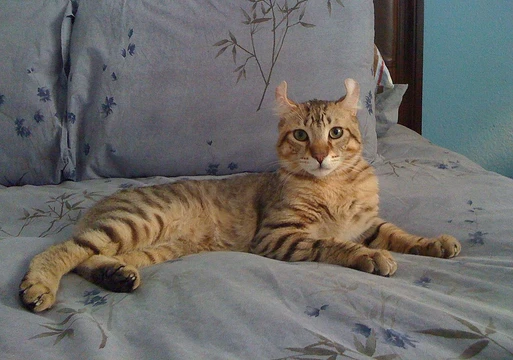
Munchkin cat
A dwarf cat breed with short legs from a genetic mutation.
Last updated
The Munchkin is a breed of domestic cat distinguished by its very short legs, a trait resulting from a genetic mutation. It is considered the original dwarf cat breed and has been documented since the 1940s, though official recognition by The International Cat Association (TICA) in 1997 sparked significant controversy. Critics and several pedigree cat associations, including the Governing Council of the Cat Fancy, have refused to recognize the breed due to concerns over health and mobility issues, and its breeding is prohibited in several countries.
Quick Facts
- Other names
- Dwarf cat
- Origin
- United States (Louisiana)
- Breed standards
- TICA
- Weight (male)
- 6–9 lb / 2.72–4.08 kg
- Weight (female)
- 4–8 lb / 1.81–3.63 kg
- Coat
- Short or long; all colors and patterns
Facts from the source article.
History
Short-legged cats have been recorded in various parts of the world since the 1940s. A British veterinary report from 1944 described four generations of such cats, but that line disappeared during the Second World War. Similar cats were later observed in Russia in 1956 and in the United States during the 1970s. In 1983, Sandra Hochenedel of Rayville, Louisiana, found two pregnant cats that had been chased under a truck.
She kept one, named Blackberry, and half of her kittens were born with short legs. Hochenedel gave a short-legged male kitten from one of Blackberry's litters to Kay LaFrance of Monroe, Louisiana, who named it Toulouse. All modern Munchkin cats descend from Blackberry and Toulouse. The breed was first presented to the public in 1991 at a televised cat show in Davis, Oklahoma, but was not officially recognized at that time.
Solveig Pflueger, a show judge and geneticist, advocated for recognition, and the breed was accepted into TICA's new breed development program in September 1994, despite protests from some breeders.
Characteristics
Opinions differ on whether the Munchkin's short legs hinder its running and leaping abilities; some sources say they do not interfere, while others report limited jumping. The breed is small to medium-sized with a moderate body type and a medium-plush coat. Males typically weigh 6 to 9 pounds, females 4 to 8 pounds. The hind legs may be slightly longer than the front, creating a slight rise from shoulder to rump.
Legs may be slightly bowed, but excessive bowing or cow-hocked legs are penalized in shows. The Munchkin comes in all coat colors and patterns, with both short-haired and long-haired varieties. TICA allows outcrossing with any domestic cat not of a recognized breed. In 2014, a Munchkin named Lilieput from Napa, California, was named the shortest living cat by Guinness World Records, standing 5.25 inches tall.
Genetics
The short legs of the Munchkin result from an autosomal dominant mutation causing chondrodysplasia. Only heterozygous cats are viable; homozygous individuals do not survive gestation. For each kitten from a mating between two heterozygous Munchkins, there is a 25% chance of failed gestation, a 25% chance of a normal long-legged cat, and a 50% chance of a short-legged cat. There is a 0% chance of a homozygous Munchkin, a 50% chance of a normal non-standard (long-legged) Munchkin, and a 50% chance of a standard (short-legged) Munchkin.
Derived breeds
The Munchkin's popularity has led to crossbreeding with other breeds to create new dwarf cat types, most of which are not recognized by major registries. These experimental crosses include the Bambino (Munchkin and Sphynx), Dwelf (Munchkin, Sphynx, and American Curl), Genetta (Munchkin, Bengal, and sometimes Ocicat), Kinkalow (Munchkin and American Curl), Lambkin or Nanus Rex (Munchkin and Selkirk Rex), Minskin (Munchkin, Burmese, Sphynx, and Devon Rex), Minuet or Napoleon (Munchkin and Persian, Himalayan, or Exotic Shorthair), and Skookum or LaMerm (Munchkin and LaPerm). The Rare and Exotic Feline Registry recognizes several of these, while TICA has preliminarily recognized the Minskin since 2018 and has recognized the Minuet experimentally since 2001. In 2019, Dutch authorities ordered a couple to stop breeding the Bambino due to welfare concerns.
Did You Know?
- The Munchkin cat has an increased incidence of lordosis and pectus excavatum.
- Munchkin cats are at higher risk for severe osteoarthritis due to shorter limbs affecting activity levels.
- The European Union prohibits breeding of dwarf cats under the European Convention for the Protection of Pet Animals.
More in Experimental cat breeds
Sources
Compiled from Wikipedia and the sources listed below. Text from Wikipedia is available under CC BY-SA 4.0; this entry is adapted from it.
- Wikipedia: Munchkin cat (CC BY-SA 4.0).
- Word definitions: the Codexery glossary, each quoted from its Wikipedia article.
Spotted an error? Know more?
Reader corrections go straight into our review queue. Suggest an edit · How this site is sourced