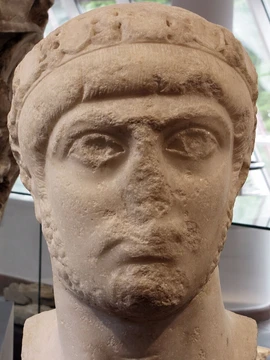
Alexios V Doukas
Last Byzantine emperor before the Latin conquest of Constantinople.
Last updated

via Wikipedia: Alexios V Doukas · see source
Alexios V Doukas, Latinized as Alexius V Ducas, was Byzantine emperor from February to April 1204, just prior to the sack of Constantinople by the Fourth Crusade. He achieved power through a palace coup, killing his predecessors in the process. Though he made vigorous attempts to defend Constantinople from the crusader army, his military efforts proved ineffective.
His actions won the support of the mass of the populace, but he alienated the elite of the city. Following the fall, sack, and occupation of the city, Alexios V was blinded by his father-in-law, the ex-emperor Alexios III, and later executed by the new Latin regime. He was the last Byzantine emperor to rule in Constantinople until the Byzantine recapture of Constantinople in 1261.
Origins and character
Little is definitely known about the ancestry of Alexios Doukas Mourtzouphlos. The surname Doukas was used by both a leading aristocratic family and many humble families. He may have been a great-great-grandson of Alexios I Komnenos through a female line, a connection common among Byzantine emperors of the period. One theory proposes he was the son of an Isaac Doukas and second cousin of Alexios IV Angelos.
His birth date is sometimes given as c. 1140 because he was considered old in 1204. A letter to Pope Innocent III called him a blood relation of Alexios IV. The historian Niketas Choniates, whom Mourtzouphlos dismissed from office, described him as extremely clever but arrogant and lecherous.
Political intrigues and usurpation
Mourtzouphlos participated in the attempted overthrow of Alexios III Angelos by John Komnenos the Fat in 1200, leading to his imprisonment until around 1201. He was released after Isaac II Angelos and Alexios IV Angelos were restored to the throne in July 1203 through crusader intervention. He then received the court position of protovestiarios. He had been married twice and was allegedly the lover of Eudokia Angelina, daughter of Alexios III.
By early 1204, the citizens of Constantinople were restless with the co-emperors' inability to protect the city from the crusaders. Crusader riots and fires made about a third of the population homeless, sapping the will to resist. Mourtzouphlos emerged as a leader of the anti-Latin movement, winning popular approval by his valour in an attack at Trypetos Lithos, where youthful archers saved him after his mount stumbled. He exploited anti-Latin hatred for his own ambition.
Emperor
Alexios V was acclaimed emperor as early as the night he moved against the Angeloi co-emperors on 27 January, and was crowned around 5 February. Finding the treasury empty, he confiscated money from the aristocracy and high officials for public use, endearing him to citizens but alienating his relations and prominent supporters. He closed the city gates to crusaders and strengthened fortifications, leading attacks on crusader sorties. On 2 February, he attacked the rearguard of Henry of Flanders returning from Filea, but was defeated; the imperial standard and the icon of the Panagia Nikopoios were captured.
The loss of the icon, seen as divine protection, convinced many that the crusaders' victory was divinely sanctioned. Alexios IV was probably killed the same day. The forcible expulsion of all Latins from Constantinople in March led the crusaders to negotiate the partition of the empire and prepare their final assault.
The fall of Constantinople, flight and death
Defenders repelled a crusader assault on 9 April, but a second attack on 12 April broke through near the Petria Gate, looting the Blachernae Palace. Alexios V tried to rally the people without success, then fled by fishing boat to Thrace that night with Eudokia Angelina and her mother Euphrosyne Doukaina Kamatera. Constantine Laskaris was acclaimed emperor in Hagia Sophia but also fled early on 13 April. Alexios V reached Mosynopolis, held by the deposed Alexios III Angelos.
Initially well received, he married Eudokia, but Alexios III then had him captured and blinded, rendering him ineligible for the throne. Abandoned by supporters and his father-in-law, Alexios V was captured near Mosynopolis or possibly in Anatolia by Latins under Thierry de Loos in November 1204.
Returned to Constantinople, he was tried for treason against Alexios IV. He argued that Alexios IV had committed treason by inviting crusaders into the city. Condemned, he was executed by being thrown from the top of the Column of Theodosius.
Did You Know?
- His nickname Mourtzouphlos referred to either bushy, overhanging eyebrows or a sullen, gloomy character.
- The loss of the Panagia Nikopoios icon to the crusaders convinced many Byzantines that divine protection had been withdrawn from Constantinople.
More in Executed Roman Emperors
Sources
Compiled from Wikipedia and the sources listed below. Text from Wikipedia is available under CC BY-SA 4.0; this entry is adapted from it.
- Wikipedia: Alexios V Doukas (CC BY-SA 4.0).
Spotted an error? Know more?
Reader corrections go straight into our review queue. Suggest an edit · How this site is sourced