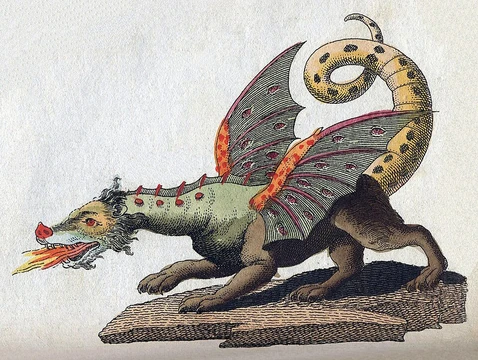
Tarasque
A hybrid dragon tamed by Saint Martha in Provençal legend.
The Tarasque is a dragon-like creature from French mythology, best known through the account in the Golden Legend. It is notable for its distinctive hybrid appearance and its association with Saint Martha, who is said to have tamed the beast. The creature has been central to the identity of Tarascon, where annual festivals have celebrated the legend since the 15th century.
Quick Facts
- Origin
- Provence, France
- First recorded
- 12th century
- Associated saint
- Saint Martha
- Festival initiated
- 1474
- Festival initiator
- René of Anjou
- Modern festival date
- Last Sunday of June
- Town associated
- Tarascon
Facts from the source article.
Legend
The legend of the Tarasque likely arose in Provence, France, between the early and late 12th century. It is recorded in several sources, most influentially in the story of Saint Martha within the Golden Legend. The monster was said to inhabit the forested banks of the Rhône between Arles and Avignon, near what is now Tarascon, then called Nerluc or 'black place'. It lurked in the river, attacking those trying to cross and sinking boats. The creature was described as a dragon, half animal and half fish, thicker than an ox and longer than a horse, with sword-like teeth. According to tradition, the Tarasque came from Galatia, a cross-breed between the biblical Leviathan and the legendary Onachus of Galatia, a creature that retaliated by flinging its dung like an arrow, causing burns. The people sought Saint Martha's help, and she found the beast devouring a man. By sprinkling holy water and holding up the cross, she made it submissive, then tied her girdle to its neck and led it to the villagers, who killed it with rocks and spears. The account in the Golden Legend roughly corresponds to versions in the pseudo-Marcella and Vincent de Beauvais's Speculum historiale, which are near-contemporaneous works from the late 12th and 13th centuries, with the pseudo-Marcella likely the oldest, dating between 1187 and 1212 or 1221. A fourth variant, the pseudo-Raban, has divergent content and was formerly attributed to Raban Maur but is now considered the work of an unknown author from the late 12th to late 13th century. Gervase of Tilbury also briefly mentions the Tarasque, placing its habitat in an abyss near the city-gates of Arles and the rock beneath the castle at Tarascon.
Description
The description of the Tarasque's physical appearance in the Golden Legend receives somewhat dissimilar treatment in the pseudo-Marcella from around 1200. This description corresponds rather closely to 17th- and 18th-century iconography and the modern-day effigy. The turtle-like carapaces, or shields, are attested in this early 13th-century writing, even though some commentators suggested they were a 15th-century addition for concealing the men carrying the effigy. The head has been described as similar to a bull and a lion, or having the muzzle of a lion with a black mane. The detail of a serpent's tail appears in both the pseudo-Marcella and the Speculum Historiale. The tail was long and ringed, resembling that of a scorpion in a lost sculpture on the Église Sainte-Marthe de Tarascon, according to Laurent Jean Baptiste Bérenger-Féraud. Some modern authors claim the tail ended in a scorpion sting, while Jean-Paul Clébert states it terminated in a cock's spur. The pseudo-Raban speaks at length of the poisonous fumes exhaled by the Tarasque, and some French sources describe its eyes as glaring sulfurously.
Festivities
The festival of the Tarasque was initiated on April 14, 1474, during Pentecost in Tarascon, at the behest of René of Anjou, to amuse his citizens with a reenactment of Saint Martha's miracle. Later, a second festival was held on July 29, the feast-day of Saint Martha. In former days, the effigy was paraded through the streets twice a year, with a maiden portraying Saint Martha escorting it by a leash or white ribbon. In the modern day, the festival is held annually on the last Sunday of June, telling the tale of the Tarasque and of Tartarin from Alphonse Daudet's Tartarin of Tarascon. The effigy changed from a wooden prop painted green to a metallic contraption in the early 19th century. Aubin-Louis Millin in 1808 described it as wooden, made of hoops covered in painted cloth. Christian Friedrich Mylius in 1818 elaborated that it resembled a turtle, consisting of a wooden framework covered with wax canvas painted apple-green, with gilded hooks and thorns on its back. The Count of Villeneuve in 1826 described it as a monstrous dragon with a torso of hoops covered with painted sheet metal, a huge shield imitating a turtle's carapace, clawed paws, a scaly tail curved several times, and a head like a bull and a lion. The wooden hull required eight men to carry, the metallic version twelve. The head could be manipulated from inside to open and close its jaws, and fuses or rockets were ignited in its nostrils to issue fiery sparks. Traditional cries for the tarasco were shouted during the festival, in a popular song attributed to King René.
Theories
Some writers have supported the idea that the tarasque legend has pre-Christian Celtic roots. French archaeologist Isidore Gilles linked it to the "tarasque of Noves," a stone statue of a sharp-toothed, scaly, chimeric beast eating a human arm. He believed this was a deified Celtic beast that received human sacrifices. Provençal poet Frederic Mistral adopted this theory. French scholar Philippe Walter argues that the Saint Martha story clearly overlays older Celtic pagan beliefs.
More in European Dragons
Spotted an error? Know more?
Reader corrections go straight into our review queue. Suggest an edit · How this site is sourced