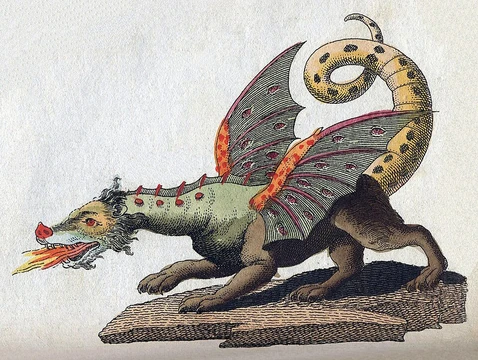
European dragon
A fire-breathing, treasure-hoarding creature of European myth.
The European dragon is a legendary creature in folklore and mythology among the overlapping cultures of Europe. Typically depicted as a large, fire-breathing, scaly, horned, lizard-like creature with leathery bat-like wings and a long prehensile tail, it often guards treasure or serves as an adversary for heroes. Dragon's blood is frequently ascribed unique powers, and the creature is commonly associated with underground lairs.
Quick Facts
- Grouping
- legendary creature
- Sub grouping
- dragon
- Similar entities
- other dragons
- Folklore
- Medieval folklore
- Region
- Europe and the Mediterranean region
- Habitat
- lairs, caves, castles, mountains
Facts from the source article.
Did You Know?
- The emblem books popular from late medieval times through the 17th century often represent the dragon as an emblem of greed.
- Agosti Xaho, a 19th-century romantic myth creator, fused myths into his creation of Leherensuge, the first and last serpent, which he claimed would arise again for the rebirth of an independent Basque republic.
- In the fantasy genre, there has been a trend of depicting dragons in a positive light as allies instead of enemies.
Classical period
Roman dragons developed from serpentine Greek ones, combined with Near Eastern dragons in the context of Hellenistic culture. The muš-ḫuššu from Babylon was a classic Near Eastern dragon. In the Book of Revelation, Satan is described as a great dragon, flaming red, with seven heads and ten horns, likely symbolizing Near Eastern dragons. In the Roman Empire, each military cohort had a signum; after Trajan's Parthian and Dacian Wars, the Dacian Draco standard entered the Legion with the Cohors Sarmatarum and Cohors Dacorum. This standard was a large dragon fixed to a lance, with silver jaws and a silken body that inflated like a windsock. In Greek mythology, dragons often guard treasure: Ladon, a hundred-headed dragon, guarded the tree of Hesperides until slain by Heracles; Python guarded the oracle of Delphi until slain by Apollo; the Lernaean Hydra, a multiple-headed serpentine swamp monster killed by Heracles, is called a dragon. Typhon, the dragon par excellence of the Greek world, was parent of all monsters and opposed the gods; he was described as snake-like with bat-like wings, breathing fire from several snake-like mouths. In Apuleius's The Golden Ass, a band of travelers encounter a monstrous dragon eating a man from their group.
Middle Ages
For centuries after the early Middle Ages, Europeans had little access to classical texts, which slowly reshaped how they imagined dragons. The modern Western dragon emerged from a blend of snake-like Greco-Roman dragons, biblical Near Eastern ones, and local folk tales, including misidentified snakes drawn with wings or legs. Interest in dragons as real animals peaked between the 11th and 13th centuries. Today, dragons are typically depicted as huge lizards or snakes with two pairs of lizard-like legs, bat wings, and the ability to breathe fire. In the Old English poem Beowulf, the dragon is called a draca or wyrm, moves by bending (bugan), has venomous bites and poisonous breath, and shows a snake-like form with no legs or wings, though it can fly. It breathes fire, lives underground, and hoards treasure. The earliest known image of a modern-style Western dragon appears in a 1260 bestiary (MS Harley 3244), showing two pairs of wings and two pairs of legs, plus a very long tail. Four-legged dragons do not appear until the 1400s, such as in Lambeth Palace Library MS 6, which illustrates a fight between a red and a white dragon from Arthurian legend.
Dragons in specific cultures
The Celtic dragon may have developed from a horned and poisonous or fire-breathing snake, mostly a snake transformed into a monster. The dragon motif in Celtic art is presumed to derive from a serpent-like creature in ancient folklore of the Middle East and Greece. Western Celtic peoples were familiar with dragons in the pre-Christian age; native Britons wore Celtic decorations with dragon motifs during the Roman invasion. Continental Celts used dragon-shaped brooches and pins during the La Téne period from c. 500 BC to 1 AD. The earliest known use of the dragon by the Celts appears on swords and sheaths from the 4th century BC. An early Iron Age Celtic sword found in Britain features two opposing dragons, possibly from the Hallstatt culture. Two other swords and scabbards from the Thames are thought to include a dragon pair from the La Tène or Hallstatt cultures. Evidence in coins shows Celticised dragons in 50–45 BC. In Germanic folklore, dragons or worms are prevalent, with notable examples including the killer of Beowulf, Fáfnir, and Jǫrmungandr. The distinction between snakes and dragons is blurred, both referred to by the same terms. Later accounts of winged dragons in these cultures likely reflect influence from Southern Europe. In later Northern European folklore, many flightless worms resembling large snakes appear, such as the Lambton Worm and the Stoor worm.
Heraldry
In British heraldry, a dragon has four legs and bat-like wings, which sets it apart from the two-legged wyvern. Its tongue traditionally ends in a barbed tip, and in more recent heraldry the tail also ends in a barb, though this tail feature only appeared after the Tudor period; before and during that era, the tail always had a blunt tip. A wingless heraldic dragon or wyvern is sometimes called a lindworm. The typical poses for a dragon are statant, with all four feet on the ground; passant, with one leg lifted; or rampant, rearing up. The coward pose, with the tail tucked between the legs, is very rare in British heraldry but more common in German systems.
Dragon imagery is linked to legendary British figures like King Uther Pendragon and King Arthur. Uther’s mythical arms are said to be two green dragons placed back-to-back, known as addorsed, with red crowns on a gold field. Arthur is also described as using two dragons addorsed. The use of heraldic dragons in England goes back to before the Norman Conquest, and dragon symbolism is traditionally tied to the Saxons. King Cuthred of Wessex carried a dragon banner, and the Bayeux Tapestry shows a dragon-shaped standard above the Saxon army. After the Conquest, red dragon standards were used by British kings and royal forces, including the English army at the Battle of Crécy, Henry III at the Battle of Lewes, and Henry VII at the Battle of Bosworth Field, but these were not usually part of royal coats of arms. Henry VIII used a red dragon as a supporter, but under King James it was replaced by the Scottish unicorn. In later heraldry, the red dragon became strictly associated with Wales. According to heraldic writer Arthur Charles Fox-Davies, the red dragon of Wales comes from the standard of the 7th-century king Cadwaladr and was used as a supporter by the Tudor dynasty. Queen Elizabeth changed the dragon supporter from red to gold gules.
More in European Dragons
Spotted an error? Know more?
Reader corrections go straight into our review queue. Suggest an edit · How this site is sourced