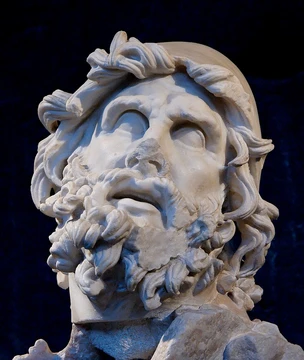
Echetus
Mythical king of the dark mainland, known for extreme cruelty.
Echetus is a mythical king and son of Euchenor and Phlogea, mentioned in Homer's Odyssey as a frightening and cruel ruler from the mainland. Some scholars refer to him as a king of Epirus. He is notable for his extreme brutality, including threats of mutilation and cannibalism.
Quick Facts
- Parents
- Euchenor and Phlogea
- Mentioned in
- Homer's Odyssey, books 18 and 21
- Daughter's lover
- Aechmodicus (in some sources)
- Epithet
- destroyer of all mortals
Facts from the source article.
Mythology
In Homer’s Odyssey, the suitor Antinous calls Echetus the “destroyer of all mortals.” The beggar Irus is threatened with being sent to Echetus, who would slice off his nose, ears, and testicles and feed them to dogs. Echetus had a daughter, Metope, who took a lover. As punishment, Echetus mutilated the lover, blinded Metope by stabbing her eyes with bronze needles, locked her in a tower, and gave her bronze grains, saying she would see again only after grinding them into flour. Other accounts name the daughter Amphissa and the lover Aechmodicus; there, Echetus invited the lover to a feast and cut off his genitals. Eventually, Echetus went mad and died by eating his own flesh.
Modern analyses on Echetus
Echetus may have been invented as a bogeyman to frighten misbehaving children or to play the villain in bedtime tales. Another idea, lacking any proof, proposes he was an actual king from Homer’s time, possibly deformed and a cannibal. In book 18 of the Odyssey, the word epironde appears in a scene with King Echetus; scholars generally agree this term means mainland Greece as seen from Ithaca. Richard Hodges and Anna Lefteratou identify Echetus as a mythical ruler of Epirus, a region of the Greek mainland. The word epeiros shows up in Homer’s Odyssey mostly to contrast land with sea, and only rarely to refer to the mainland core of northwestern Greece. Some researchers see Homer’s use of epeiros as purely geographic, while others argue that in book 24 it also points to northwestern Greece. The proper name Epirus first appears in the 6th century BCE, in the writings of Hecataeus of Miletus. According to Irad Malkin, both Echetus and Thesprotia in the Odyssey come from the same “dark mainland.” Echetus, who seems to rule the mainland directly across from Ithaca, is hostile to the island, whereas Thesprotia, a more distant region, is an ally.
More in Epirotic Mythology
Spotted an error? Know more?
Reader corrections go straight into our review queue. Suggest an edit · How this site is sourced