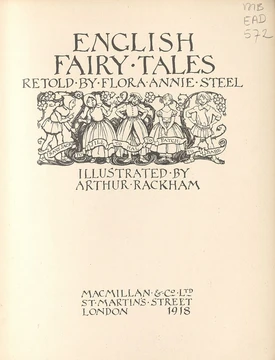
Goldilocks and the Three Bears
A classic tale of curiosity and the rule of three.
"Goldilocks and the Three Bears" is a traditional 19th-century British fairy tale with three known versions. The earliest version features an impudent old woman who intrudes upon the home of three bachelor bears, while the second replaces her with a young blonde girl named Goldilocks. The third and most familiar version presents the bears as a family of three: a father, a mother, and a baby bear.
Quick Facts
- Author
- Robert Southey
- Original title
- "The Story of the Three Bears"
- Country
- United Kingdom
- Genre
- Fairy tale
- Published in
- The Doctor
- Publication type
- Essay and story collection
- Publisher
- Longman
- Rees
- etc.
- Format
Facts from the source article.
Literary elements
The story employs the literary rule of three throughout: three chairs, three bowls of porridge, three beds, and three title characters. Three sequences show the bears discovering that someone has eaten their porridge, sat in their chairs, and lain in their beds, leading to the climax when Goldilocks is found. Earlier, three sequences show Goldilocks trying the bowls, chairs, and beds, each time finding the third "just right." Author Christopher Booker calls this the "dialectical three," where the first is wrong in one way, the second in another, and only the third is just right. He notes that finding an exact middle path between opposites is of great importance in storytelling. This concept has spread to fields such as developmental psychology, biology, economics, Buddhism, and engineering, where it is known as the "Goldilocks principle." In planetary astronomy, a planet at the right distance for liquid water is said to be in the "Goldilocks zone." Stephen Hawking remarked that the development of intelligent life requires planetary temperatures to be "just right."
Interpretations
Harvard professor Maria Tatar observes that the story is often seen as a cautionary fable about the dangers of entering unknown places, using repetition to hold a child's attention and reinforce themes of protection and safety. She notes that modern interpretations frame it as a quest for what is "just right," while earlier generations viewed it as a tale about an intruder lacking self-control and respect for others' property. Child psychologist Bruno Bettelheim describes Goldilocks as "poor, beautiful, and charming," noting that only her hair is portrayed positively. He discusses the tale through Oedipal issues and adolescent identity crisis, arguing that the story does not encourage children to work through growing-up challenges one at a time and fails to end with the promise of future happiness for those who navigate the Oedipal phase. Tatar critiques Bettelheim's analysis as overly instrumentalizing fairy tales, turning them into vehicles for messages and behavioral models. She suggests the story emphasizes respecting others' property and the consequences of trying things that do not belong to you.
In other media
The earliest animated film version of the story came from Walt Disney in 1922, with a second adaptation co-produced by Disney and MGM arriving in 1939. Coronet Films put out a live-action short in 1958 that used real bears and a child actor. Warner Bros. Cartoons created several animated shorts where Papa Bear was a tiny, irritable bear, Mama Bear was tall and slender, and Baby Bear, named "Junyer," was a large, clumsy simpleton. In "Rudolph's Shiny New Year," a long scene swaps Goldilocks for the Baby New Year, Happy. Jay Ward's "Fractured Fairy Tales" offered a twisted version where Goldilocks runs a winter resort and the bears break in to hibernate. Hanna-Barbera produced "Help!... It's the Hair Bear Bunch!" for CBS Saturday mornings in 1971–72; one episode loosely adapted the Goldilocks story, with child actor Twinkles Sunshine playing the role. Earlier, Hanna-Barbera's Hokey Wolf episode "Too Much to Bear" cast a bank robber as the Goldilocks figure. Faerie Tale Theatre aired a "Goldilocks" episode in 1984 starring Tatum O'Neal. The Spanish animated series "The Three Bears" ran from 1999 to 2001. In "The Simpsons" Halloween episode "Treehouse of Horror XI," Goldilocks gets comically mauled by the bears. On "Ever After High," Blondie Lockes is Goldilocks's daughter. In the 2022 film "Puss in Boots: The Last Wish," Goldilocks and the Three Bears are secondary antagonists. The characters also appeared as Muppets on "Sesame Street." In November 1949, Walt Disney published the comic "The Goldilocks Gambit," written by Carl Barks.
Frequently Asked Questions
Who wrote Goldilocks and the Three Bears?
Goldilocks and the Three Bears was written by Robert Southey.
When was Goldilocks and the Three Bears published?
Goldilocks and the Three Bears was published in 1837.
Who published Goldilocks and the Three Bears?
Goldilocks and the Three Bears was published by Longman, Rees and etc.
More in English Fairy Tales
Spotted an error? Know more?
Reader corrections go straight into our review queue. Suggest an edit · How this site is sourced