Childe Rowland
A brother rescues his sister from the King of Elfland.
Childe Rowland is an English fairy tale, most famously recorded by Joseph Jacobs in his 1890 collection English Fairy Tales. The story is notable for its connection to Shakespeare's King Lear and Robert Browning's poem 'Childe Roland to the Dark Tower Came', and is classified as Aarne-Thompson-Uther type 312D, 'Rescue by the Brother'.
Quick Facts
- Aarne-thompson-uther type
- 312D
- Year of jacobs' version
- 1890
- Earlier version published by
- Robert Jamieson
- Year of jamieson's version
- 1814
Facts from the source article.
Did You Know?
- The story of Childe Roland is given prominence in Harper Lee's initial draft of To Kill a Mockingbird, later published as Go Set a Watchman.
- In Book 2 of Seanan McGuire's Indexing series, the prison used to hold rogue fairy tale characters is named Childe.
Synopsis
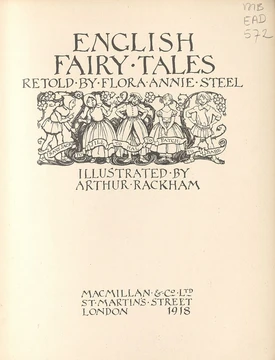
The story begins with the four children of the Queen—Childe Rowland, his two older brothers, and his sister Burd Ellen—playing ball near a church. Rowland kicks the ball over the church, and Burd Ellen goes to retrieve it, but she circles the church 'widdershins' (opposite the direction of the sun) and vanishes. Rowland consults Merlin, who tells him that his sister has been taken to the Dark Tower by the King of Elfland, and only the boldest knight in Christendom can rescue her. The eldest brother sets out, following Merlin's instructions, but does not return; the middle brother meets the same fate. Finally, Childe Rowland goes forth, armed with his father's sword, which never strikes in vain. Merlin instructs him to cut off the head of anyone in Elfland who speaks to him until he sees his sister, and to eat or drink nothing while there. Rowland obeys, beheading a horseherd, a cowherd, and a henwife. The henwife tells him to circle a hill three times widdershins and say, 'Open, door! open, door! And let me come in.' A door opens, and Rowland enters a great hall where Burd Ellen sits under the King's spell. She warns him that their brothers are prisoners in the Dark Tower, nearly dead. Forgetting Merlin's warning, Rowland asks for food; his sister complies. At the last moment, he remembers and throws the food down. The King of Elfland bursts in, and Rowland fights him, subduing him with his father's sword. The King begs for mercy, and Rowland spares him on condition that his siblings are freed. They all return home, and Burd Ellen never circles the church widdershins again. In a later version by F. A. Steel, when Rowland finds Burd Helen, he cuts off her head, which restores the real Burd Helen; this explains why the older brothers failed, as they could not bring themselves to do so.
History
Joseph Jacobs based his version on Robert Jamieson's 1814 account in Illustrations of Northern Antiquities, which Jamieson had heard from a tailor. Jamieson compared the narrative to Danish ballads about Rosmer Halfmand from the 1695 work Kaempe Viser, which include three ballads about a giant or merman stealing a girl whose brother rescues her. Unlike the English Roland, the Danish hero relies on trickery, and some versions involve an incestuous relationship. Jamieson also compared the story to 'The Merman and Marstig's Daughter', where a merman steals a young woman from a church, and noted similarities with The Old Wives' Tale and Milton's Comus.
Cultural influences
Shakespeare's King Lear and Robert Browning's 1855 poem 'Childe Roland to the Dark Tower Came' both reference this tale. Browning's poem later inspired Gordon R. Dickson's Childe Cycle series and Stephen King's Dark Tower series. Jacobs's version may have influenced Lord Dunsany's 1924 novel The King of Elfland's Daughter. Louis MacNeice wrote a radio play, The Dark Tower, which first aired on the BBC Home Service on 26 January 1946, with music by Benjamin Britten. Alan Garner used the tale as a foundation for his 1965 novel Elidor. Andre Norton retold the story in her 1967 novel Warlock of the Witch World. English folk singer Martin Carthy based his song 'Jack Rowland' on the tale, included on his 1982 album Out of the Cut. Terry Pratchett's 2003 novel The Wee Free Men features a character named Roland de Chumsfanleigh, who is taken by the Queen of the Elves.
More in English Fairy Tales
Spotted an error? Know more?
Reader corrections go straight into our review queue. Suggest an edit · How this site is sourced