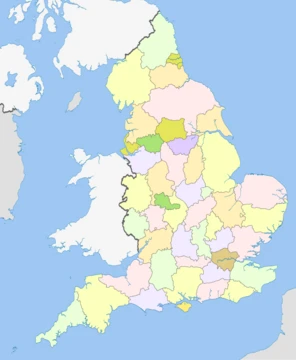
Middlesex
Historic county of England, largely now part of Greater London.
Middlesex (abbreviated as Middx) is a historic county of England, the second smallest after Rutland. Its borders were mostly defined by three rivers: the Thames to the south, the Lea to the east, and the Colne to the west, while a ridge of hills marked its northern edge with Hertfordshire. Today, nearly all of its former territory falls within the ceremonial county of Greater London, with only small portions in Hertfordshire and Surrey.
The county’s name comes from its origins as the homeland of the Middle Saxons during the early Middle Ages, and it became part of that territory by the ninth or tenth century. The City of London, once part of Middlesex, became a self-governing county corporate in the twelfth century. Even so, the sheriffs of London kept some authority in Middlesex, while the rest of the county remained separate. The Bishop of London’s diocese also stretched across Middlesex. To the east of the City, the Tower Division (or Tower Hamlets) enjoyed considerable independence under its own Lord Lieutenant. To the west, areas around Westminster and Charing Cross became increasingly built up.
As London expanded into rural Middlesex, the Corporation of London resisted efforts to extend the City’s boundaries into the county, which created challenges for local government, public works, and the justice system. In the eighteenth and nineteenth centuries, population density was especially high in the southeastern part of the county, covering the East and West Ends of London. In 1855, this densely populated southeast, along with parts of Kent and Surrey, came under the Metropolitan Board of Works for certain infrastructure projects, though it remained part of Middlesex. The Metropolitan Police also grew during the nineteenth century.
When county councils were introduced in 1889, about twenty percent of the historic county’s area—and a third of its population—was absorbed into the new administrative county of London. The rest became the administrative county of Middlesex, governed by the Middlesex County Council, which met at the Middlesex Guildhall in Westminster. Further suburban growth, driven by better public transport and new industries, led to the creation of Greater London in 1965. This new area included nearly all of the historic county of Middlesex, with the remainder going into neighboring ceremonial counties.
The county’s roots lie in the settlement of the Middle Saxons. The exact extent of that province is unclear and likely changed over time, but it certainly covered at least the area of the current county and much of Hertfordshire. Although the province appears to have come under the rule of the Kingdom of the East Saxons, and is only ever recorded as part of it, charter evidence suggests it was not part of their core territory. It is possible that the county was independent at some point. Essex was sometimes ruled by joint co-kings, and the Middle Saxon province may have been the domain of one of them. This link to Essex lasted through the Diocese of London, re-established in 604 as the East Saxon see, whose boundaries were based on the Kingdom of Essex until the nineteenth century.
The name means “territory of the middle Saxons,” formed from Old English words for “middle” and “Saxons” (as in Essex, Sussex, and Wessex). In 704, it was recorded as “Middelseaxan” in a Latin Anglo-Saxon chronicle about land at Twickenham. The Saxons got their name from the seax, a kind of knife they were known for. The seax appears in the heraldic emblems of both Essex and Middlesex, each bearing three seaxes—though depicted by Tudor heralds as falchions or scimitars. The names Middlesex, Essex, Sussex, and Wessex all contain the word “Saxon.”
It is not known exactly when Middlesex became a county, possibly in the early tenth century, but it clearly did not cover the whole former Middle Saxon Province of Essex. The Domesday Book of 1086 records it divided into six hundreds: Edmonton, Elthorne, Gore, Hounslow (later called Isleworth), Ossulstone, and Spelthorne. The City of London has been self-governing since the thirteenth century and became a county corporate. Middlesex also included Westminster, which was separate from the City. Westminster Abbey dominated that area until the Dissolution of the Monasteries greatly reduced its influence. A Court of Burgesses was set up in 1585 to fill the power vacuum left by the Abbey.
Of the six hundreds, Ossulstone contained the districts closest to the City of London. During the seventeenth century, it was split into four divisions—Finsbury, Holborn, Kensington, and Tower—which, along with the Liberty of Westminster, largely took over the administrative functions of the hundred. The county had parliamentary representation from the thirteenth century. Outside the metropolitan area, Middlesex stayed mostly rural until the mid-nineteenth century, so special local government boards for metropolitan areas developed late. Other than the Cities of London and Westminster, the county’s governance evolved slowly.
Quick Facts
- Areafirst
- 181320 acre
- Areafirstyear
- 1801/1881
- Areathird
- 148701 acre
- Areathirdyear
- 1911
- Arealast
- 148691 acre
- Arealastyear
- 1961
- Origin
- Middle Saxons
- Preceded by
- Kingdom of Essex
Facts from the source article.
Lore & Background
The name of the county derives from its origin as a homeland for the Middle Saxons in the early Middle Ages, with the county subsequently part of that territory in the ninth or tenth century. The City of London, formerly part of the county, became a self governing county corporate in the twelfth century; the City was still able to exert influence as the sheriffs of London maintained their jurisdiction in Middlesex, though the county otherwise remained separate. The diocese of the Bishop of London also extended through Middlesex. To the east of the City, the Tower Division (or Tower Hamlets) had considerable autonomy under its own Lord Lieutenant. To the west, precincts around Westminster and Charing Cross became built up.
Reader's Guide
Despite London's expansion into rural Middlesex, the Corporation of London resisted attempts to expand the City of London boundaries into the county, posing problems for the administration of local government, public infrastructure, and justice. In the eighteenth and nineteenth centuries, the population density was especially high in the southeast of the county, including the East and West Ends of London. In 1855 the densely populated southeast, together with sections of Kent and Surrey, came under the Metropolitan Board of Works for certain infrastructure purposes, while remaining a part of Middlesex. The Metropolitan Police also developed in the nineteenth century. When county councils were introduced in 1889, about twenty per cent of the area of the historic county, along with a third of its population, was incorporated into the new administrative county of London. The remainder formed the administrative county of Middlesex, governed by the Middlesex County Council, which met regularly at the Middlesex Guildhall in Westminster. Further suburban growth, stimulated by the improvement and expansion of public transport, as well as the setting up of new industries, led to the creation of Greater London in 1965, an area which included almost all of the historic county of Middlesex, with the rest included in neighbouring ceremonial counties.
More in English Counties
Spotted an error? Know more?
Reader corrections go straight into our review queue. Suggest an edit · How this site is sourced