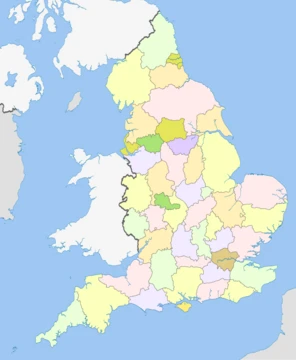
Staffordshire
The historic county of the Staffordshire Hoard and the Potteries
Staffordshire (postal abbreviation Staffs.) is a ceremonial county located in the West Midlands of England. It shares borders with Cheshire to the north-west, Derbyshire and Leicestershire to the east, Warwickshire to the south-east, the West Midlands county and Worcestershire to the south, and Shropshire to the west. The city of Stoke-on-Trent is the largest settlement.
Covering an area of 1,713 km², the county’s landscape is hilly in both the north and south. The southern Pennines lie in the north, including part of the Peak District National Park. In the south are the Cannock Chase Area of Outstanding Natural Beauty, sections of the National Forest, and Kinver Edge. Most of the county is drained by the River Trent and its tributaries. The Trent rises near Biddulph, flows south-west through Staffordshire, meets the River Sow just east of Stafford, then joins the River Tame and turns north-east, leaving the county into Derbyshire just downstream of Burton upon Trent.
The county contains several Iron Age tumuli and Roman camps. Angles settled the area in the sixth century, and the oldest known Stafford knot—the county’s symbol—appears on an Anglian cross in the churchyard of Stoke Minster. Staffordshire was formed in the early tenth century, when Stafford became the capital of Mercia. It remained relatively settled for centuries, then industrialised rapidly during the Industrial Revolution. The North Staffordshire coalfield was exploited, fuelling iron and automobile industries in the south. Pottery is the county’s most famous export, with a limited amount still produced in Stoke-on-Trent.
Historically, Staffordshire was divided into five hundreds: Cuttlestone, Offlow, Pirehill, Seisdon, and Totmonslow. Its historic boundaries covered much of what is now the metropolitan county of West Midlands. An administrative county of Staffordshire was created in 1889 under the Local Government Act 1888, covering the county except for the county boroughs of Wolverhampton, Walsall, and West Bromwich in the south (the Black Country), and Hanley in the north. The same Act united the towns of Tamworth (partly in Warwickshire) and Burton upon Trent (partly in Derbyshire) entirely within Staffordshire. In 1553, Queen Mary made Lichfield a county corporate, meaning it was administered separately from the rest of Staffordshire until 1888.
Handsworth and Perry Barr were transferred to the county borough of Birmingham, and thus Warwickshire, in 1911 and 1928 respectively. Burton became a county borough in 1901, followed by Smethwick in the Black Country in 1907. In 1910, the six towns of the Staffordshire Potteries, including Hanley, merged into the single county borough of Stoke-on-Trent. A notable boundary change occurred in 1926 when the east of Sedgley was transferred to Worcestershire to allow construction of the new Priory Estate on land purchased by Dudley County Borough council.
A major reorganisation in the Black Country in 1966, following the Local Government Commission for England’s recommendation, created a contiguous area of county boroughs. The County Borough of Warley was formed from the merger of the county borough of Smethwick and municipal borough of Rowley Regis with the Worcestershire borough of Oldbury; this new county borough was associated with Worcestershire. Meanwhile, the county borough of Dudley, historically a detached part of Worcestershire, expanded and became associated with Staffordshire. This reorganisation left the administrative county of Staffordshire with a thin protrusion passing between the county boroughs to the east and Shropshire to the west, forming a short border with Worcestershire.
Under the Local Government Act 1972, on 1 April 1974, the county boroughs of the Black Country and the Aldridge-Brownhills Urban District of Staffordshire became part of a new metropolitan county of West Midlands, along with Birmingham, Solihull, Coventry, and other districts. County boroughs were abolished; Stoke became a non-metropolitan district in Staffordshire, and Burton formed an unparished area in the district of East Staffordshire. On 1 April 1997, following a recommendation by the Banham Commission, Stoke-on-Trent became a unitary authority independent of Staffordshire once more.
In July 2009, the largest hoard of Anglo-Saxon gold ever found in Britain was discovered in a field near Lichfield. The artefacts, known as the Staffordshire Hoard, have been tentatively dated to the 7th or 8th centuries, placing their origin in the time of the Kingdom of Mercia.
Staffordshire has a completely comprehensive education system with eight independent schools. Most secondary schools serve students from ages 11 to 16 or 18, but two in Staffordshire Moorlands and South Staffordshire operate from ages 13 to 18. Resources are shared where appropriate. The county has two universities: Keele University, west of Newcastle-under-Lyme, and the University of Staffordshire, with campuses in Stoke-on-Trent.
Quick Facts
- Region
- West Midlands
- Founded
- Ancient
- Lord lieutenant office
- Lord Lieutenant of Staffordshire
- Lord lieutenant name
- Professor Elizabeth Barnes
- High sheriff office
- High Sheriff of Staffordshire
- Area (km²)
- 2713
- Area total rank
- 18th
- Ethnicity
- 97.0% White, 1.7% S.Asian, 1.3% Other
Facts from the source article.
Reader's Guide
Staffordshire is hilly to the north and south. The southern end of the Pennines is in the north, containing part of the Peak District National Park. The Cannock Chase AONB and parts of the National Forest and Kinver Edge are in the south. The River Trent and its tributaries drain most of the county. From its source, near Biddulph, the river flows through Staffordshire in a southwesterly direction, meeting the Sow just east of Stafford; it then meets the River Tame and turns north-east, exiting into Derbyshire immediately downstream of Burton upon Trent. For local government purposes Staffordshire comprises a non-metropolitan county, with eight districts, plus the unitary authority area of Stoke-on-Trent. The county historically included the north-west of the West Midlands county, including Walsall, West Bromwich, and Wolverhampton. Education: Staffordshire has a completely comprehensive system with eight independent schools. Most secondary schools are from 11 to 16 or 18, but two in Staffordshire Moorlands and South Staffordshire are from 13 to 18. There are two universities in the county, Keele University, west of Newcastle-under-Lyme, and the University of Staffordshire, which has campuses in Stoke-on-Trent, Stafford, London, Lichfield and Shrewsbury. Sport: The modern county of Staffordshire currently has three professional football clubs – Stoke City and Port Vale, both from Stoke-on-Trent, and Burton Albion, who play in Burton upon Trent. In cricket, Staffordshire is one of the nineteen Minor counties of English and Welsh cricket. It is represented in Minor counties cricket by Staffordshire County Cricket Club who have played in the Minor Counties Championship since 1895, a competition which it has won outright eleven times.
More in English Counties
Spotted an error? Know more?
Reader corrections go straight into our review queue. Suggest an edit · How this site is sourced