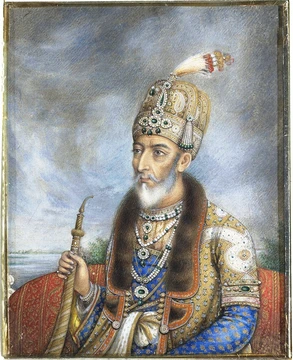
Jahandar Shah
Ninth Mughal emperor, a puppet ruler under his vizier.
Jahandar Shah, born Mirza Mu'izz-ud-Din Beg Muhammad Khan, was the ninth Mughal emperor for a short period in 1712-1713. The eldest son of Bahadur Shah I, he won the throne through a violent struggle that killed his three brothers. His vizier Zulfiqar Khan was crucial to his victory and later controlled him, making Jahandar Shah the first Mughal ruler who was essentially a puppet. He lacked the skills to maintain the empire, instead focusing on pleasure and neglecting state affairs.
Quick Facts
- Coronation
- 29 March 1712
- Predecessor
- Shah Alam I
- Successor
- Farrukh Siyar
- Birth name
- Mirza Mu'izz-ud-Din Beg Muhammad Khan
- Birthplace
- Deccan, Mughal Empire
- Died
- 11 February 1713
- Place of death
- Delhi, Mughal Empire
- Burial place
- Humayun's Tomb, Delhi, India
Facts from the source article.
Did You Know?
- Jahandar Shah was beaten to death and then beheaded on 11 February 1713.
- His body was paraded around Delhi in parts, hanging upside down from two elephants.
- He reintroduced couplets on his coins, issuing them in gold, silver, and copper.
Early life
Born on 10 May 1661 in the Deccan, Mu'izz-ud-din was the eldest son of Prince Mu'azzam and Nizam Bai, a Hyderabad noble. As Aurangzeb's eldest grandson, his birth was celebrated by the court. He spent three years campaigning in the Deccan before moving to northern India, and in 1706 subdued the rebellious Mirani chief of Dera Ghazi Khan. When his father became Emperor Bahadur Shah in June 1707, Mu'izz-ud-din received the title Jahandar Shah and was appointed governor of Thatta and Multan.
War of succession
A war of succession began as Bahadur Shah lay on his deathbed in 1712. The most powerful prince was his second son Azim-ush-Shan, while Jahandar Shah was the weakest. The outcome was engineered by the noble Zulfiqar Khan, who built an alliance between Jahandar Shah and his younger brothers Rafi-ush-Shan and Jahan Shah.
Reign
Jahandar Shah was crowned on 29 March 1712. His accession was not well-supported, and he was viewed as an illegitimate ruler. He rewarded his supporters and severely punished nobles who had backed his brothers, with several executed. He let the bodies of the defeated princes rot in the open for days before entombment. With his accession, Zulfiqar Khan assumed the post of wazir and wielded effective power, the first time an outsider to the dynasty held absolute power. Zulfiqar Khan sought amicable relations with Rajputs, Sikhs, and Marathas, but the empire's finances deteriorated. Jahandar Shah conspired against Zulfiqar Khan, creating political chaos. He married his beloved Lal Kunwar, and her family gained unprecedented power. Contemporary chroniclers noted his indulgence in feasts and entertainments, and cruelty to opponents. Recent scholars highlight his political weakness and the growing self-interest of nobles as factors in his reign's turbulence.
Personal life
Jahandar Shah's first wife was the daughter of Mirza Mukarram Khan Safavi, married on 13 October 1676. After her death, he married her niece, Sayyid-un-Nissa Begum, on 30 August 1684. The marriage was consummated on 18 September, and she was presented with jewels worth 67,000 rupees. Another wife was Anup Bai, who died at Delhi on 17 April 1735; historian William Irvine says she was the mother of Prince Muhammad Aziz-ud-din Mirza, though contemporary sources name Muazzamabadi Mahal as his mother. Another wife was Lal Kunwar, daughter of Khasusiyat Khan, whom he gave the title Imtiyaz Mahal. One daughter, Rabih Begum, was betrothed to Bidar Dil Mirza on 20 May 1710 and died on 7 September 1710. Another daughter, Iffat Ara Begum, married Khwaja Musa Sarbuland Khan.
More in Emperors of the Mughal Empire
Spotted an error? Know more?
Reader corrections go straight into our review queue. Suggest an edit · How this site is sourced