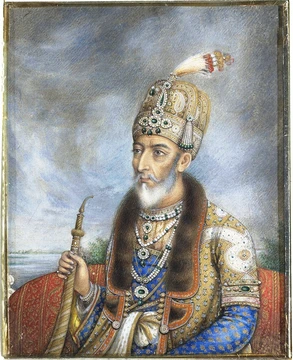
Alamgir II
Fifteenth Mughal emperor, murdered by his vizier.
Mirza Aziz-ud-Din Muhammad (6 June 1699 – 29 November 1759), known by his regnal name Alamgir II, was the fifteenth Mughal emperor, reigning from 1754 to 1759. He was a son of Jahandar Shah and was placed on the throne by the vizier Imad-ul-Mulk after the deposition of Ahmad Shah Bahadur. His reign was marked by weak rule, with real power held by his vizier, and ended with his murder.
Quick Facts
- Reign
- 3 June 1754 – 29 November 1759
- Predecessor
- Ahmad Shah
- Successor
- Shah Jahan III
- Regent
- Imad-ul-Mulk (1754–1756)
- Spouses
- Zinat Mahal; Zinat Afruz Begum (1758)
- Issue
- Shah Alam II
- Gauhar-un-Nissa Begum
- Khair-un-Nissa Begum
- Daulat-un-Nissa Begum
- Full name
- Mirza Aziz-ud-Din Alamgir II
- House
- Mughal dynasty
Facts from the source article.
Early life
Alamgir II was born Aziz-ud-Din on 6 June 1699 at Burhanpur, the second son of Muizz-ud-Din (later Jahandar Shah) and a Rajput princess named Anup Bai, about whose existence little is clear. He was seven when his great-grandfather Aurangzeb died. After his father Jahandar Shah was defeated by Farrukhsiyar, Aziz-ud-Din was imprisoned in 1714 by Asaf Jah I under Farrukhsiyar and remained in captivity until 1754. He was then released by the usurping vizier Ghazi ud-Din Khan Feroze Jung III, who saw him as a frail personality and gave him the title Alamgir II on 2 June 1754.
Reign
This development displeased Imad-ul-Mulk, who sought to strengthen his authoritarianism with Maratha support. In 1755, the Mughal viceroy of Punjab, Moin-ul-Mulk, died; his widow Mughlani Begum sought assistance from Ahmad Shah Durrani to halt succession struggles and quell Sikh rebels. Ahmad Shah Durrani marched into Lahore in 1756, appointed his son Timur Shah Durrani as viceroy, and placed Adina Beg as Faujdar of Doab. He then plundered Sikh and Hindu inhabitants in the eastern Punjab. In January 1757, Alamgir II, with courtiers including Shah Waliullah and nobles such as Najib-ul-Daula, met Ahmad Shah Durrani, whose forces engaged the Marathas and threatened to overthrow Imad-ul-Mulk. Relations between the Durrani and Mughal empires strengthened when Timur Shah Durrani was chosen as suitor of Alamgir II's daughter Zuhra Begum, and Ahmad Shah Durrani married Hadrat Begum, daughter of former emperor Muhammad Shah. Ahmad Shah Durrani returned to Kabul, leaving his forces under Timur Shah Durrani at Lahore, where they founded the Zamzama cannon with Mughal metalsmiths. He was supported by Mohammad Bahawal Khan II and Muhammad Nasir Khan I. In July 1757, the Marathas under Raghunathrao, assisted by Imad-ul-Mulk, rejected the Durrani-Mughal alliance and besieged Delhi.
Foreign relations
In 1756, the Seven Years' War broke out, and Alamgir II was supported by various international belligerents; it was the first global war involving a Mughal emperor beyond India's boundaries. In 1755, Alamgir II wrote to De Bussy requesting French assistance against the Maratha Confederacy, asking for a French contingent of 1,000 to protect Delhi and promising payment and settlement of Carnatic Wars disputes in favor of the French East India Company. In 1757, Alamgir II achieved peace between the Durrani Emirate and the Mughal Empire, securing matrimonial alliances: Timur Shah Durrani married Gauhar Afroz Begam, daughter of Alamgir II, in February 1757, and Ahmad Shah Durrani married Hazrat Begum, daughter of former emperor Muhammad Shah, in 1757. The Swedish East India Company operated in Surat as a co-belligerent of Alamgir II, possibly assisting the first Nawab of Junagadh.
Death
The deposed Imad-ul-Mulk, fearing this, aligned with Maratha leader Sadashivrao Bhau and defeated Najib-ud-Daula after 15 days. Imad-ul-Mulk then feared Alamgir II would recall Ahmad Shah Durrani or use his son Prince Ali Gauhar to dispossess him, so he plotted to murder the emperor and his family. In November 1759, Alamgir II was told a pious man had come to meet him; eager to meet holy men, he set out to Kotla Fateh Shah, where he was stabbed repeatedly by Imad-ul-Mulk's assassins. His death was mourned throughout the Mughal Empire, particularly by the Muslim populace.
More in Emperors of the Mughal Empire
Spotted an error? Know more?
Reader corrections go straight into our review queue. Suggest an edit · How this site is sourced