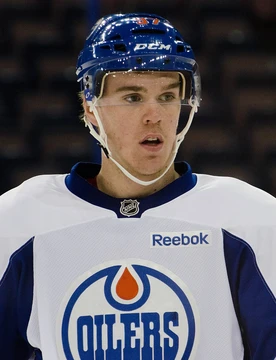
Georges Laraque
Haitian-Canadian enforcer, politician, and former Oiler.
Last updated
Georges Laraque is a Haitian-Canadian former professional ice hockey player, politician, author, and radio host. He is noted for being one of the most successful hockey enforcers of his time, spending the majority of his NHL career with the Edmonton Oilers, who drafted him 31st overall in 1995.
Lore & Background
Laraque entered the Quebec Major Junior Hockey League (QMJHL), playing for several teams and winning the Memorial Cup with the 1996 Granby Prédateurs. After junior hockey, he spent parts of two seasons with the AHL's Hamilton Bulldogs. His first professional fight occurred on October 25, 1996, against Chris LiPuma. In a pre-season game on September 15, 1997, he fought established heavyweight Donald Brashear to impress the coaching staff.
Called up to the NHL on November 15, 1997, he won his first career fight against Todd Simpson and was victorious in four others before being reassigned to the AHL. A year later, after hard work to improve his game, he made the NHL on a regular basis. Though a power forward in junior, he is considered primarily an enforcer at the NHL level. His 273-pound body and fighting habit made him one of the league's most feared forwards.
He was unanimously awarded the 'Best Fighter' award from The Hockey News in 2003 and named the number one enforcer by Sports Illustrated in 2008. Despite his reputation, he scored a hat trick against the Los Angeles Kings on February 21, 2000, and was named the game's first star. During the 2004–2005 NHL lockout, he played in Sweden with AIK. On November 23, 2005, he defeated the 6'7", 260-pound Derek Boogaard.
In the 2006 off-season, he wanted to stay with Edmonton and was willing to take a salary cut for a long-term, no-trade clause deal, but the Oilers did not agree, and he signed with the Phoenix Coyotes on July 5, 2006. He scored his first goal as a Coyote against Edmonton on October 26, 2006. He was traded to the Pittsburgh Penguins for the 2007–08 season for Daniel Carcillo, as his former junior coach and Penguins coach Michel Therrien believed he was needed to protect Sidney Crosby and Evgeni Malkin. On July 3, 2008, he signed as a free agent with the Montreal Canadiens, taking jersey number 17 because number 27 was worn by Alex Kovalev.
Montreal sought him to add toughness after being outplayed physically by the Philadelphia Flyers in the previous year's playoffs and having difficulty countering Milan Lucic. On November 21, 2009, he was suspended five games for a knee-to-knee hit on Niklas Kronwall. His final fight was on December 12, 2009, against Eric Boulton. The Canadiens released him on January 21, 2010, and bought out his contract on June 15, 2010.
Suffering from two herniated discs in his back, he announced his retirement. While with the Oilers, he was famous for his 'Laraque Leap', smashing his body against the glass at Northlands Coliseum after a goal. He came out of retirement on January 16, 2015, playing two games for Norway's Lokomotiv Fana, and again on February 20, 2026, for one game with the Columbus River Dragons as a celebrity player for Military Appreciation Night. He also served as assistant coach of the Haiti street and ball hockey national team during the 2015 Ball Hockey World Championship.
The Enforcer Who Defied the Stereotype
Georges Laraque entered professional hockey as a 273-pound force of nature, drafted 31st overall by the Edmonton Oilers in 1995 after a standout junior career in the QMJHL where he accumulated 107 points and 661 penalty minutes across 173 games. His path to the NHL was gradual: a first professional fight in October 1996, a pre-season showdown with veteran Donald Brashear in September 1997 to impress coaching staff, and finally his first NHL bout against Todd Simpson in November of that year.
Over a 14-year career spanning the Oilers, Phoenix Coyotes, Pittsburgh Penguins, and Montreal Canadiens, Laraque cemented his reputation as one of the league's most feared forwards. The Hockey News unanimously named him Best Fighter in 2003, and Sports Illustrated ranked him the number one enforcer in 2008. Yet beneath the brawn lay a surprising offensive spark: on February 21, 2000, he scored a hat trick against the Los Angeles Kings and was named first star of that game, proving his skill extended well beyond the fighting circle.
A Career Forged in Hardship and Hard Choices
Laraque's journey through the NHL was marked by pivotal decisions and physical toll. During the 2004-05 lockout he played in Sweden with AIK, and upon returning he delivered a memorable victory over the towering 6-foot-7, 260-pound Derek Boogaard in November 2005. His relationship with Edmonton soured in the 2006 off-season when he sought a long-term deal with a no-trade clause and was willing to accept a salary cut, but the Oilers refused, leading him to sign with Phoenix in July. A year later he was traded to Pittsburgh, where coach Michel Therrien—his former junior mentor—saw him as a shield for young stars Sidney Crosby and Evgeni Malkin.
In 2008 he joined Montreal, donning number 17 because his beloved 27 was already taken. His final season was marred by a five-game suspension for a knee-to-knee hit on Niklas Kronwall, a last fight against Eric Boulton in December 2009, and ultimately a release in January 2010. Two herniated discs in his back had been plaguing him, and he announced his retirement shortly after his contract was bought out in June.
From the Rink to the Radio Booth and the Ballot Box
After hanging up his skates, Laraque channeled his energy into advocacy, media, and public service. He became the host of a show on BPM Sports 91.9 in Montreal, while also serving as a public speaker and a member of the NHL's diversity coalition. His speaking engagements center on the fight against racism, and he is known as an outspoken vegan. In 2012 he took on the role of executive director of the newly formed Canadian Hockey League Players' Association.
His political involvement deepened when he joined the Green Party of Canada in February 2010 and was named one of its two deputy leaders that July. He ran as the Green candidate in the Bourassa by-election in 2013 but resigned from both the candidacy and the deputy leadership in October of that year. Throughout it all, his roots in Haiti—his parents were born there before immigrating to Canada, and he was born in Montreal—remained a driving force in his public life.
The Laraque Leap and a Life of Comebacks
Few images in Oilers lore are as vivid as the "Laraque Leap"—the moment Laraque would hurl his entire body against the glass at Northlands Coliseum to celebrate a goal, a signature celebration that made him a fan favorite in Edmonton. His charitable work extended far beyond the ice: he spent time visiting patients in hospitals, played in charity hockey games, and after his release by Montreal in 2010, he dedicated himself to raising funds to rebuild the Grace Children's Hospital in Port-au-Prince, partnering with World Vision and the NHL Players' Association. He also aided in the broader development and construction of a hospital in Haiti. His relationship with hockey never fully ended.
In January 2015 he briefly suited up for Norway's Lokomotiv Fana, playing two games before retiring again. He also served as assistant coach for Haiti's street and ball hockey national team at the 2015 Ball Hockey World Championship in Zug, Switzerland. Then, in February 2026, he made one final appearance, joining the Columbus River Dragons for a single Military Appreciation Night game in the Federal Prospects Hockey League.
Reader's Guide
Georges Laraque's significance lies in his dual legacy as one of the NHL's most feared enforcers and as a prominent figure in Canadian politics and activism. On the ice, his 273-pound frame and willingness to fight made him a dominant physical presence, earning him unanimous recognition as the league's best fighter by The Hockey News in 2003 and the top enforcer by Sports Illustrated in 2008. Despite his reputation, he demonstrated offensive capability, notably scoring a hat trick in 2000. His career spanned 14 NHL seasons with four teams, but he is most closely associated with the Edmonton Oilers, who drafted him and where he developed his iconic 'Laraque Leap'.
Off the ice, he became a deputy leader of the Green Party of Canada from 2010 to 2013 and ran for federal office. He has been an outspoken vegan since 2009, investing in raw vegan restaurants, and has been active in charity, including raising money to rebuild a children's hospital in Haiti after the 2010 earthquake. He also hosted a radio show, served as executive director of the Canadian Hockey League Players' Association in 2012, and participated in events such as a celebrity drag competition and the television show Battle of the Blades. His post-playing career reflects a commitment to social and political causes, making him a notable figure beyond hockey.
Career statistics and honours
Career statistics
| Regular season | Playoffs | ||||||||||||
|---|---|---|---|---|---|---|---|---|---|---|---|---|---|
| Season | Team | League | GP | G | A | Pts | PIM | GP | G | A | Pts | PIM | |
| 1992–93 | Montreal-Bourassa Canadien | QMAAA | 37 | 8 | 20 | 28 | 50 | 3 | 1 | 2 | 3 | 2 | |
| 1992–93 | Saint-Jean Lynx | QMJHL | — | — | — | — | — | 1 | 0 | 0 | 0 | 0 | |
| 1993–94 | Saint-Jean Lynx | QMJHL | 70 | 11 | 11 | 22 | 142 | 4 | 0 | 0 | 0 | 7 | |
| 1994–95 | Saint-Jean Lynx | QMJHL | 62 | 19 | 22 | 41 | 259 | 7 | 1 | 1 | 2 | 42 | |
| 1995–96 | Laval Titan Collège Français | QMJHL | 11 | 8 | 13 | 21 | 76 | — | — | — | — | — | |
| 1995–96 | Saint-Hyacinthe Lasers | QMJHL | 8 | 3 | 4 | 7 | 59 | — | — | — | — | — | |
| 1995–96 | Granby Prédateurs | QMJHL | 22 | 9 | 7 | 16 | 125 | 18 | 7 | 6 | 13 | 104 | |
| 1996–97 | Hamilton Bulldogs | AHL | 73 | 14 | 20 | 34 | 179 | 15 | 1 | 3 | 4 | 12 | |
| 1997–98 | Hamilton Bulldogs | AHL | 46 | 10 | 20 | 30 | 154 | 3 | 0 | 0 | 0 | 11 | |
| 1997–98 | Edmonton Oilers | NHL | 11 | 0 | 0 | 0 | 59 | — | — | — | — | — | |
| 1998–99 | Edmonton Oilers | NHL | 39 | 3 | 2 | 5 | 57 | 4 | 0 | 0 | 0 | 2 | |
| 1998–99 | Hamilton Bulldogs | AHL | 25 | 6 | 8 | 14 | 93 | — | — | — | — | — | |
| 1999–2000 | Edmonton Oilers | NHL | 76 | 8 | 8 | 16 | 123 | 5 | 0 | 1 | 1 | 6 | |
| 2000–01 | Edmonton Oilers | NHL | 82 | 13 | 16 | 29 | 148 | 6 | 1 | 1 | 2 | 8 | |
| 2001–02 | Edmonton Oilers | NHL | 80 | 5 | 14 | 19 | 157 | — | — | — | — | — | |
| 2002–03 | Edmonton Oilers | NHL | 64 | 6 | 7 | 13 | 110 | 6 | 1 | 3 | 4 | 4 | |
| 2003–04 | Edmonton Oilers | NHL | 66 | 6 | 11 | 17 | 99 | — | — | — | — | — | |
| 2005–06 | Edmonton Oilers | NHL | 72 | 2 | 10 | 12 | 73 | 15 | 1 | 1 | 2 | 44 | |
| 2006–07 | Phoenix Coyotes | NHL | 56 | 5 | 17 | 22 | 52 | — | — | — | — | — | |
| 2006–07 | Pittsburgh Penguins | NHL | 17 | 0 | 2 | 2 | 18 | 2 | 0 | 0 | 0 | 0 | |
| 2007–08 | Pittsburgh Penguins | NHL | 71 | 4 | 9 | 13 | 141 | 15 | 1 | 2 | 3 | 4 | |
| 2008–09 | Montreal Canadiens | NHL | 33 | 0 | 2 | 2 | 61 | 4 | 0 | 0 | 0 | 4 | |
| 2009–10 | Montreal Canadiens | NHL | 28 | 1 | 2 | 3 | 28 | — | — | — | — | — | |
| 2014–15 | Fana IHK | NOR.3 | 2 | 4 | 3 | 7 | 10 | — | — | — | — | — | -| |
| 2025-26 | Columbus River Dragons | FPHL | 1 | 0 | 0 | 0 | 0 | — | — | — | — | — | -| |
| NHL totals | 695 | 53 | 100 | 153 | 1126 | 57 | 4 | 8 | 12 | 72 | |||
Tables copied from the source article, totals included as the source gives them: Wikipedia: Georges Laraque (CC BY-SA 4.0). Wide tables scroll sideways.
Frequently Asked Questions
Who is Georges Laraque to Oilers fans?
He is a Haitian-Canadian enforcer who spent the bulk of his NHL career in Edmonton after being selected 31st overall in the 1995 draft. Born in Montreal in 1976, he became one of the league's most feared and effective fighters during his years in the blue-and-orange.
How did Laraque reach the NHL?
After logging 173 games and 107 points in the QMJHL, he was taken 31st overall by Edmonton in the 1995 Entry Draft. He went on to suit up for four NHL clubs—Oilers, Coyotes, Penguins, and Canadiens—though Edmonton remained his longest and most defining stop.
What has Laraque done since leaving hockey?
After hanging up his skates, he moved into public life as a politician, author, and radio personality. His post-hockey career has kept him in the public eye well beyond his playing days.
More in Edmonton Oilers Players
Test yourself
Three questions drawn from this entry’s sources. Pick an answer to check it.
Answers checked against the source article
Sources
Compiled from Wikipedia and the sources listed below. Text from Wikipedia is available under CC BY-SA 4.0; this entry is adapted from it.
- Wikipedia: Georges Laraque (CC BY-SA 4.0).
- Statistics, medals and awards: the tables of the source article.
- Word definitions: the Codexery glossary, each quoted from its Wikipedia article.
Spotted an error? Know more?
Reader corrections go straight into our review queue. Suggest an edit · How this site is sourced