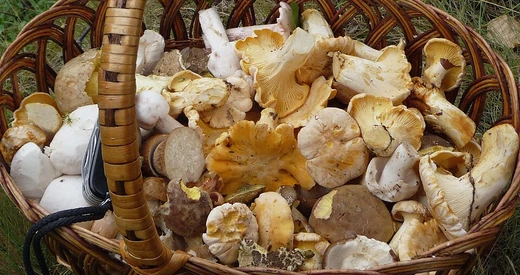
Armillaria mellea
Edible honey fungus that causes root rot in woody plants.
Armillaria mellea is an edible basidiomycete fungus in the honey fungus genus Armillaria. It is a plant pathogen that causes Armillaria root rot in many plant species and is part of a cryptic species complex of closely related and morphologically similar species. The fungus is notable for its bioluminescent mycelium and its wide distribution in temperate regions of the Northern Hemisphere.
Quick Facts
- Species
- mellea
Facts from the source article.
Did You Know?
- Cultivation of A. mellea mycelia has been used since 1994 to support the cultivation of Gastrodia elata, a non-photosynthetic orchid used in traditional Chinese medicine.
- The fungus produces cytotoxic compounds known as melleolides, made from orsellinic acid and protoilludane sesquiterpene alcohols via esterification.
- Armillaria mellea has been recorded as food for adults of the pleasing fungus beetles Tritoma biguttata biguttata, Tritoma atriventris, T. humeralis, and T. mimetica.
Description
The cap of this fungus is smooth and measures 3 to 15 centimeters across. It starts out convex, then flattens as it ages, often developing a raised central bump, and later may become somewhat dish-shaped. The cap margins tend to arch when mature, and the surface turns sticky in wet conditions. While it is usually honey-colored, its appearance varies; sometimes a few dark, hairy scales appear near the center in a radial pattern.
The gills are initially white, later sometimes turning pinkish-yellow or discolored, and are broad, fairly spaced, and attached to the stem at right angles or slightly running down it. The cap flesh is whitish with a sweet smell and taste that has a slight bitterness. The stem is 5 to 20 centimeters long and 0.5 to 3.5 centimeters thick, fibrous, firm and spongy at first but later becoming hollow. It is cylindrical, tapering to a point at the base where it fuses with other stems in a clump.
The upper stem is whitish, the lower part brownish-yellow, often with a very dark base. A broad, persistent, skin-like ring sits on the upper stem, with a velvety edge and yellowish fuzz underneath; it extends as a white partial veil that protects the young gills. Microscopically, the spores are roughly elliptical, 6–9 by 5–7 micrometers, inamyloid, with prominent pointed projections at the base. The spore print is white.
The basidia lack basal clamps. Underground, a mat of mycelial threads can spread over great distances, bundled into black rhizomorphs. The mycelia glow when actively growing, due to a blockage that stops hispidin synthesis.
Ecology
Armillaria mellea thrives in damp ground and cooler soil; once soil temperatures climb past 79 degrees Fahrenheit, its growth stalls. It can survive extreme events like wildfires because the soil insulates it. You might find it in gardens, parks, vineyards, tree nurseries, and wild areas. It usually lives in partnership with hardwoods and conifers, including fruit orchards, planted forests, vineyards, and a handful of herbaceous plants.
It spreads to new hosts via rhizomorphs or basidiospores, but spores rarely infect a living host and tend to settle on dead wood instead. Rhizomorphs, however, can stretch up to ten feet to reach a fresh host. Signs of infection are subtle and easy to miss. The most obvious is a cluster of honey-colored mushrooms sprouting at the plant’s base.
Other signs include white, fan-shaped mycelia under the bark and black rhizomorphs in the soil, each about 1/32 to 1/8 inch thick. Because the mushrooms are short-lived and resemble those of other fungi, the rhizomorphs and mycelial fans are more dependable clues. Symptoms are more varied: slowed growth, branch dieback, yellowing leaves, rotted wood at the base or roots, cankers, cracked bark, oozing stems, wilting, leaf drop, and sudden death. Wilting, defoliation, and dieback happen after the cambium is destroyed.
The disease usually progresses slowly, with worsening dieback and declining yields over time. It ranks among the top killers of trees and shrubs in both wild and cultivated settings.
Hosts
Armillaria mellea can attack hundreds of woody plants, from trees and shrubs to hedges and vines, though some species are more prone to infection than others. Affected genera include Abies, Acer, Aesculus, Alnus, Berberis, Carpinus, Catalpa, Cornus, Corylus, Cupressus, Cydonia, Eucalyptus, Fagus, Ficus, Forsythia, Fuchsia, Ginkgo, Hedera, Hibiscus, Hydrangea, Ilex, Jasminum, Juniperus, Lavandula, Lonicera, Magnolia, Malus, Morus, Olea, Picea, Pinus, Populus, Punica, Rhamnus, Rhododendron, Rhus, Ribes, Rosa, Rosmarinus, Salix, Salvia, Solanum, Spiraea, Symphoricarpos, Taxus, Thuja, Tilia, Viburnum, Vitis, Weigela, and many others.
In grapevines, the fungus invades roots and the root crown, destroying the cambium and decaying xylem, which leads to white rot. Infected vines often have shriveled berries, and after veraison, leaves and berries may dry out rapidly, followed by vine death. Vineyard outbreaks start at a single point and spread in a circle, with vines at the center dying faster than those on the edge, which may show no symptoms. Infection usually occurs when roots contact old infected wood in the soil, especially where oaks once grew, as the fungus can live for years in woody debris.
The pathogen survives on both living and dead grapevine roots, and vines typically die once about half the root collar is girdled.
Uses
Armillaria mellea is a decent edible mushroom, though its tough stems are often tossed aside. It’s best picked young and cooked well. Mushrooms growing on buckeye or hemlock trees might upset your stomach. The flavor is mildly sweet and nutty, with a texture that can be chewy or crunchy depending on how you prepare it. Boiling them first gets rid of any bitterness and may cut down on stomach irritants. Drying keeps and boosts the taste, but rehydrated ones are often tough. You can also pickle or roast them. The fruit body is packed with carbohydrates like polysaccharides, sugars, and chitin, and is high in protein and fiber but low in fat. That makes it a good option for people with high blood pressure or hardening of the arteries, and the fiber could help with diabetes and weight control. Indigenous peoples may have used these mushrooms as a laxative.
More in Edible Fungi
Spotted an error? Know more?
Reader corrections go straight into our review queue. Suggest an edit · How this site is sourced