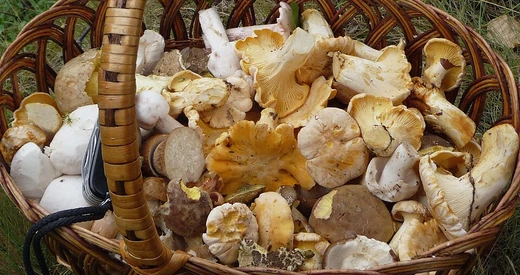
Mushroom hunting
Gathering wild mushrooms for food, dye, or psychotropic use.
Mushroom hunting is the activity of gathering wild mushrooms for food, psychotropic drugs, or dye. It requires analysis to distinguish useful species from poisonous ones, often using advanced techniques. The practice is popular throughout most of Eurasia and Australia, as well as in West Africa and temperate North America.
Quick Facts
- Mushroom festival location (madisonville
- Texas Mushroom Festival
Facts from the source article.
Did You Know?
- David Arora recommends using a firm container such as a basket for collecting mushrooms, with lighter specimens above heavier ones and species separated using waxed paper, not plastic bags.
- In the North American Pacific Northwest, mushrooms are most common in autumn.
Identification
There are many field guides to help tell edible or psychedelic mushrooms apart from toxic or unpalatable ones. To identify a mushroom by sight, you usually need to look closely at the shape of its cap, the pattern of its gills, and the structure of its stem. Sometimes a microscope is required to rule out dangerous lookalikes. Another common trick is making a spore print: you set the mushroom on a piece of paper or glass and let its spores drop down to reveal their color. Mushrooms tend to start growing when the weather gets both warm and damp. In the Pacific Northwest of North America, they appear from spring into summer but are most plentiful in autumn. In the Southwest, they show up during winter rains and in spring. In the Midwest and Northeast, you can find them from late April until the first frosts of fall. In the Colorado Rockies, July and August are the best months. Along the Gulf Coast, they keep coming through winter. Some mushrooms are especially sought after. Chanterelles are a favorite in Europe and the United States, and on the West Coast they are picked for sale. Hedgehog mushrooms, with spines under the cap, are also well liked. Morels are another popular edible. Lobster mushrooms taste a bit like shellfish and have no dangerous lookalikes. Porcini, or Boletus edulis, is highly prized for its nutty flavor and is a big deal in Italy. Caesar's mushroom is edible but belongs to the Amanita group, so you have to be very careful identifying it; it was named after Roman emperors who enjoyed it. The matsutake, popular in Japan and also found in the Pacific Northwest, smells spicy—David Arora compared it to "Red Hots and dirty socks." The Japanese species doesn't grow in North America, and you must not confuse it with the deadly Smith's amanita. Many truffles are also treasured for their taste and smell, and they can fetch extremely high prices.
Poisonous mushrooms
Foraging for mushrooms carries serious risks because many edible and poisonous varieties look nearly identical. While some toxic mushrooms only cause stomach problems, others lead to organ failure or death. The majority of fatal poisonings come from Amanita species like the death cap and destroying angel, which contain amatoxins that can trigger kidney failure. Death caps are sometimes mistaken for edible paddy straw mushrooms, but those are only found in Asia, not the United States. Young death caps also resemble edible puffballs, but cutting them open reveals the difference: puffballs are solid white inside, while a young death cap shows a distinct mushroom shape. Another amatoxin-containing Amanita, the destroying angel, can be confused with edible meadow mushrooms. Galerina marginata and Conocybe rugosa also carry amatoxins; Galerina marginata is seldom eaten because of its tiny size but can be mixed up with hallucinogenic Psilocybe species. Cortinarius rubellus and Cortinarius orellanus contain orellanine, a toxin that destroys the liver and kidneys. The jack o' lantern mushroom, which causes gastrointestinal distress, is often confused with edible chanterelles. Some poisonous species, including Amanita muscaria, Paxillus involutus, and Gyromitra esculenta, are parboiled and eaten in certain regions. However, Paxillus involutus contains toxins that accumulate in the body over time and can prove fatal later, and parboiling does not always remove the toxins from Gyromitra esculenta, so eating it is not advised.
History
People have been hunting mushrooms for thousands of years, with evidence of consumption dating back to the Paleolithic period. In 2015, scientists found traces of mushrooms on the teeth of ancient skeletons from Spain. A Sumerian text mentions that the Amorites may have eaten truffles. Ötzi the Iceman, a 5,300-year-old mummy, carried two types of mushrooms: birch polypore, likely used as an antibiotic or anti-inflammatory, and hoof fungus, probably for starting fires. In ancient Egypt, mushrooms were seen as a gift from the god Osiris and were only for the nobility. The Greeks and Romans also ate them. Caesar's mushroom was named after Roman emperors who favored it, and Emperor Claudius may have been poisoned by his wife Agrippa, who mixed it with deadly death cap juice. Truffles were highly valued in Rome. In China, the lingzhi mushroom was used for medicine. During medieval times in Europe, mushroom hunting continued, but people often viewed mushrooms with suspicion and linked them to witchcraft. Sami shamans in Northern Europe used fly agaric in rituals for its mind-altering effects. Europeans ate truffles, field mushrooms, porcinis, chanterelles, and morels. In the Middle East, the physician Al-Biruni wrote about eating several species, including truffles. Shiitake cultivation began in China during the Middle Ages. In Japan, matsutake mushrooms were so prized that only the imperial court could eat them until the 17th and 18th centuries, and nobles often gave them as gifts. The fear of mushrooms in Europe started to fade during the Renaissance.
Regional importance
Mushroom hunting is a widespread activity across Europe, Asia, Australia, West Africa, and the temperate parts of Canada and the United States. Beyond cooking and certain psychotropic uses, mushrooms can also serve as a source of dye. In Britain, the average mushroom-picking season has grown to 75 days, a significant increase from the 33-day season of the 1950s. Japan places special value on specific varieties, with the matsutake mushroom being a prized delicacy. In Slavic and Baltic nations, mushroom picking is a regular family outing. As mycologist David Arora noted, the tradition is deeply ingrained in Russian culture, far from being reserved for experts or academics. After a heavy rain during the season, entire families head to nearby woods, gathering buckets of mushrooms. These are often cooked right away in omelettes or fried in butter, or preserved by drying or marinating for later use. In southern Lithuania, mushroom hunting is considered a national sport, and the town of Varėna hosts a Mushroom Festival featuring a championship hunt. In the United States, popular picking areas include the Appalachian region and the West Coast from San Francisco Bay north through northern California, Oregon, and Washington, along with many other places. In Nigeria, the sclerotia of Pleurotus tuber-regium are added to soups and used medicinally for mumps. In Cameroon, Flamulina velutipes is a sought-after delicacy, typically gathered by women and children in rural areas. Mushroom festivals generally take place between September and October, depending on local mushroom availability. Notable U.S. festivals include the Annual National Morel Mushroom Festival in Boyne City, Michigan; the Mushroom Festival in Mount Pisgah, Oregon; the Texas Mushroom Festival in Madisonville, Texas; and the Telluride Mushroom Festival in Telluride, Colorado.
More in Edible Fungi
Spotted an error? Know more?
Reader corrections go straight into our review queue. Suggest an edit · How this site is sourced