Easy Money (board game)
A Monopoly-like board game introduced by Milton Bradley in 1935.

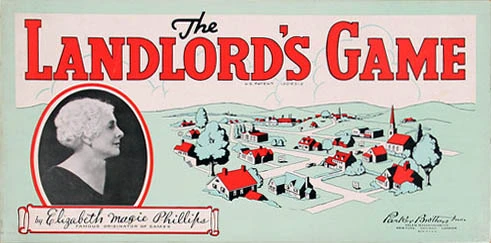
Easy Money, also known as The Game of Easy Money, was a board game first released by the Milton Bradley Company in 1936. It belongs to the same family as Monopoly, drawing on The Landlord's Game for its core mechanics: moving pieces around a circuit, drawing cards, buying properties, and building houses on them.
**History** In 1934, Charles Darrow showed his Monopoly design to Parker Brothers, which initially declined it. After Monopoly and a similar game called Finance became hits, Milton Bradley decided to produce its own direct imitation of Monopoly. By then, the patents on The Landlord's Game had expired, and the auction-style monopoly game was in the public domain. Nonetheless, Parker Brothers sued Milton Bradley for patent infringement, forcing the company to license Parker Brothers' patents to keep making the game. For its 1936 "New Improved Edition"—released in three separate versions—Milton Bradley had to alter the game so it no longer played so closely to Monopoly. The game was covered by utility patents licensed from Parker Brothers, with no evidence of a design patent application.
The board was redesigned for the 1940s edition, and the box got a new look in the 1950s. The final Milton Bradley edition came out in 1974, with all dollar amounts multiplied by ten and the board further changed to look less like Monopoly. In 2004, under license from Hasbro, Winning Moves reissued the 1950s version with updated property names as part of their 'Classic' series.
**Gameplay** Easy Money is part of the Landlord's Game/auction family, with Monopoly as its most famous relative. Players start with a fixed sum of money. Property owners charge rents based on the houses built on that property. Players can trade or sell properties. Other spaces on the board trigger specific actions when landed on or passed over.
Key differences from Monopoly include: - No color groups for properties. Instead, a player must own one "street" on each of the four board sides before building improvements. - Utilities and commercial buildings have no listed purchase prices; they are automatically auctioned by the bank to the highest bidder when a player lands on an unowned one. - No Title Deed cards with printed rents and mortgage values; that information is printed directly on the board.
- Introduced
- 1936
- Notable editions
- 1936 New Improved Edition, 1940s edition, 1950s edition, 1974 edition, 2004 reprint by Winning Moves
Lore & Background
Milton Bradley Company was not one of the companies that Charles Darrow showed his Monopoly to in 1934; he approached Parker Brothers, which initially turned him down. After the success of Monopoly and Finance, Milton Bradley decided to issue its own direct imitation of Monopoly, not a version of Finance. Despite the Landlord's Game patents having expired and the auction-monopoly game having developed in the public domain, Parker Brothers sued Milton Bradley for patent infringement, forcing the latter to license Parker Brothers' patents to continue production. MB was forced to make changes for its 1936 'New Improved Edition' so that it no longer played quite so similarly to Monopoly. No evidence exists of a design patent application for Easy Money; the game was covered by utility patents licensed from Parker Brothers.
Reader's Guide
Easy Money is a member of the Landlord's Game/auction family, of which Monopoly is the most famous example. Key differences from Monopoly include: no color groups (a player must own one street on each of the four sides before improving properties), no listed purchase prices for utilities or commercial buildings (they are automatically auctioned), no Title Deed cards (information is printed on the board), color-coded houses for ownership and rent, no dedicated Jail space, no Free Parking (money from accident spaces goes to Hospital), a red traffic light space, and Give-or-Take cards drawn on doubles. Players start with $2,000 (later $20,000 in the 1974 edition) and earn $250 ($2,500) for a full circuit. The game ends when one player cannot pay; remaining players' net worth determines the winner. A major flaw is that a player collects more by mortgaging than was paid when purchasing the property. Games are generally shorter than Monopoly sessions. In 1989, Milton Bradley published a similarly titled game, Ea$y Money, completely unrelated in look or gameplay.
Did You Know?
- Parker Brothers sued Milton Bradley for patent infringement over Easy Money, forcing MB to license Parker Brothers' patents.
- In Easy Money, there is no Jail space and no Free Parking; money from accident spaces goes to the Hospital space.
More in Economic simulation board games 1-24
Spotted an error? Know more?
Reader corrections go straight into our review queue. Suggest an edit · How this site is sourced