Albertus Magnus
Medieval philosopher, scientist, and Doctor of the Church who systematized Aristotle's works.
Last updated
Albertus Magnus was a German Dominican friar, philosopher, scientist, and bishop who lived from around 1200 to 15 November 1280.[1][2] Among medieval philosophers and thinkers, he is ranked as one of the most significant.[3] During his life, people called him Doctor universalis and Doctor expertus; he was made a saint in 1931.[4]
Last updated 2026-09-28 from the source article.
Life and work
He taught as a lecturer in Cologne, Regensburg, Freiburg, Strasbourg, and Hildesheim.[5] In 1254 he was elected Provincial of his Order in Germany.[6] Pope Alexander IV made him bishop of Regensburg in 1260, an office from which he resigned after three years.[7] Lauingen is the probable birthplace of Albert, and he likely received his education at the University of Padua, where he became familiar with Aristotle's works.[8][9]
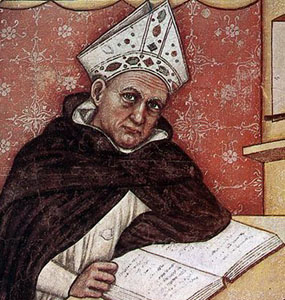
Pope Urban IV freed Albert from his episcopal responsibilities in 1263 and tasked him with promoting the Eighth Crusade.[7]
What the cited sources add
The Stanford Encyclopedia of Philosophy describes Albert as one of the most universal thinkers of the Middle Ages.[10] The same source notes that Albert and his student Thomas Aquinas believed Aristotle's natural philosophy posed no obstacle to Christian philosophy.[10] The Catholic Encyclopedia states that Albert was assiduous in cultivating the natural sciences and was an authority on physics, geography, astronomy, mineralogy, chemistry, zoology, physiology, and phrenology.[6] According to the Catholic Encyclopedia, Albert was the chief commentator on Aristotle's works after Averroes.[6]
The University of Houston records that a bronze statue of Albertus Magnus by sculptor Gerhard Marcks was acquired by the university in 1970.[11]
References
- Wikipedia, "Albertus Magnus" (CC BY-SA 4.0), which cites: Duchet-Suchaux, "The Bible and the Saints", Flammarion, 1994, p. 325 (original not read by us) en.wikipedia.org
- Wikipedia, "Albertus Magnus" (CC BY-SA 4.0), which cites: "Zeittafel", Gemeinden.erzbistum-koeln.de (original not read by us) en.wikipedia.org
- Wikipedia, "Albertus Magnus" (CC BY-SA 4.0), which cites: "Alberti Magni e-corpus" (original not read by us) en.wikipedia.org
- Wikipedia, "Albertus Magnus" (CC BY-SA 4.0), which cites: Weisheipl, "Albertus Magnus and the Sciences: Commemorative Essays", Pontifical Institute of Mediaeval Studies, 1980, p. 46; Joachim R. Söder, "Albert der Grosse – ein staunen- erregendes Wunder," Wort und Antwort 41 (2000): 145; J.A. Weisheipl, "Albertus Magnus," Joseph Strayer ed., (original not read by us) en.wikipedia.org
- Wikipedia, "Albertus Magnus" (CC BY-SA 4.0), which cites: Kovach, Francs, and Rober Shahan. Albert the Great: Commemorative Essays. Norman, Oklahoma: University of Oklahoma Press, 1980, p. x. (original not read by us) en.wikipedia.org
- Kennedy, Daniel. "St. Albertus Magnus." The Catholic Encyclopedia. Vol. 1. New York: Robert Appleton Company, 1907. 10 Sept. 2014. facts only, no text reused. newadvent.org
- Wikipedia, "Albertus Magnus" (CC BY-SA 4.0), which cites: Führer, Markus, "Albert the Great", The Stanford Encyclopedia of Philosophy (Winter 2014 Edition), Edward N. Zalta (ed.), (we also read that source) en.wikipedia.org
- Wikipedia, "Albertus Magnus" (CC BY-SA 4.0), which cites: Tugwell, Simon, "Albert and Thomas", Paulist Press, 1988, p. 3, 96, 97; Tugwell, Simon, "Albert and Thomas", Paulist Press, 1988, p. 3, 96, 97 (we also read that source) en.wikipedia.org
- Wikipedia, "Albertus Magnus" (CC BY-SA 4.0), which cites: Tugwell 1988, p. 4–5 (original not read by us) en.wikipedia.org
- Führer, Markus, "Albert the Great", The Stanford Encyclopedia of Philosophy (Winter 2014 Edition), Edward N. Zalta (ed.),. facts only, no text reused. plato.stanford.edu
- "Albertus Magnus, Original casting 1955, 3 of 3 casting 1970", University of Houston, 8 March 2019. facts only, no text reused. publicartuhs.org
Each numbered sentence above was checked against the source it cites before publication. Sentences citing Wikipedia adapt text from the English Wikipedia article Albertus Magnus (contributors), used under CC BY-SA 4.0; this entry is available under the same licence. Other sources were used for facts only; no text or images are copied from them.
More in Early Church Fathers And Saints
Sources
Compiled from Wikipedia and the sources listed below. Text from Wikipedia is available under CC BY-SA 4.0; this entry is adapted from it.
- Wikipedia: Albertus Magnus (CC BY-SA 4.0).
Spotted an error? Know more?
Reader corrections go straight into our review queue. Suggest an edit · How this site is sourced