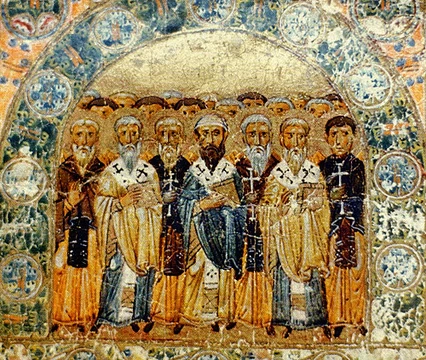
Clement of Rome
Early Bishop of Rome and Apostolic Father.
Last updated
The late first-century Bishop of Rome, Clement I, is regarded as the initial figure among the Apostolic Fathers.[1]
Last updated 2026-10-04 from the source article.
Life and work
According to Tertullian, Saint Peter ordained Clement, and early episcopal lists rank him as either the second or third bishop of Rome.[2] Clement's sole authentic surviving work is his epistle to the Corinthian church (1 Clement), composed to address a conflict where certain presbyters had been removed from office.[3] A second document, 2 Clement, was historically attributed to him, but current scholarly consensus identifies it as a sermon composed by a different writer.[3] Clement probably perished while in banishment, and it is possible he suffered martyrdom.[4]
Apocryphal narratives from the 4th century, such as those by Rufinus, describe Clement being jailed under Emperor Trajan and then killed by being fastened to an anchor and cast into the sea.[4]
What the cited sources add
The Orthodox Church in America account states that Clement was born at Rome into a rich and illustrious family and was raised by strangers.[5] According to the same source, Clement was baptized by the Apostle Peter and became his zealous disciple and constant companion.[5] The account also notes that after the death of the Apostle Peter, Saint Linus was the next Bishop of Rome, succeeded by Saint Anacletus, and then Saint Clement.[5] The Orthodox Church in America describes that Clement was banished to the Crimea to work at a stone quarry, where he found many Christian believers sentenced to labor under harsh conditions.[5]
The account further relates that Clement's apostolic activity aroused the wrath of Emperor Trajan, who ordered that Clement be drowned.[5] According to the Christian Iconography source, the remains of Clement are now interred with honor in the basilica named for him, having been transported there by Cyril and Methodius.[6] That same source indicates that the Anchored Cross, also called the Mariner's Cross, is known as St. Clement's Cross because it symbolizes the method of his execution.[7][6]
References
- Wikipedia, "Clement of Rome" (CC BY-SA 4.0) en.wikipedia.org
- Wikipedia, "Clement of Rome" (CC BY-SA 4.0), which cites: Tertullian, "De Praescriptione Haereticorum", The Theatre, 1722; Cross, "The Oxford Dictionary of the Christian Church", Oxford University Press, 2005, p. 363 (we also read that source) en.wikipedia.org
- Wikipedia, "Clement of Rome" (CC BY-SA 4.0), which cites: Cross, "The Oxford Dictionary of the Christian Church", Oxford University Press, 2005, p. 363; Cross, "The Oxford Dictionary of the Christian Church", Oxford University Press, 2005, p. 363 (original not read by us) en.wikipedia.org
- Wikipedia, "Clement of Rome" (CC BY-SA 4.0), which cites: ; Tyrannius Rufinus, "The Martyrdom of Clement - an English Translation", Early Church Texts, 2024 (we also read that source) en.wikipedia.org
- "Hieromartyr Clement, Pope of Rome", The Orthodox Church in America, 2024. facts only, no text reused. oca.org
- Stracke, "Saint Clement: The Iconography", Christian Iconography, 20 October 2015. facts only, no text reused. christianiconography.info
- Wikipedia, "Clement of Rome" (CC BY-SA 4.0), which cites: Stracke, "Saint Clement: The Iconography", Christian Iconography, 20 October 2015 (we also read that source) en.wikipedia.org
Each numbered sentence above was checked against the source it cites before publication. Sentences citing Wikipedia adapt text from the English Wikipedia article Clement of Rome (contributors), used under CC BY-SA 4.0; this entry is available under the same licence. Other sources were used for facts only; no text or images are copied from them.
More in Early Church Fathers And Saints
Related in Early Church Fathers And Saints
Links follow this subject's own source article.
Sources
Compiled from Wikipedia and the sources listed below. Text from Wikipedia is available under CC BY-SA 4.0; this entry is adapted from it.
- Wikipedia: Clement of Rome (CC BY-SA 4.0).
Spotted an error? Know more?
Reader corrections go straight into our review queue. Suggest an edit · How this site is sourced