Tang dynasty

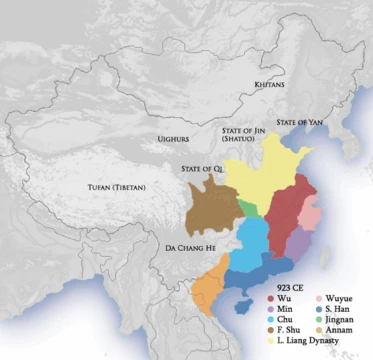
The Tang dynasty governed China from 618 until 907, with a break between 690 and 705. It came after the Sui dynasty and gave way to the Five Dynasties and Ten Kingdoms period. Most historians see the Tang as a peak in Chinese civilization, a cosmopolitan golden age. Through early military campaigns, its rulers gained territory that exceeded the Han dynasty’s reach. The Li family founded the dynasty by exploiting Sui decline, pushing it to collapse, and then starting a period of progress and stability in the first half of their rule. Empress Wu Zetian formally interrupted the dynasty from 690 to 705, taking the throne, creating the Wu Zhou dynasty, and becoming China’s only legitimate female emperor. The An Lushan rebellion (755–763) caused devastation and weakened central authority in the dynasty’s later half. The Tang kept a civil-service system by recruiting scholar-officials through standard exams and recommendations. In the 9th century, regional military governors called *jiedushi* rose up and eroded this civil order. The dynasty and central government declined in the latter part of the 9th century; agrarian rebellions led to massive population loss and displacement, widespread poverty, and more government dysfunction, finally ending the dynasty in 907. For much of the dynasty, the Tang capital at Chang’an (now Xi’an) was the world’s most populous city. Two censuses in the 7th and 8th centuries put the empire’s population at around 50 million, which grew to an estimated 80 million by the dynasty’s end. The Tang raised professional and conscripted armies of hundreds of thousands to fight nomadic powers for control of Inner Asia and the profitable Silk Road trade routes. Distant kingdoms and states paid tribute to the Tang court, and the Tang indirectly controlled several regions through a protectorate system. Beyond political dominance, the Tang had a strong cultural impact on neighboring East Asian nations like Japan and Korea. Chinese culture thrived and matured during the Tang era. It is traditionally seen as the greatest age for Chinese poetry. Two of China’s most famous poets, Li Bai and Du Fu, lived in this period, contributing along with poets like Wang Wei to the monumental *Three Hundred Tang Poems*. Many renowned painters—such as Han Gan, Zhang Xuan, and Zhou Fang—were active, and Chinese court music flourished with instruments like the popular pipa. Tang scholars compiled a rich variety of historical literature, encyclopedias, and geographical works. Notable innovations included the development of woodblock printing. Buddhism became a major influence in Chinese culture, with native Chinese sects gaining prominence. However, in the 840s, Emperor Wuzong enacted policies to suppress Buddhism, which then declined in influence. **History**
**Establishment**
Emperor Gaozu (born Li Yuan) founded the Tang dynasty. He was previously the Duke of Tang and governor of Taiyuan, the capital of modern Shanxi, during the Sui dynasty’s collapse (581–618). The House of Li had ethnic Han origins and belonged to the northwest military aristocracy common under the Sui. According to official Tang records, they were paternally descended from Laozi (the traditional founder of Taoism, whose personal name was Li Dan or Li Er), the Han dynasty general Li Guang, and Li Gao, founder of the Han-ruled Western Liang kingdom. This family was known as the Longxi Li lineage, which also included the prominent Tang poet Li Bai. The Tang emperors were partially of Xianbei ancestry, since Emperor Gaozu’s mother, Duchess Dugu, was part-Xianbei. Some historians argue that the Tang imperial family’s ties to the distinguished Longxi Li clan of Han descent may be fabricated. Howard J. Wechsler notes that it has been suggested the Tang House of Li descended from a minor offshoot of the eastern Li clan of Zhaojun in Hebei, which had intermarried substantially with non-Han tribal aristocracy. Chen Sanping argues that the House of Li had a patrilineal Xianbei lineage that was concealed by modifying their genealogy. This argument is partly based on a comparison with Li Xian, a Northern Zhou general whose epitaph states he was descended from both the Han dynasty general Li Ling and Yidigui, a 10th-generation ancestor from the steppes. However, a genetic study of the daughter of the Duke of Longxi (Li Hu), the Tang founder’s paternal grandfather, and her nuclear family shows they were primarily related to agricultural farming communities in northern China (95.8%–97.3%), with minor admixture from Eurasian Steppe pastoralists (2.7%–4.2%). The family’s haplogroups are common in Han and East Asian populations and atypical in Xianbei individuals. Despite possessing Xianbei names (Bulugu and Daye), the findings suggest they did not have true Xianbei ancestry, reflecting the historical policy of granting Xianbei names to Han aristocrats in Western Wei. Li Yuan had prestige and military experience, and was a first cousin of Emperor Yang of Sui (their mothers were both Dugu sisters). Li Yuan rose in rebellion in 617, along with his son and his equally militant daughter Princess Pingyang (d. 623), who raised and commanded her own troops. In winter 617, Li Yuan occupied Chang’an, relegated Emperor Yang to the position of *Taishang Huang* (‘retired emperor’), and acted as regent to the puppet child-emperor Yang You. Upon news of Emperor Yang’s murder by General Yuwen Huaji on June 18, 618, Li Yuan declared himself emperor of the newly founded Tang dynasty.
- died
- 907 (end of dynasty)
- field
- Imperial dynasty
- nationality
- Chinese
- known_for
- Golden age of Chinese civilisation, cosmopolitan culture, poetry, woodblock prin
Lore & Background
The Li family founded the dynasty after taking advantage of a period of Sui decline and precipitating their final collapse. Emperor Gaozu (born Li Yuan) was the founder, previously the Duke of Tang and governor of Taiyuan. In winter 617, Li Yuan occupied Chang'an, and on news of Emperor Yang's murder on June 18, 618, he declared himself emperor. His son Li Shimin, known by his temple name Taizong, deposed him in 626 after the Xuanwu Gate Incident, where he killed two brothers. Taizong proved a capable leader who listened to the wisest members of his council. During the Tang campaign against the Eastern Turks, the Eastern Turkic Khaganate was destroyed after the capture of its ruler, Illig Qaghan, by the famed Tang military officer Li Jing. With this victory, the Turks accepted Taizong as their khagan, a title rendered as Tian Kehan. Under Emperor Gaozong, the Western Turkic Khaganate was finally annexed after General Su Dingfang's defeat of Khagan Ashina Helu in 657. The dynasty was formally interrupted from 690 to 705 when Empress Wu Zetian seized the throne, proclaiming the Wu Zhou dynasty and becoming the only legitimate Chinese female emperor. A palace coup on February 20, 705, forced her to yield; the Tang was formally restored on March 3.
Reader's Guide
The Tang dynasty is significant as a high point of Chinese civilisation, marked by a golden age of cosmopolitan culture. Its territory surpassed that of the Han dynasty, and its capital Chang'an was the world's most populous city for much of its existence. Two censuses of the 7th and 8th centuries estimated the empire's population at about 50 million people, which grew to an estimated 80 million by the dynasty's end. The dynasty maintained a civil-service system by recruiting scholar-officials through standardised examinations and recommendations to office, though the rise of regional military governors known as jiedushi during the 9th century undermined this civil order. Chinese culture flourished, especially poetry, with famous poets Li Bai and Du Fu, along with Wang Wei, contributing to the Three Hundred Tang Poems. Painters such as Han Gan, Zhang Xuan, and Zhou Fang were active, and Chinese court music flourished with instruments such as the popular pipa. Notable innovations included the development of woodblock printing. Buddhism became a major influence in Chinese culture, with native Chinese sects gaining prominence, though in the 840s, Emperor Wuzong enacted policies to suppress Buddhism, which subsequently declined in influence. The An Lushan rebellion (755–763) led to devastation and the decline of central authority during the latter half of the dynasty. Agrarian rebellions resulted in mass population loss and displacement, widespread poverty, and further government dysfunction that ultimately ended the dynasty in 907. The Tang exerted a powerful cultural influence over neighbouring East Asian nations such as Japan and Korea.
Did You Know?
- The Tang dynasty was formally interrupted from 690 to 705 when Empress Wu Zetian became the only legitimate Chinese female emperor, proclaiming the Wu Zhou dynasty.
- Emperor Taizong was accepted as khagan of the Turks after the destruction of the Eastern Turkic Khaganate, holding the title Tian Kehan alongside his rule as Son of Heaven.
- The Tang capital Chang'an was the world's most populous city for much of the dynasty's existence.
- Two of China's most famous poets, Li Bai and Du Fu, belonged to the Tang era, contributing to the Three Hundred Tang Poems.
- The An Lushan rebellion (755–763) led to devastation and the decline of central authority during the latter half of the dynasty.
Frequently Asked Questions
What is Tang dynasty known for?
Tang is celebrated as a golden age of Chinese civilisation, renowned for its cosmopolitan culture, poetry, woodblock printing, and sweeping territorial expansion. Its early rulers waged military campaigns that pushed the dynasty's borders well beyond those of the earlier Han dynasty.
How does Tang dynasty's story end?
The dynasty's rule concluded in 907, after which China fractured into the Five Dynasties and Ten Kingdoms period. This marked the close of roughly three centuries of Tang imperial governance over the region.
Why is Tang dynasty important?
Historians broadly regard the Tang as a high point in Chinese civilisation, representing a peak of cosmopolitan culture and artistic achievement. Its lasting legacy in poetry, printing technology, and territorial reach shaped the trajectory of subsequent Chinese history.
More in Dynasties And Kingdoms 1-19
Spotted an error? Know more?
This is a living reference — every entry is fact-audited, and reader corrections feed straight into our audit queue. Suggest an edit · See this site's audit record