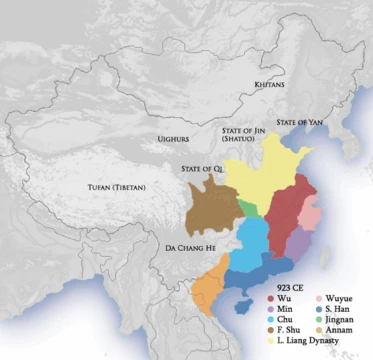
Five Dynasties and Ten Kingdoms period
An era of division and warfare in Imperial China.

Between 907 and 979 CE, China fragmented into a period known as the Five Dynasties and Ten Kingdoms. In the Central Plain, five ruling houses rose and fell in quick succession. Meanwhile, over a dozen other states—the ten most powerful of which are called the Ten Kingdoms—emerged, mostly in the south. This era is traditionally marked as starting with the Tang dynasty's collapse in 907 and culminating with the Song dynasty's founding in 960. Over the next 19 years, the Song gradually absorbed the remaining southern states, though the Liao dynasty held the north (later succeeded by the Jin), and the Western Xia eventually formed in the northwest.
Many of these states had been effectively independent well before 907, as the late Tang lost control over its regional military governors, known as *jiedushi*. The key turning point was when foreign powers recognized these regimes as sovereign. After the Tang fell, several warlords in the Central Plain declared themselves emperors. For roughly 70 years, near-constant warfare raged between these kingdoms and their shifting alliances, all aiming to seize the Central Plain and claim legitimacy as the Tang's successor. The last regime to fall was the Northern Han, conquered by the Song in 979. For centuries afterward, the Song controlled most of the south but coexisted with the Liao, Jin, and other northern regimes until the Yuan dynasty eventually conquered them all.
**Background**
The An Lushan Rebellion (755–763) and the Huang Chao Rebellion weakened the Tang imperial government in the 8th century. As central authority declined after An Lushan, large regional administrations called circuit commissions began to overlay the old districts and prefectures that had been standard since the Qin dynasty (221–206 BCE). These circuits later became the boundaries of the southern kingdoms, and many circuit commissioners became their emperors or kings. By the early 10th century, the Tang court granted increasing power to the *jiedushi*—regional military governors who operated independently. They were no longer appointed by the central government, instead passing their positions hereditarily, from father to son or patron to protégé. They commanded armies that rivaled the palace troops and amassed great wealth, evident from their lavish tombs.
Historian Hugh Clark outlines three stages of political trends during this period. First (880–910), between the Huang Chao Rebellion and the Tang's formal end, warlords controlling one or two prefectures each fought chaotically. Second (910–950), these warlords stabilized and gained enough legitimacy to proclaim new dynasties. Third (950–979), the Later Zhou and its successor, the Song, forcefully reunified China and demilitarized the provinces. In this model, southern China—divided into several independent kingdoms—was more stable than the north, which saw constant regime change. The southern kingdoms could therefore pursue trade, land reclamation, and infrastructure projects, laying the groundwork for the Song economic boom. This economic shift also drove a large southward migration.
**North**
According to Nicholas Tackett, three Hebei provinces—Chengde, Youzhou, and Weibo—maintained much greater autonomy after the An Lushan rebellion. Under local military control, they never paid taxes, and governorships became hereditary. They occasionally fought the central government or each other, and Youzhou conducted its own foreign policy. This caused the culture of these northeastern provinces to diverge from the capital. Many elites in post-Tang China, including future Song emperors, came from this region. The administrations of the Five Dynasties and early Song were disproportionately drawn from military governor families in northern and northwestern China (Hebei, Shanxi, Shaanxi), their personal staffs, and bureaucrats who served in the Five Dynasties' capitals. These families rose to prominence as central authority unraveled after the An Lushan Rebellion, despite lacking prestigious ancestry. Historian Deng Xiaonan argued that many of these military families, including the Song imperial family, were of mixed Han Chinese, Turkic, and Kumo Xi ancestry.
The term "Five Dynasties" was coined by Song historians, reflecting the view that the successive regimes based in Kaifeng controlled the Central Plain and held the Mandate of Heaven. The first of the Five Dynasties was founded by Zhu Wen, a rebel defector turned warlord who ended the Tang. The remaining Five Dynasties, as well as the Song, all emerged from a military organization originally led by Shatuo Turks, whose commanders replaced each other in frequent coups. The Later Tang was founded by Li Cunxu, son of Shatuo leader Li Keyong, who was Zhu Wen's main military rival in the late Tang. The Later Jin founder Shi Jingtang was the son of a Shatuo commander in Li Keyong's army and became the son-in-law of the Later Tang general and emperor Li.
- start
- 907 CE
- end
- 979 CE
- preceded_by
- Tang dynasty
- followed_by
- Song dynasty
- region
- Imperial China
- key_feature
- Political upheaval and division
Lore & Background
The era is traditionally seen as beginning with the fall of the Tang dynasty in 907 and reaching its climax with the founding of the Song dynasty in 960. In the following 19 years, Song gradually subdued the remaining states, culminating with the conquest of the northern state of Northern Han in 979, but the Liao dynasty still remained in China's north, and the Western Xia was eventually established in China's northwest. Many states had been de facto independent long before 907 as the late Tang dynasty's control over its numerous fanzhen officials waned, but the key event marking the start of the period was the formal end of the Tang dynasty and the establishment of the Later Liang in 907. After the Tang collapsed, several warlords of the Central Plain crowned themselves emperor. During the 70-year period, there was near-constant warfare between the emerging kingdoms and the alliances they formed. All had the ultimate goal of controlling the Central Plain and establishing themselves as the Tang's successor.
Reader's Guide
The Five Dynasties and Ten Kingdoms period represents a critical transitional phase in Chinese history, bridging the Tang and Song dynasties. The term 'Five Dynasties' was coined by Song dynasty historians and reflects the view that the successive regimes based in Kaifeng controlled the Central Plain and possessed the Mandate of Heaven. The first of the Five Dynasties was founded by Zhu Wen, the rebel defector turned warlord who ultimately ended the Tang dynasty. The rest of the Five Dynasties as well as the Song dynasty all emerged from a military organization originally led by Shatuo Turks whose commanders replaced each other in frequent coup d'état. The Southern regimes generally had more stable and effective government during this period, allowing them to embark on trade, land reclamation, and infrastructure projects, laying the groundwork for the Song Dynasty economic boom. This economic shift to the south also led to a vast southward migration. The last of the Five Dynasties and Ten Kingdoms regimes was Northern Han, which held out until Song conquered it in 979. For the next several centuries, although the Song controlled much of South China, they coexisted alongside the Liao dynasty, Jin dynasty, and various other regimes in China's north, until finally all of them were conquered by the Yuan dynasty.
Did You Know?
- The era lasted from 907 to 979 CE.
- The term 'Five Dynasties' was coined by Song dynasty historians.
- The last regime to fall was Northern Han, conquered by Song in 979.
- Southern kingdoms were more stable than the North and engaged in trade and infrastructure projects.
Frequently Asked Questions
What is the Five Dynasties and Ten Kingdoms period?
It was a turbulent stretch of Chinese history from 907 to 979 CE in which the empire broke apart into multiple rival states. In the northern Central Plain, five short-lived dynasties rose and fell in quick succession, while roughly a dozen other kingdoms — the ten most prominent being the so-called Ten Kingdoms — held territory across southern China.
What defines the Five Dynasties and Ten Kingdoms period's political structure?
The era is marked by simultaneous fragmentation, with five successive dynastic regimes controlling the northern heartland while ten major kingdoms operated independently in the south. This made it one of the longest stretches of divided rule in Chinese imperial history.
How does the Five Dynasties and Ten Kingdoms period come to an end?
The period concluded in 979 CE when the Song dynasty finished its reunification campaign by conquering the last remaining southern kingdom. That victory ended the era of multiple rival states and restored a single imperial authority over China.
Why is the Five Dynasties and Ten Kingdoms period historically significant?
It represents a prolonged interval of upheaval and warfare that shattered the centralized order inherited from the Tang dynasty. The chaos and regional autonomy of this era directly shaped the institutional reforms and military strategies of the Song dynasty that followed.
What precedes and follows the Five Dynasties and Ten Kingdoms period?
It immediately followed the collapse of the Tang dynasty and was succeeded by the reunified Song dynasty. The transition marks a shift from a single imperial power to fragmented multi-state rule and back to centralized governance.
More in Dynasties And Kingdoms 1-19
Spotted an error? Know more?
This is a living reference — every entry is fact-audited, and reader corrections feed straight into our audit queue. Suggest an edit · See this site's audit record