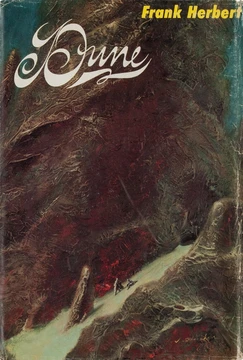
Heretics of Dune
Fifth Dune novel, set 1,500 years after God Emperor.

Heretics of Dune, published in 1984, is the fifth novel in Frank Herbert’s six-book Dune series. The story takes place 1,500 years after the events of *God Emperor of Dune* (1981). Humanity is following the course set by the tyrant Leto II Atreides to ensure its survival, but a new danger emerges: the Honored Matres, a violent matriarchy from outside the known universe that seeks only conquest and destruction.
Fifteen centuries after the God Emperor’s 3,500-year rule ended with his assassination, humanity is firmly on the Golden Path, Leto’s plan to save the species. By crushing human ambition for millennia and dismantling the spice-based economy, Leto triggered the Scattering—an explosion of humanity into the cosmos after his death. Sandworms have returned to Arrakis (now called Rakis), restoring the flow of spice. Three powers dominate: the Ixians, with their undetectable no-ships; the Bene Tleilax, who manufacture spice in axlotl tanks and have created new Face Dancers; and the Bene Gesserit, a matriarchal order of subtle manipulators with superhuman abilities. But people from the Scattering are returning with strange powers, most notably the Honored Matres, a society of women bred for combat and sexual control of men.
Bene Gesserit Mother Superior Taraza recalls Mentat and former Supreme Bashar Miles Teg from retirement to protect a new Tleilaxu-provided Duncan Idaho ghola on Gammu (formerly Giedi Prime). She also sends Imprinter Lucilla to train Duncan and bind his loyalty through sexual imprinting. Meanwhile, Teg’s biological daughter, Reverend Mother Darwi Odrade, takes command of the Bene Gesserit keep on Rakis. There, the Sisterhood discovers Sheeana, an orphan girl who can control giant sandworms, and hopes to control her and the religion forming around her. After thwarting an attack on Sheeana, Odrade trains her and finds a huge spice hoard left by Leto, along with a message urging the Bene Gesserit to find noble purpose.
When an assassination attempt targets Duncan, Lucilla and Teg flee with him into the countryside, hiding in an old Harkonnen no-globe. Teg awakens Duncan’s original memories before Lucilla can imprint him. Teg is captured by Honored Matres and tortured with a T-Probe, but under pressure he discovers new abilities—enhanced physical powers and a strange prescience—which he uses to escape and capture a no-ship with old comrades.
Quick Facts
- Author
- Frank Herbert
- Audio Read By
- Simon Vance
- Cover Artist
- Abe Echevarria
- Country
- United States
- Language
- English
- Series
- Dune series
- Genre
- Science fiction
- Published
- 1984
- Publisher
- Putnam
- Media Type
- Print (hardcover & paperback)
- Pages
- 480
- Isbn
- 0-399-12898-0
Facts from the source article.
Lore & Background
Fifteen hundred years after the 3,500-year reign of the God Emperor Leto II Atreides ended with his assassination, humanity is firmly on the Golden Path, Leto's plan to save humanity from destruction. By crushing the aspirations of humans for over three thousand years and dismantling the complex economic system dependent on the spice melange, Leto caused the Scattering, an explosion of humanity into the rest of the universe upon his death. Sandworms have reappeared on Arrakis (now called Rakis), and have renewed the flow of the all-important spice to the galaxy. A new civilization has risen, with three dominant powers: the Ixians, whose no-ships are capable of piloting between the stars and are invisible to outside detection; the Bene Tleilax, who have learned to manufacture spice in their axlotl tanks and have created a new breed of Face Dancers; and the Bene Gesserit, a matriarchal order of subtle political manipulators who possess superhuman abilities. However, people from the Scattering are returning with their own peculiar powers. The most powerful of these forces are the Honored Matres, a violent society of women bred and trained for combat and the sexual control of men.
Reader's Guide
Heretics of Dune continues the Dune saga by exploring the consequences of Leto II's Golden Path and the Scattering. The novel introduces the Honored Matres as a new antagonist, a brutal matriarchy from beyond the known universe. The plot follows the Bene Gesserit's efforts to control the orphan girl Sheeana, who can control giant sandworms, and the return of the Duncan Idaho ghola. The novel was ranked as the No. 13 hardcover fiction best seller of 1984 by The New York Times. Kirkus Reviews described it as 'another uneven entry, slow to start and hastily, rather abruptly concluded—but more exciting and adventurous than any since the original Dune, with a gratifying influx of new ideas.' The novel sets up the final book in the series, Chapterhouse: Dune.
Did You Know?
- Frank Herbert wrote much of the initial draft in Hawaii using a Compaq word processor.
- Herbert's time writing the draft was 'exceedingly arduous and much slower' due to tending to his wife Beverly's medical crises.
- The novel features the return of sandworms on Arrakis, now called Rakis.
The Galaxy After the God Emperor
Fifteen centuries after the assassination of Leto II Atreides, whose 3,500-year reign shaped all of human history, the galaxy of Heretics of Dune is a transformed place. Leto's deliberate suppression of human ambition and his dismantling of the spice-dependent economy culminated in the Scattering, an explosive dispersal of humanity across the wider universe. On Arrakis, now renamed Rakis, sandworms have returned and the flow of melange has resumed, sustaining a new galactic civilization. Three powers dominate this era: the Ixians, whose stealthy no-ships travel between stars undetected; the Bene Tleilax, who have developed artificial spice production in axlotl tanks and engineered a new generation of Face Dancers; and the Bene Gesserit, a matriarchal order wielding subtle political influence and superhuman abilities. Yet the returning Scattered peoples bring their own extraordinary gifts, and among them lurks the most dangerous force the known universe has ever faced.
The Honored Matres and the Central Conflict
The Honored Matres arrive as the novel's central threat, a brutal matriarchal society from beyond the known universe whose sole purposes are conquest and destruction. Bred and trained exclusively for combat and the sexual domination of men, they represent a force utterly alien to the political machinations of the established powers. Their invasion shatters the careful balance between the Ixians, the Bene Tleilax, and the Bene Gesserit. The conflict forces unlikely alliances and desperate gambits: Mother Superior Taraza schemes to manipulate the Tleilaxu into an alliance that ultimately serves the Sisterhood's interests, while Reverend Mother Odrade sees through her plan and kills both Taraza and Tleilaxu Master Waff. Miles Teg, pulled from retirement, discovers prescient abilities under torture and leads a suicidal defense of Rakis designed to provoke the Matres into destroying the planet and its sandworms. Meanwhile, Duncan Idaho's ghola, Sheeana the worm-tamer, and the young Matre Murbella become entangled in a web of loyalty, memory, and survival that stretches across the galaxy.
The Creative Struggle Behind the Novel
Frank Herbert composed much of the initial draft of Heretics of Dune in Hawaii, working on a Compaq word processor. The process was, by his own son Brian's account, exceedingly arduous and much slower than Herbert's typical writing pace. The cause was personal and painful: Herbert spent considerable time away from his study tending to the medical crises of his wife, Beverly Herbert. This domestic burden weighed heavily on the creative process, slowing the production of what would become the fifth installment in his six-novel Dune saga. The novel was published in 1984, and despite the difficult circumstances of its creation, it managed to capture the attention of both critics and readers. Its placement as the penultimate book in the series meant it carried the weight of resolving long-running plot threads while still setting the stage for the final volume. The Hawaii setting and the Compaq word processor offer a small but humanizing glimpse into the behind-the-scenes reality of producing a major science fiction work during the early days of personal computing.
Critical Reception and Commercial Standing
Upon its 1984 release, Heretics of Dune achieved notable commercial success, earning a position as the No. 13 hardcover fiction best seller of the year according to The New York Times. Critically, the reception was mixed but generally positive. Kirkus Reviews acknowledged the novel as another uneven entry, slow to start and hastily, rather abruptly concluded, yet praised it as more exciting and adventurous than any since the original Dune, with a gratifying influx of new ideas. This assessment captures a common thread in reviews of the later Dune novels: the series had expanded its scope dramatically, introducing entirely new factions, powers, and conflicts while maintaining the thematic DNA of the original. As the fifth of six books, Heretics of Dune occupied a particular narrative position, resolving the immediate threat of the Honored Matres while deepening the mystery of Leto's Golden Path. The novel's blend of political intrigue, action, and speculative worldbuilding, even in its uneven moments, helped sustain the Dune franchise's readership through to its conclusion.
Frequently Asked Questions
What is Heretics of Dune?
Heretics of Dune is the fifth novel in Frank Herbert's six-book Dune saga, published in 1984. It is set fifteen centuries after the assassination of the God Emperor Leto II and follows humanity as it continues along the survival course he engineered.
Who are the Honored Matres in Heretics of Dune?
The Honored Matres are a savage matriarchal warrior caste hailing from beyond the known universe, driven by a singular desire for conquest and annihilation. They serve as the novel's central external threat, attacking human civilization with relentless brutality.
How does Heretics of Dune end?
The story closes with humanity weathering the Honored Matres' devastating assault, thanks in large part to the coordinated efforts of figures like Shadama, Shaddam IV, and the Bene Gesserit. The Golden Path survives intact, setting the stage for the series finale, Children of Dune.
Why is Heretics of Dune important to the Dune series?
It bridges the fifteen-hundred-year narrative gap between God Emperor of Dune and the final book, showing how Leto II's deliberate suppression of human ambition still shapes civilization millennia later. The novel also introduces the Honored Matres, a threat that forces characters to confront whether the Golden Path can withstand an enemy from outside the galaxy.
What is the Golden Path in Heretics of Dune?
The Golden Path is the vast, millennia-long strategy that the late God Emperor Leto II designed to steer humanity toward long-term species survival. In this novel, the human galaxy is firmly locked into that prescribed trajectory, and the plot hinges on whether an alien invasion can derailed it.
More in Dune novels 1-24
Spotted an error? Know more?
Reader corrections go straight into our review queue. Suggest an edit · How this site is sourced