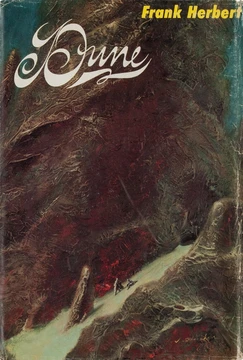
Dune Messiah
Sequel to Dune, exploring Paul Atreides' troubled reign.

Dune Messiah, the second novel in Frank Herbert’s six-book Dune series, was published in 1969. The American science fiction writer had already serialized the story in five installments of *Galaxy* magazine that same year before Putnam released it as a book. Picking up where *Dune* (1965) left off, the novel follows Emperor Paul Atreides twelve years into his rule. Having accepted the role of messiah to the Fremen, Paul has triggered a jihad that has conquered most of the known universe, killing 61 billion people. He sees in his prescient visions that this outcome is not the worst possible for humanity, so he allows the war to continue, focusing on reforming the Empire and securing his dynasty while remaining the focal point of the Fremen religion.
A conspiracy to dethrone Paul involves the Bene Gesserit, the Spacing Guild, and the Tleilaxu. The Guild Navigator Edric uses his own prescience to shield their meetings—attended by Reverend Mother Mohiam and Tleilaxu Face Dancer Scytale—from Paul’s visions. Mohiam recruits Princess Irulan, daughter of the deposed Emperor Shaddam IV, who is married to Paul for political reasons. Paul refuses to father a child with Irulan, and his Fremen concubine Chani has also failed to produce an heir, creating tension. Desperate to secure her place and preserve the Bene Gesserit breeding program, Irulan secretly gives Chani contraceptives. Paul knows this but has foreseen that his heir’s birth will kill Chani, and he does not want to lose her.
The conspirators give Paul a ghola named Hayt, a reanimated being made by the Tleilaxu in the image of his deceased teacher and friend Duncan Idaho. They hope the ghola will weaken Paul’s rule by disconcerting him and appealing to his emotions. Accepting the gift also costs Paul support among the Fremen, who view the Tleilaxu and their creations as unclean. Chani switches to a traditional Fremen fertility diet to prevent Irulan from tampering with her food, and she becomes pregnant. However, the prolonged contraceptive use has weakened her, endangering the pregnancy.
Paul learns of a Fremen conspiracy against him but sees a Tleilaxu plot beneath it. As his soldiers move against the conspirators, a Tleilaxu atomic weapon called a stone burner destroys the area, maiming or killing many soldiers and blinding Paul.
Quick Facts
- Author
- Frank Herbert
- Audio Read By
- Scott Brick / Katherine Kellgren / Euan Morton / Simon Vance
- Cover Artist
- Jack Gaughan
- Country
- United States
- Language
- English
- Series
- Dune
- Genre
- Science fiction
- Published
- 1969
- Publisher
- Putnam Publishing
- Media Type
- Print (hardcover & paperback)
- Pages
- 256
- Oclc
- 32595
Facts from the source article.
Lore & Background
Paul 'Muad'Dib' Atreides has ruled as Emperor for 12 years. By accepting the role of messiah to the Fremen, he has unleashed a jihad which has conquered most of the known universe but is powerless to stop the lethal excesses of the religious juggernaut he has created. Although 61 billion people have perished, Paul's prescient visions indicate this is far from the worst possible outcome for humanity. Motivated by this knowledge, Paul allows the war to continue and maintains his role as a focal point for the Fremen religion while turning his attention to reforming the Empire and entrenching his dynasty.
Reader's Guide
Dune Messiah serves as an inversion of the heroic narrative of Dune, as Frank Herbert likened the initial trilogy to a fugue where Dune was a heroic melody and Dune Messiah its inversion. The novel undermines Paul's triumph with a string of failures and philosophical paradoxes. Critical reception was mixed: Galaxy Science Fiction called it 'Brilliant,' while Brian Herbert noted it 'hadn’t been favorably received by the critics,' with sales coming 'on the coattails of Dune.' The novel was adapted as part of the 2003 Sci-Fi Channel miniseries Frank Herbert's Children of Dune, and a film adaptation directed by Denis Villeneuve, Dune: Part Three, is scheduled for 2026.
Did You Know?
- Parts of Dune Messiah were written prior to the completion of Dune itself.
- The novel appeared initially as a five-part serial in Galaxy Science Fiction magazine from July to November 1969.
- David Lynch planned a sequel to his 1984 Dune film based on Dune Messiah, but it did not proceed after the critical and commercial failure of Dune.
- Dune Messiah and Children of Dune were published in a single volume by the Science Fiction Book Club in 2002.
The Burden of the Prophet King
Paul Atreides sits on the imperial throne twelve years after accepting the Fremen's messianic title, a decision that set in motion a holy war consuming most of the known universe. Sixty-one billion lives have been lost, yet his prescient visions tell him this carnage is still a comparatively gentle fate for humanity. Rather than attempting to halt the jihad, Paul permits it to rage on, reasoning that the worst scenarios he glimpses are far worse. He continues to serve as the living center of Fremen devotion while quietly working to reshape the Empire and lock down his dynasty's hold on power. His personal life, however, is a source of quiet anguish. He knows his political wife Irulan has been secretly dosing his Fremen concubine Chani with contraceptives, yet he cannot bring himself to father a child with her. His visions have shown him that the birth of their heir will cost Chani her life, and he refuses to trade her survival for a successor. This tension between prophecy and love becomes the emotional core of his reign.
The Three-Power Conspiracy
The Bene Gesserit, the Spacing Guild, and the Tleilaxu unite in a covert plot to unseat Paul, a scheme made possible by Guild Navigator Edric, whose own prescient abilities allow him to cloak their clandestine meetings from Paul's all-seeing visions. Reverend Mother Mohiam recruits Princess Irulan, Paul's politically arranged wife, who has been covertly administering contraceptives to Chani in a bid to secure her own place in the Atreides line and preserve the bloodline for the sisterhood's breeding program. The Tleilaxu contribution is the ghola Hayt, a reanimated construct built in the likeness of Duncan Idaho, Paul's beloved childhood mentor. The conspirators calculate that this uncanny gift will unsettle Paul emotionally and erode his standing among the Fremen, who regard Tleilaxu artifacts as unclean. Posing as a dwarf servant, the Tleilaxu agent Bijaz secretly implants a kill command in Hayt's neural architecture, a failsafe designed to eliminate Paul at the most vulnerable moment. The entire operation is a layered trap, each faction contributing a different piece while keeping their true aims hidden from the others.
Chani's Sacrifice and the Prophet's Fall
Chani, determined to protect her pregnancy from Irulan's interference, switches to a traditional Fremen fertility diet, but the prolonged contraceptive exposure has left her body dangerously fragile. During the birth, her weakened frame gives way and she dies. Before her final breath, she delivers twins, both carrying full access to ancestral memories of both sexes. The son is an entirely unforeseen child; Paul's visions had shown him only a daughter. The trauma of her death triggers the hidden command in Hayt, but the ghola's body resists the kill order, and the shock restores Duncan Idaho's full consciousness, freeing him from Tleilaxu control. In the chaos, Scytale draws a knife against the infants, demanding Paul's abdication and surrender of all CHOAM holdings. Paul, now completely blind in the physical sense, kills Scytale with a dagger to the eye, guided by a vision seen through his newborn son's eyes. Stripped of his prophetic sight and his physical sight alike, Paul embraces the Fremen tradition of the blind and walks alone into the desert, securing the loyalty of his people for the twins he names Leto and Ghanima.
From Magazine Pages to the Silver Screen
Frank Herbert had already drafted portions of Dune Messiah before he finished the original Dune, and the sequel first reached readers as a five-part serial in Galaxy Science Fiction magazine between mid-summer and late autumn of 1969, accompanied by illustrations from Jack Gaughan. A hardcover edition from Putnam followed in October of that same year, with the American and British printings distinguished by separate prologue passages that recapped the events of the first novel. Over the decades the book found new life in various collected editions, including a 1979 Gollancz volume pairing it with Dune and Children of Dune as The Great Dune Trilogy, and a 2002 Science Fiction Book Club single-volume release. On screen, Dune Messiah and its sequel were jointly adapted by the Sci-Fi Channel into the 2003 miniseries Frank Herbert's Children of Dune. The story is set to return to the big screen when Denis Villeneuve's Dune: Part Three arrives in 2026, capping a trilogy that began with his 2021 and 2024 films.
Frequently Asked Questions
What is Dune Messiah?
Dune Messiah is the second novel in Frank Herbert's Dune series, released by Putnam in 1969 after a serialization in Galaxy magazine. It picks up twelve years after the first book and follows Emperor Paul Atreides as he struggles to maintain control over the galactic empire his jihad has created.
What is Dune Messiah about?
The story examines the psychological toll of Paul's prescient visions and the political machinations of the Bene Gesserit, who seek to manipulate the Fremen religion from behind the scenes. At its core, the novel interrogates whether a messiah can truly be free when every possible future is already visible to him.
How does Paul Atreides die in Dune Messiah?
Paul is assassinated by his own Fremen, who have been radicalized against him after he refuses to perform a ritual sacrifice demanded by their faith. His death ends the messianic era and leaves the Fremen to find a new identity without their god-king.
How does Dune Messiah end?
The novel closes with Paul's murder and the immediate political chaos that follows, as the Fremen lose their unifying figure and the empire begins to fracture. Herbert leaves the reader with the implication that the Fremen's next great step will be to leave Arrakis entirely.
Why is Dune Messiah important to the Dune series?
It functions as a deconstruction of the hero narrative set up in the first novel, showing the human cost of Paul's rule and the 61 billion lives lost to his jihad. The book also establishes key plot threads—Bene Gesserit scheming, ecological change on Arrakis, and the Fremen's cultural evolution—that carry through the remaining four novels.
More in Dune novels 1-24
Spotted an error? Know more?
Reader corrections go straight into our review queue. Suggest an edit · How this site is sourced