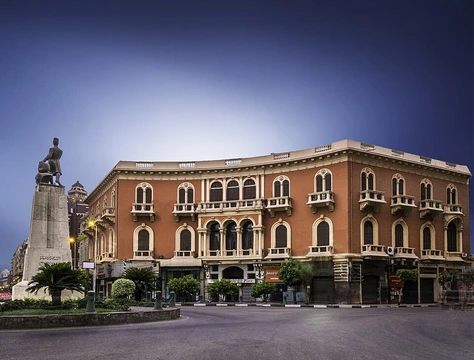
Shepheard's Hotel
Last updated

via Wikipedia: Shepheard's Hotel · see source
For nearly a century, from the middle of the 19th century until its destruction in 1952 during the Cairo Fire, Shepheard's Hotel was the leading hotel in Cairo and one of the most celebrated hotels in the world. It was located across from the Azbakeya Gardens. Five years after the original hotel was destroyed, a new one was built on the bank of the Nile and named the Shepheard Hotel.
Quick Facts
- Established
- 1841
- Original name
- Hotel des Anglais
- Founder
- Samuel Shepheard
- Destruction
- 1952 during the Cairo Fire
- Modern hotel built
- 1957
- Location of original
- Across from Azbakeya Gardens
Facts from the source article.
History
The hotel was originally established in 1841 by Samuel Shepheard under the name "Hotel des Anglais" and was later renamed Shepheard's Hotel. Shepheard, an Englishman from Preston Capes, Northamptonshire, had been described as "an undistinguished apprentice pastry chef." He co-owned the hotel with Mr. Hill, Mohammed Ali Pasha's head coachman. When soldiers staying at the hotel were suddenly moved to Crimea and left unpaid bills, Shepheard travelled personally to Sevastopol to collect payment.
In 1845, Hill gave up his interest, and Shepheard became sole owner. Shepheard sold the hotel in 1861 for £10,000 to the Bavarian hotelier Philip Zech (or Zeck) and retired to Eathorpe Hall, Warwickshire, England. Richard Burton, a close friend, described Shepheard as "a remarkable man in many points, and in all things the model John Bull." The hotel was renovated in 1869 after a fire destroyed the south wing.
By the last decade of the 19th century, the original building was considered dated, and Zech hired the Nuremberg-born German architect Johann Adam Rennebaum to design a new hotel on the same plot. This final building, completed in 1891, is the most famous incarnation. The Arab Hall, also designed by Rennebaum, was added in 1898, with further expansions in 1904, 1909, and 1927. Rennebaum's name was largely omitted from documentation, likely due to a concerted attempt by British colonial authorities after the First World War to erase German influence in Egypt.
Ownership passed to Zech's daughter and her husband, Mr. and Mrs. Kemmerich, who sold the hotel in 1896 to Egyptian Hotels Ltd. That company leased it to the Compagnie Internationale des Grands Hôtels, which was later purchased by the Swiss hotel magnate Karl (Charles) Baehler. Shepheard's Hotel was famed for its grandeur, its guests, and as a base for the military.
In popular culture
Shepheard's Hotel has welcomed a variety of fictional visitors over the years. It appeared in the 1934 British film The Camels Are Coming. The 1996 movie The English Patient set several scenes there, though those were actually shot at The Grand Hotel des Bains in Venice Lido, Italy.
Harry Turtledove's The Race Colonization series uses the hotel as a command center. Agatha Christie placed it in Crooked House and also mentioned it in Death on the Nile. Anthony Trollope's 1861 short story "An Unprotected Female at the Pyramids" references it, and the hotel regularly appears throughout Elizabeth Peters' Amelia Peabody novels.
Modern Shepheard Hotel
The modern Shepheard Hotel was erected in 1957 by Egyptian Hotels Ltd. in Garden City, Cairo, about 0.8 km from the original site. The hotel and land are owned by E.G.O.T.H. (The Egyptian General Company for Tourism & Hotels). It was managed by Helnan International Hotels and known as the Helnan Shepheard Hotel. In 2009, Rocco Forte Hotels announced a complete renovation and planned to reopen in 2012, but the renovations never happened, and the hotel closed in 2014.
In 2020, E.G.O.T.H. signed a $90 million agreement with Saudi Arabia's Al Sharif Group to redevelop the hotel. In 2021, Mandarin Oriental Hotel Group was selected to operate the hotel upon reopening. In 2023, Al Sharif awarded a contract to Cairo-based SIAC Construction to rebuild the hotel.
Did You Know?
- The Suffering bastard cocktail was created at the hotel's bar by bartender Joe Scialom as a hangover cure for allied troops.
- Nazi General Rommel allegedly said, "I'll be drinking champagne in the master suite at Shepheard's soon."
- Harold Macmillan wrote that previous Greek governments-in-exile "have been broken in the bar of Shepheard's."
- The hotel's architect, Johann Adam Rennebaum, was largely omitted from documentation, likely due to British efforts after WWI to erase German influence in Egypt.
More in Downtown Cairo
Sources
Compiled from Wikipedia and the sources listed below. Text from Wikipedia is available under CC BY-SA 4.0; this entry is adapted from it.
- Wikipedia: Shepheard's Hotel (CC BY-SA 4.0).
Spotted an error? Know more?
Reader corrections go straight into our review queue. Suggest an edit · How this site is sourced