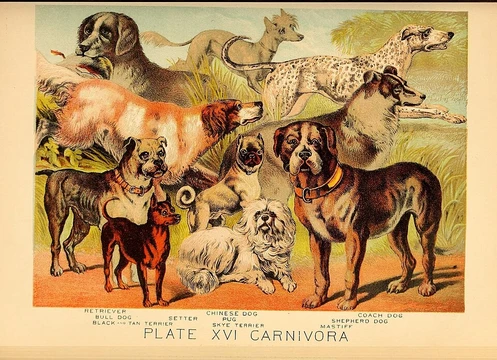
Greyhound
Ancient sighthound bred for speed and sight hunting.

The Greyhound is a breed of dog and a sighthound, an ancient breed historically developed for hunting game by sight and speed. It has later been used in organised coursing and greyhound racing, and is also kept as a show dog and companion animal. The breed is characterized by a tall, muscular, smooth-coated build, a long tail, tough feet, and a distinctive flexible, 'S-shaped' outline typical of sighthounds. This build, including long legs, a deep chest, a flexible spine, and a slim frame, enables high sprinting speeds; in racing, Greyhounds can reach peak speeds of at least a certain velocity, with typical winning speeds around a specific mark. Males stand about 71 to 76 centimetres tall at the withers and weigh roughly 27 to 40 kilograms, while females are smaller, with heights of 66 to 71 centimetres and weights of 25 to 34 kilograms, though individual weights can vary. Their short fur is easy to maintain and comes in approximately 30 recognized color forms, including white, brindle, fawn, black, red, and blue, alone or in combination. The skull is dolichocephalic, relatively long compared to its width, with an elongated muzzle. Temperamentally, Greyhounds are gentle, affectionate, and sensitive, responding best to gentle commands. They are generally not barkers and are friendly to strangers and family alike, with a 2008 study identifying them as one of the least aggressive breeds. However, they can exhibit sleep startle if disturbed while napping, and many sleep with eyes partially open. They are outgoing, sociable, and often follow owners from room to room, but small animals may trigger prey-driven behavior. Historically, the breed has been celebrated in literature, heraldry, and art as an elegant companion and hunter. Modern racing and adoption programs have redefined them as sporting dogs that offer friendly companionship in retirement. Due to a strong prey drive and poor recall, they should be leashed unless in a secure, fenced area, and some jurisdictions mandate this. Healthwise, a 2024 UK study found a life expectancy of 11.5 years, below the average for purebreds. Their speed stems from a light but muscular build, a large heart, a high proportion of fast-twitch muscle fibers, a double suspension gallop, and extreme spinal flexibility. Hindlimb and forelimb muscles each constitute over 18% of body mass, with back musculature at 12%. Their unique p
- field
- Sighthound breed
- known_for
- High sprinting speeds, racing, and gentle temperament
- height_male
- 71–76 cm (28–30 in) at withers
- height_female
- 66–71 cm (26–28 in) at withers
- weight_male
- 27–40 kg (60–88 lb)
- weight_female
- 25–34 kg (55–75 lb)
Lore & Background
The Greyhound is a tall, muscular, smooth-coated sighthound with a long tail, tough feet, and a distinctive flexible, S-shaped outline. Its long legs, deep chest, flexible spine, and slim build enable high sprinting speeds, achieved through a double suspension rotary gallop in which all four feet leave the ground twice per stride. Males typically stand taller at the withers and weigh more than females, which are smaller. The short fur is easy to maintain and appears in about thirty recognized color forms, including white, brindle, fawn, black, red, and blue, alone or in combination. The breed is dolichocephalic, with a skull long relative to its width and an elongated muzzle. Historically developed for hunting game by sight and speed, Greyhounds were later used in organized coursing and racing, and are also kept as show dogs and companions. They are gentle, affectionate, and sensitive, responding best to gentle commands. They rarely bark, are friendly to strangers, and are among the least aggressive dog breeds toward people and other dogs. However, they can exhibit sleep startle if disturbed while napping, and many sleep with eyes partially open. Their strong prey drive and poor recall mean they must remain leashed unless in a secure, fenced area. The breed’s unique physiology requires veterinary expertise, especially with anesthesia, as their livers have lower oxidative enzyme levels and their blood chemistry differs from other breeds.
Reader's Guide
The Greyhound's significance lies in its dual role as a high-performance racing dog and a gentle companion. Its long legs, deep chest, flexible spine, and slim build enable sprint speeds of at least 69 km/h (43 mph), with typical winning speeds of 58–61 km/h (36–38 mph). The breed has a unique physiology: a large heart, high proportion of fast-twitch muscle fibers, and a double suspension rotary gallop. Greyhounds have higher red blood cell levels than other breeds but lower platelet counts, and they are prone to delayed hemorrhage after trauma or surgery due to breed-associated hyperfibrinolysis. They are sensitive to pyrethrin-based insecticides and require specialized veterinary care, particularly with anesthesia. Despite a life expectancy of 11.5 years (below the purebreed average of 12.7), Greyhounds are known for their gentle, affectionate temperament and low aggression, making them excellent pets. Their lack of undercoat and body fat makes them susceptible to extreme temperatures, so they must be housed inside. Re-homing bodies recommend leashing at all times outdoors due to strong prey drive and poor recall.
Did You Know?
- Greyhounds can reach peak speeds of at least 69 km/h (43 mph).
- Greyhounds have higher levels of red blood cells but lower levels of platelets than other breeds.
- Greyhounds cannot metabolize barbiturate-based anesthesia in the same way as other breeds due to lower amounts of oxidative enzymes in their livers.
Common Misconceptions (Editorial)
Some people believe Greyhounds are aggressive or high-energy pets, but the facts show they are known for a gentle temperament and are often retired from racing as friendly companions. Others may think all sighthounds are the same, but Greyhounds are specifically noted for their distinctive flexible, S-shaped outline and their unique biological traits, such as an inability to metabolize barbiturate-based anesthesia like other breeds. Additionally, while many assume they are simply fast dogs, the breed can reach peak speeds of at least 69 km/h (43 mph), making them elite sprinters.
Why It Matters (Editorial)
The Greyhound endures as a breed because it bridges ancient hunting heritage with modern companionship, celebrated in literature and art for centuries. Its transition from racing star to beloved family pet reflects a cultural shift in how we value and care for athletic animals, proving that speed and gentleness can coexist in one remarkable creature.
Frequently Asked Questions
What is a Greyhound?
The Greyhound is an ancient sighthound breed originally developed for hunting game by sight and speed. It is recognized for its tall, muscular, smooth-coated frame and is one of the fastest dog breeds in the world.
What are the Greyhound's key physical traits?
The breed features a distinctive flexible, S-shaped body outline characteristic of sighthounds, along with a long tail and tough feet. Males stand 71–76 cm at the withers and weigh 27–40 kg, while females are slightly smaller at 66–71 cm.
What is a Greyhound used for?
Historically bred for sight hunting, the Greyhound has also been employed in organized coursing and greyhound racing. Today it is kept as a show dog and a popular companion animal.
What is a Greyhound's temperament like?
Despite their athletic, speed-focused heritage, Greyhounds are well known for their gentle and calm disposition, making them popular family companions.
More in Dog Breeds 1-22
Spotted an error? Know more?
This is a living reference — every entry is fact-audited, and reader corrections feed straight into our audit queue. Suggest an edit · See this site's audit record