Refractive error
A common vision problem caused by improper focusing of light on the retina.
Last updated
When the eye or cornea is misshapen, light doesn't focus correctly on the retina, causing refractive errors like near-sightedness, far-sightedness, astigmatism, and presbyopia. These are a leading cause of vision loss globally.
Classification
Refractive error, sometimes called ametropia, occurs when the refractive power of an eye does not match the length of the eye, so the image is focused away from the central retina. Types include myopia, hyperopia, presbyopia, and astigmatism. Myopia, or nearsightedness, results from refractive power too strong for the eyeball length, causing blurry distance vision; it is corrected with a concave lens. Hyperopia, or farsightedness, arises when refractive power is too weak, blurring near vision; convex lenses provide correction.
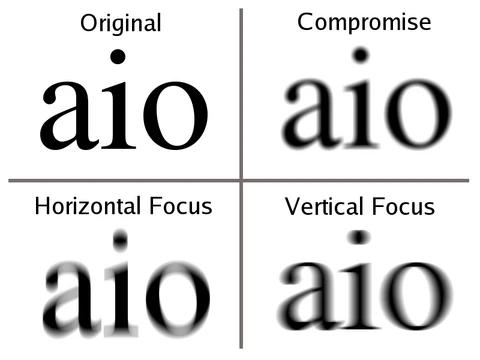
Presbyopia involves age-related decline in lens flexibility, leading to difficulty with near vision, often managed with reading glasses, bifocals, or progressive lenses. Astigmatism stems from non-uniform refractive power across the cornea due to asymmetry, causing image distortion. Children are typically born hyperopic and shift toward emmetropia or myopia as their eyes lengthen. Other terminology includes anisometropia (unequal refractive power between eyes) and aniseikonia (differing magnification).
Refractive errors are measured using three numbers: sphere (indicating nearsightedness with a minus sign or farsightedness with a plus sign), cylinder (amount of astigmatism), and axis (direction of astigmatism in degrees).
Risk factors
Genetic predilection for refractive error is supported by evidence; individuals with affected parents are more likely to have similar errors. The Online Mendelian Inheritance in Man database lists 261 genetic disorders in which myopia is a symptom, including heritable connective tissue disorders such as Knobloch syndrome, Marfan syndrome, and Stickler syndrome. Myopia also appears in X-linked disorders involving retinal photoreceptor function, such as autosomal recessive congenital stationary night blindness, retinitis pigmentosa 2, and Bornholm eye disease.
Many genes associated with refractive error cluster in biological networks related to connective tissue growth and extracellular matrix organization. Environmental factors correlate with myopia risk: visually intensive occupations, reading, and prolonged near work (reading, screens, writing) are associated with myopia.
Children with myopia spend more time reading than non-myopic children, who spend more time outdoors. Socioeconomic status and higher education levels are also reported risk factors. Blepharoptosis can induce refractive errors.
Management
Management of refractive error occurs after diagnosis by optometrists, ophthalmologists, refractionists, or ophthalmic medical practitioners. Treatment depends on the amount and severity; those with mild, asymptomatic errors may choose no correction. For symptomatic individuals, glasses, contact lenses, refractive surgery, or a combination are typically used. Eyeglasses serve as an added lens to bend light onto the retina.
Reading glasses are over-the-counter aids for presbyopia. Single vision prescription lenses correct only one type of defective vision. Multifocal lenses correct both near and far vision, benefiting presbyopia. Contact lenses include hard lenses that reshape the cornea and soft lenses made of silicone or hydrogel, worn daily or for extended periods.
Complications can occur, especially with daily-use lenses; if redness, itching, or difficulty in vision develops, use should stop and an ophthalmologist consulted. Availability and affordability of eyeglasses pose challenges in low-income settings, and children may not wear them consistently.
Epidemiology
At least 2 billion people worldwide have refractive errors. Uncorrected refractive error affected an estimated 660 million people (10 per 100) in 2013. Refractive errors are the first common cause of visual impairment and the second most common cause of visual loss.
Disability-adjusted life years for refractive error showed an 8% increase from 1990 to 2019. Rates vary by region: about 25% of Europeans and 80% of Asians are affected. Myopia is one of the most prevalent eye disorders, with adult rates between 15 and 49% and child rates between 1.2 and 42%.
Hyperopia more commonly affects young children and the elderly. Presbyopia affects most people over age 35 and nearly 100% by ages 55–65. Uncorrected refractive error is a major cause of vision loss alongside cataracts, macular degeneration, and vitamin A deficiency.
Did You Know?
- In emmetropia, the eye focuses light correctly on the retina when viewing distant objects (beyond 6 meters).
- Accommodation is the process by which the eye thickens the lens to increase refractive power for near objects.
- Cycloplegic agents are frequently used to determine refractive error more accurately, especially in children.
More in Disorders of Ocular Muscles, Binocular Movement, Accommodation and Refraction
Sources
Compiled from Wikipedia and the sources listed below. Text from Wikipedia is available under CC BY-SA 4.0; this entry is adapted from it.
- Wikipedia: Refractive error (CC BY-SA 4.0).
- Word definitions: the , each quoted from its Wikipedia article.
Spotted an error? Know more?
Reader corrections go straight into our review queue. Suggest an edit · How this site is sourced