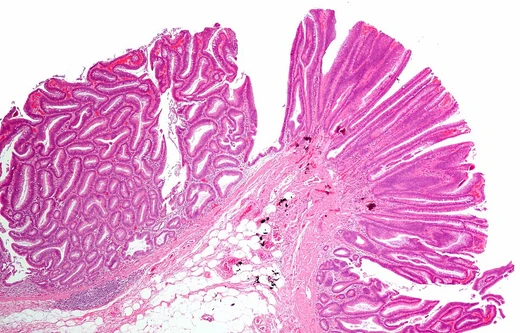
Sessile serrated lesion
Premalignant flat colon lesion linked to serrated pathway colorectal cancer.
Last updated
A sessile serrated lesion is a flat, precancerous growth in the colon, most often in the cecum and ascending colon. It can develop into colorectal cancer via the serrated pathway, a different process than the usual APC gene mutation route. Finding multiple SSLs can point to serrated polyposis syndrome.
Diagnosis
SSLs are diagnosed by microscopic appearance. Histomorphologic features include basal dilation of the crypts, basal crypt serration, crypts running horizontal to the basement membrane, and crypt branching. Basal dilation of the crypts is the most common feature. Unlike conventional colonic adenomas, SSLs typically lack nuclear changes such as hyperchromatism, crowding, or elliptical nuclei.
Did You Know?
- Serrated polyps include hyperplastic polyps and traditional serrated adenomas in addition to SSLs.
- The serrated polyposis syndrome diagnosis is made by fulfillment of any of the World Health Organization's clinical criteria.
More in Digestive System Neoplasia
Sources
Compiled from Wikipedia and the sources listed below. Text from Wikipedia is available under CC BY-SA 4.0; this entry is adapted from it.
- Wikipedia: Sessile serrated lesion (CC BY-SA 4.0).
- Word definitions: the Codexery glossary, each quoted from its Wikipedia article.
Spotted an error? Know more?
Reader corrections go straight into our review queue. Suggest an edit · How this site is sourced