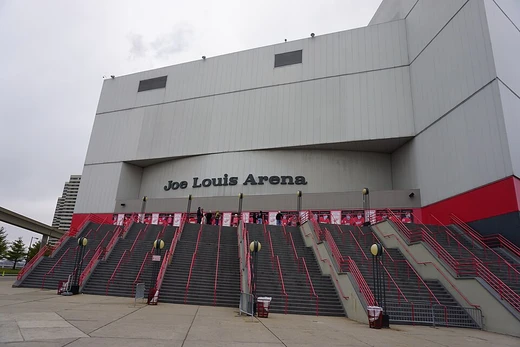
1950 Stanley Cup Final
Red Wings beat Rangers in seven games for fourth Cup.

The 1950 Stanley Cup Final was a best-of-seven series between the New York Rangers and the Detroit Red Wings. For the Rangers, this was their first trip to the championship round since they won the Cup in 1940. The two teams had met before in the 1937 Final, which Detroit took in five games. This time, the Red Wings again came out on top, winning the series in seven games to claim their fourth Stanley Cup and their first since 1943.
This series holds a couple of unique distinctions. It was the last Stanley Cup Final where one team played no home games, and the last to feature neutral-site games until 2020. Because the circus had taken over Madison Square Garden, two games were played in Toronto.
New York reached the Final by beating the Montreal Canadiens 4–1. Detroit got there by defeating the three-time defending champion Toronto Maple Leafs 4–3, avenging two straight sweeps at Toronto’s hands in the previous Finals.
In the series, Rangers forward Don Raleigh scored two overtime winners. The deciding Game 7 went into double overtime, where Detroit’s Pete Babando scored the Cup-winning goal—the first time the Stanley Cup was ever won in extra time of a Game 7. The Red Wings accomplished this without star Gordie Howe, who was injured in the first game of the playoffs.
As runner-up, the Rangers received the O’Brien Cup, becoming the last team to win that trophy, which was retired after the season. Originally the championship trophy of the National Hockey Association (the NHL’s precursor), the O’Brien Cup had been awarded to the NHL champion before the league took over the Stanley Cup in 1927. (Note: The O'Brien Cup was actually awarded until 2021, not retired after 1950.)
The Stanley Cup was presented to Red Wings captain Sid Abel by NHL President Clarence Campbell after Detroit’s 4–3 double-overtime win in Game 7.
Several players and staff had their names engraved on the Cup. Notably, goaltender Terry Sawchuk played only seven NHL games in 1950 because Harry Lumley was injured, but Sawchuk was not available for the playoffs—he was helping the AHL Indianapolis Capitals win the Calder Cup. Instead, Harry MacQueston was called up as the spare goalie for the playoffs. MacQueston’s name was engraved on the Cup, though he never played in the NHL; it was later removed when the Cup was redone in the 1957–58 season.
- Champion
- Detroit Red Wings
- Runner-up
- New York Rangers
- Games
- 7
- Winning goal
- Pete Babando (double overtime, Game 7)
- First overtime cup winner in game 7
- Yes
- Neutral site games
- Two in Toronto
Lore & Background
The 1950 Stanley Cup Final was the last to feature a team that did not host any games and also the last to include neutral site games until 2020. Two games were played in Toronto because the circus had taken over Madison Square Garden in New York, causing scheduling conflicts. New York's Don Raleigh scored two overtime winners in the series, while Pete Babando scored the Cup-winning goal in double overtime of Game 7, the first time ever the Stanley Cup was won in extra frames in a Game 7.
Reader's Guide
The 1950 Stanley Cup Final is historically significant for several reasons. It was the first Stanley Cup Final decided in overtime of Game 7, with Pete Babando's double-overtime goal securing the championship for Detroit. The series also marked the last time a team (the Rangers) did not host any games, and the last time neutral site games were used until 2020. The Red Wings won without Gordie Howe, who was injured in the first game of the playoffs. As runner-up, the Rangers were awarded the O'Brien Cup, becoming the last team to win that trophy, which was retired after the season. The O'Brien Cup had originally been the championship trophy of the National Hockey Association and later awarded to the NHL champion before the league took over control of the Stanley Cup in 1927.
Did You Know?
- Don Raleigh scored two overtime winners for the Rangers in the series.
- The O'Brien Cup was not retired after 1950; it continued to be awarded to the NHL's runner-up until 2021.
Roads to the Championship
Both franchises arrived at the 2008 Stanley Cup Final carrying distinct momentum. Detroit, the Presidents' Trophy holders, had been powered by a forward trio of Henrik Zetterberg, Pavel Datsyuk, and Johan Franzen, who combined to produce 55 goals across the first three playoff rounds. Their path included a six-game grind past Nashville—where struggling goaltender Dominik Hasek was swapped for Chris Osgood mid-series—a four-game sweep of Colorado in which Franzen personally matched the entire Avalanche squad's nine-goal output, and a six-game victory over Dallas that secured the franchise's fifth Campbell Bowl.
Pittsburgh, the Atlantic Division champions with the second-best Eastern Conference record, told a different story. Captain Sidney Crosby, sidelined for 29 regular-season games by an ankle injury, returned to top the first three rounds in assists and tie for the playoff points lead. Goaltender Marc-Andre Fleury led the league with three shutouts, while Evgeni Malkin and Marian Hossa each posted nine goals and ten assists. The Penguins reversed a previous-season 4-1 loss by sweeping Ottawa, then dispatched the New York Rangers and Philadelphia Flyers in five-game series to claim the Prince of Wales Trophy.
Detroit's Opening Blitz
Game one in Detroit showcased a Red Wings team that controlled every facet of play. After a Lidstrom goal was waved off due to goaltender interference on Tomas Holmstrom, Pittsburgh squandered four consecutive power-play opportunities in a scoreless first period. The second period broke open when Mikael Samuelsson buried an unassisted wrap-around at 13:01, and he struck again just over two minutes into the third. Dan Cleary added a shorthanded tally at 17:18, and Henrik Zetterberg capped the rout with a power-play goal thirteen seconds before the horn. Chris Osgood posted his second playoff shutout, and Detroit outshot Pittsburgh 36 to 19.
Game two proved even more lopsided. Coach Michel Therrien shuffled his lines and brought back Gary Roberts, but the damage was already done. Brad Stuart opened the scoring with a slap shot at 6:55, assisted by Valtteri Filppula, and Tomas Holmstrom extended the lead to 2-0 before the first period ended. Pittsburgh failed to register a single shot on goal during the game's first twelve minutes. Filppula added a wrist-shot goal on Marc-Andre Fleury at 8:48 of the third, and Osgood stopped all 22 shots he faced for his second consecutive shutout.
Historic Firsts and Enduring Legacy
This series carried a weight of historical firsts that stretched far beyond the ice. It marked the first postseason meeting between the Red Wings and Penguins, and the first time since the 1909 World Series that professional sports teams from Detroit and Pittsburgh had faced one another in a postseason contest. The two clubs had not even played each other during the 2007-08 regular season.
For Detroit, it was the 23rd Finals appearance and the first since hoisting the Cup in 2002. Winning in six games gave them an eleventh Stanley Cup title. For Pittsburgh, it was only their third Finals trip, the first since their back-to-back championships in 1991 and 1992.
The matchup also held a unique distinction in NHL history: it was the first all-United-States Cup Final since 2003 and the last one until 2026 in which neither team had to play a Game 7 in any earlier round of that season's playoffs. As of 2026, this remains the most recent major professional sports championship won by a Detroit-based franchise, a fact that underscores how long the city has waited for another title of this caliber.
Individual Brilliance and Storylines
Several individual narratives gave this series its emotional texture. Henrik Zetterberg, the engine of Detroit's attack, was named the Conn Smythe Trophy winner as the most valuable player of the entire playoffs. His power-play goal with thirteen seconds left in Game one became the symbolic capstone of a dominant performance.
On Pittsburgh's side, Sidney Crosby's journey was particularly compelling. After missing 29 regular-season games to an ankle injury, the captain returned to lead the first three playoff rounds in assists and tie for the points lead heading into the Final. In Game three, playing before a home crowd that had won sixteen straight postseason games, Crosby scored twice—his second on the power play just 2:34 into the second period—giving the Penguins their first series goal.
Detroit's Johan Franzen etched his name in playoff lore by scoring nine goals in the Colorado sweep, matching the entire Avalanche squad's output. Chris Osgood, who replaced the struggling Dominik Hasek mid-series against Nashville, delivered back-to-back shutouts in the opening two games, stopping all 22 shots in Game two. A ceremonial faceoff before Game one, with former captains Mario Lemieux and Steve Yzerman dropping pucks to their successors, added generational continuity.
Frequently Asked Questions
Who won the 1950 Stanley Cup Final?
The Detroit Red Wings defeated the New York Rangers in a seven-game series to claim the championship. It was Detroit's fourth Cup overall and their first title since 1943.
How did the 1950 Stanley Cup Final end?
Pete Babando scored the game-winning goal in double overtime of Game 7 to seal the series for Detroit. The dramatic finish made it one of the most memorable Cup-clinching moments in NHL history.
What made the 1950 Stanley Cup Final unusual?
It was the last championship series in which one team played zero home games, with two contests instead held at a neutral site in Toronto. No subsequent Final has used that format.
How many games did the 1950 Stanley Cup Final last?
The series went the full seven games before Detroit closed it out. The two clubs had also met in the 1937 Final, a contest the Wings won in five games.
What was at stake for the Rangers in the 1950 Stanley Cup Final?
It was New York's first trip to the championship round since they last won the Cup in 1940. Despite that long drought, they ultimately fell short against Detroit's experienced roster.
More in Detroit Red Wings games 1-24
Spotted an error? Know more?
Reader corrections go straight into our review queue. Suggest an edit · How this site is sourced