
1942 Stanley Cup Final
First reverse sweep in Stanley Cup Final history (also achieved by 1975 Flyers).

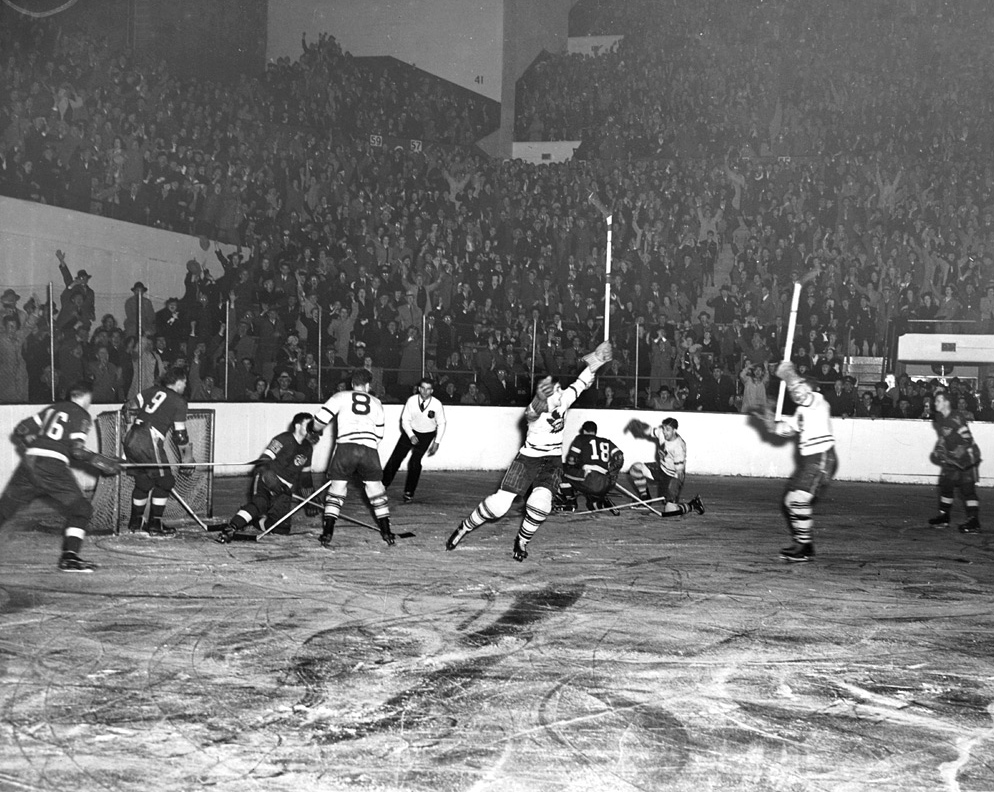
Conn Smythe Fonds · Public domain
The 1942 Stanley Cup Final matched the Toronto Maple Leafs against the Detroit Red Wings in a best-of-seven series. After dropping the first three games, Toronto rallied to win four straight, taking the series in seven games and claiming their fourth Stanley Cup. This made them the first team in North American professional sports to erase a 3–0 series deficit and win the championship. Toronto and the 1975 Philadelphia Flyers are the only NHL clubs to accomplish this feat in a Stanley Cup Final. It was also the first Final to go the full seven games and one of two ever decided by a reverse sweep (the other being the 1975 Final).
Toronto reached the Final by defeating the New York Rangers 4–2 in a best-of-seven semifinal. Detroit advanced through two best-of-three series: a 2–1 win over the Montreal Canadiens and a 2–0 sweep of the Boston Bruins.
Game one, in Toronto, saw Detroit’s Don Grosso open the scoring early. John McCreedy tied it, but Sid Abel put the Wings ahead again. Sweeney Schriner tied it once more before the first period ended. Grosso scored again late in the second, and Detroit held on for a 3–2 win. In game two, also in Toronto, Grosso scored twice. The Wings led 2–0 after the first on goals by Grosso and Mud Bruneteau. Schriner cut the lead to 2–1 in the second, but Grosso and Gerry Brown made it 4–1 early in the third. Wally Stanowski scored for Toronto, but Detroit won 4–2 to take a 2–0 series lead.
Game three shifted to Detroit. Toronto jumped ahead 2–0 on two goals by Lorne Carr, but the Wings tied it before the first period ended on tallies by Brown and Joe Carveth. Sid Abel left the game with a possible fractured jaw; his replacement, Pat McReavy, scored the go-ahead goal early in the second. Syd Howe added another, and Eddie Bush scored in the third to make the final 5–2.
Facing elimination in game four, Toronto coach Hap Day replaced Gordie Drillon and Bucko McDonald with Don Metz and Hank Goldup. The first period was scoreless. Detroit’s Bruneteau and Abel made it 2–0 midway through the second, but Toronto tied it on goals by Bob Davidson and Carr. Carl Liscombe put the Wings ahead 3–2 early in the third, but Syl Apps tied it two minutes later. Nick Metz scored the winner with seven minutes left. The game ended in chaos: Detroit’s Eddie Wares drew a misconduct penalty and a $50 fine for arguing.
- Series result
- Toronto Maple Leafs 4, Detroit Red Wings 3
- First team to overcome 3–0 series defici
- Yes
- First stanley cup final to go seven game
- Yes
- Only stanley cup final to result in a re
- No (also 1975 Philadelphia Flyers)
- Game 7 attendance
- 16,218 fans
- Series winner scored by
- Sweeney Schriner
Lore & Background
The Maple Leafs reached the Final by defeating the New York Rangers 4–2 in a best-of-seven series. The Red Wings advanced through two best-of-three series: winning 2–1 against the Montreal Canadiens and 2–0 against the Boston Bruins. The Final opened in Toronto, where Detroit took a 3–2 win, followed by a 4–2 victory in game two. In game three in Detroit, the Wings won 5–2 after the Leafs took an early 2–0 lead. Toronto staved off elimination in game four with a 4–3 win in Detroit, a game that ended in a near-riot: Detroit coach Jack Adams attacked referee Mel Harwood after the final buzzer, leading to an indefinite suspension from NHL president Frank Calder.
Reader's Guide
The 1942 Stanley Cup Final is historically significant as the first instance in North American professional sports of a team winning a playoff series after trailing 3–0. The Maple Leafs' reverse sweep has never been duplicated in a Stanley Cup Final, though it has occurred three times elsewhere in the Stanley Cup playoffs. The series also marked the first seven-game Final and the only reverse sweep in Final history. The comeback reshaped perceptions of resilience in hockey and remains a benchmark for playoff drama. The series featured notable events: the suspension of Detroit coach Jack Adams after attacking a referee, the insertion of Don Metz and Hank Goldup into the Toronto lineup after game three, and the presence of 18-year-old Gaye Stewart, who became the youngest player to win the Stanley Cup. The deciding game drew the largest crowd to see a hockey game in Canada at that time.
Did You Know?
- Toronto and the 1975 Philadelphia Flyers are the only NHL teams to overcome a 3–0 deficit in the Stanley Cup Final.
- The 1942 and 1975 Finals are the only two reverse sweeps in Stanley Cup Final history.
The Unprecedented Comeback
The 1942 Stanley Cup Final will forever be remembered for what Toronto accomplished after falling three games to none. The Maple Leafs, who had lost the first three contests to Detroit, rallied to capture four straight and claim their fourth championship. This feat made them the first team in the history of North American professional sports to overcome a 3-0 series deficit in a playoff series. Even more remarkably, the result produced the only reverse sweep ever recorded in a Stanley Cup Final. While the broader NHL has seen this comeback duplicated three additional times in its playoff history, no other Cup Final has ever ended in such a fashion. Toronto remains the sole NHL franchise to have won a Stanley Cup Final after trailing 3-0, a distinction that has stood for over eight decades. The series also marked the first time in the Cup's history that a Final stretched to a full seven games, cementing its place as a landmark event in the sport's narrative.
Game Four's Descent into Chaos
The fourth game in Detroit, where Toronto staved off elimination with a 4-3 victory, devolved into one of the most volatile episodes in early hockey history. In the final minute, Detroit's Eddie Wares drew a misconduct penalty and a fifty-dollar fine for arguing and refusing to leave the ice. Referee Mel Harwood, while Wares was still on the sheet, dropped the puck for a faceoff and immediately called a too-many-men penalty on Don Grosso. Grosso threw down his stick and gloves and was fined twenty-five dollars. The eruption did not stop there. Detroit coach Jack Adams launched a profanity-laced attack on Harwood, punching him in the face. Fans booed the officiating and littered the ice with paper, peanuts, and even a woman's shoe. NHL president Frank Calder and Harwood had to be escorted out of the arena under police protection. Calder immediately suspended Adams indefinitely and imposed one-hundred-dollar fines on both Grosso and Wares.
Roads to the Summit
The two finalists arrived at the 1942 Cup Final through different playoff paths. Toronto, as the conference champion, faced the New York Rangers in a best-of-seven series and dispatched them 4-2 to earn their place in the championship round. Detroit's journey was more circuitous. The Red Wings were required to play two separate best-of-three series en route to the Final. They first edged the Montreal Canadiens 2-1, then swept the Boston Bruins 2-0 to claim their conference title. This structural difference meant Detroit had played fewer games but had to win two distinct mini-series, while Toronto's path was a single extended contest. The 1942 Final itself became the first Stanley Cup Final in history to require all seven games, a milestone that underscored how evenly matched these two teams were. The combination of Detroit's two-round gauntlet and Toronto's single long series set the stage for a championship battle that neither side could dominate early on.
The Final Three Games and the Record Crowd
After Toronto's stunning 9-3 demolition of Detroit in Game 5, fueled by Don Metz's three goals and two assists, the series shifted decisively. In Game 6, Detroit's players vowed a different performance, and the contest was notably disciplined with no penalties called. The first period was described as hard-hitting hockey and ended scoreless. Just fourteen seconds into the second, Don Metz stole the puck near the Detroit goal and beat Johnny Mowers to give Toronto the lead. Goalie Turk Broda then held the Red Wings scoreless for the remainder to record the series' only shutout. Goldham and Billy Taylor scored thirty-two seconds apart late in the third to seal it. The deciding Game 7 drew 16,218 fans, the largest crowd to witness a hockey game in Canada at that time. Detroit survived a two-man disadvantage in the first period, and Syd Howe opened the scoring in the second on a passing play involving Abel and Orlando. Toronto's chance came in the third when Orlando tripped Apps; just as the penalty expired, Schriner scored to complete the historic reverse sweep.
Gallery
Frequently Asked Questions
Who won the 1942 Stanley Cup Final?
The Toronto Maple Leafs defeated the Detroit Red Wings four games to three to capture their fourth Stanley Cup. They accomplished this by winning four straight games after trailing the series 0-3.
What made the 1942 Stanley Cup Final historically significant?
It was the first instance in North American professional sports where a team erased a 3-0 series deficit to win a championship. It also marked the very first Stanley Cup Final to require all seven games.
How did the 1942 Stanley Cup Final series unfold?
Detroit seized a commanding 3-0 lead in the best-of-seven, but Toronto then won four consecutive games to steal the title. Game 7 drew 16,218 fans to watch the comeback complete.
Why is the 1942 Stanley Cup Final especially painful for Detroit Red Wings fans?
The Wings held a 3-0 series advantage and still lost the championship, making it one of the most stinging defeats in franchise lore. The collapse cemented the series as a cautionary tale about never counting an opponent out.
What records does the 1942 Stanley Cup Final hold?
It remains the first Stanley Cup Final decided by a reverse sweep and the first to go the full seven games. Only the 1975 Philadelphia Flyers have since matched that 3-0 comeback in a Cup Final.
More in Detroit Red Wings games 1-24
Spotted an error? Know more?
Reader corrections go straight into our review queue. Suggest an edit · How this site is sourced