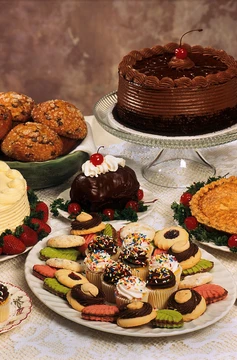
Bread pudding
A dessert made from stale bread, milk, and eggs.

Wikipedia / Wikimedia Commons
Bread pudding began as a British dessert, created by soaking stale bread in milk, cream, or water. Eggs and a fat like oil, butter, or suet are usually added, along with other ingredients that determine whether the dish is sweet or savory. Sweet versions often include sugar, syrup, honey, dried fruit, nuts, and spices such as cinnamon, nutmeg, mace, or vanilla. The bread is soaked in the liquid, mixed with everything else, and then baked. Savory puddings, such as breakfast strata, can be served as a main course, while sweet ones are typically eaten for dessert. This dish is also called poor man's pudding or simply pudding. In other languages, its name translates to "bread pudding" or "pudding," including *pudín* and *budín*. In the Philippines, a popular version uses Pandesal bread. Mexico has a similar Lenten dish called *capirotada*. In Liverpool, UK, a moist variation of Nelson Squares—itself a bread pudding with shortcrust pastry—is known as "Wet Nelly."
The dish originated with 11th-century English cooks who found a use for leftover stale bread. Over time, it became known as "poor man's pudding" due to food scarcity, originally made with just boiling water, sugar, and spices. By the 13th century, eggs and milk were added, creating what became known as bread and butter pudding. The 18th-century English cookbook *The Compleat Housewife* includes two recipes for baked bread pudding, one labeled "A Bread and Butter Pudding for Fasting Days." When the first settlers arrived in the 13 English Colonies in America, bread pudding became popular there and later in the United States.
Regional variations are widespread. In Hong Kong, bread pudding often comes with vanilla cream dressing. In Malaysia, it is served with custard sauce. Philippine bakeries commonly use stale unsold bread to make the bright-red filling of *pan de regla*. In Southeast Asia—including Malaysia, Singapore, and Indonesia—bread pudding appears in local dessert shops, sometimes with coconut milk, pandan leaves, palm sugar, or tropical fruits. Turkey's version, *ekmek kadayıfı*, is topped with kaymak or ice cream and garnished with ground pistachio or shredded coconut. In the Levant, *Aish as-Saraya* is a popular bread pudding flavored with rose water. Myanmar's *Pu Tin* has been a favorite since colonial times and is also added to the dessert *Falooda*. Bangladesh has *Shahi Tukra*, a variation dating to the Mughal era, known in Hyderabad as *Double Ka Meetha*.
In the Americas, Canadian bread pudding sometimes uses maple syrup; in Quebec, it is called *Pouding chômeur*. Puerto Rico offers many variations, including cream cheese with lime zest and guava, or coconut-sweet plantain with rum raisins, always spiced and cooked like crème caramel in a bain-marie. In Argentina, Peru, Paraguay, and Uruguay, it is *budín de pan*. Brazil's *pudim de pão* blends bread, eggs, milk, condensed milk, butter, vanilla, and optional cinnamon, then bakes it in a caramel-lined mold in a water bath, resulting in a creamy, dense flan-like dessert. Panama calls it *mamallena*, Aruba *pan bolo*, Cuba *pudín de pan* often served with guava marmalade, and Chile *colegial* or *budín de pan*. In Mexico, it is simply *budín*, typically made with leftover bolillo bread, raisins, and pecans. In the United States, especially Louisiana, sweet bread puddings are served with sauces like whiskey, rum, or caramel.
In Europe, the United Kingdom seasons bread pudding with nutmeg and cinnamon, serving it with rum or whisky sauce or hot custard; Nelson Squares is a pastry-enclosed version. Brussels, Belgium, bakes it with brown sugar, cinnamon, stale bread, and raisins or apple. Hungary's *Máglyarakás* ("bonfire") features whipped egg whites on top. In Mecklenburg-Vorpommern, Germany, black bread is used for *Schwarzbrotpudding*. The Czech Republic and Slovakia know it as *žemľovka*, made with apples, raisins, and rolls soaked in sweet milk, topped with whipped egg whites.
- Origin
- Britain
- First known century
- 11th century
- Also known as
- Poor man's pudding
- Key ingredients
- Stale bread, milk/cream/water, eggs, fat, sugar/spices
- Notable variations
- Capirotada (Mexico), Nelson Squares (UK), Shahi Tukra (Bangladesh)
Lore & Background
Bread pudding originated with 11th-century English cooks who repurposed leftover stale bread. In the following centuries, the dish became known as 'poor man's pudding' because of the scarcity of food at the time, with the pudding being made only with boiling water, sugar, and spices. It was only in the 13th century that eggs and milk were added to the recipe, which then became known as Bread and butter pudding. The 18th-century English cookbook The Compleat Housewife contains two recipes for baked bread pudding, the first identified as 'A Bread and Butter Pudding for Fasting Days'.
Reader's Guide
Bread pudding's significance lies in its origins as a frugal dish that repurposed stale bread, reflecting historical food scarcity. Over centuries, it evolved from a simple mixture of water, sugar, and spices to include eggs and milk in the 13th century, becoming a versatile dessert or savory main course. Its spread to the 13 English Colonies in America and subsequent global variations—such as the Mexican capirotada, the Filipino pan de regla, and the Turkish ekmek kadayıfı—demonstrate its adaptability to local ingredients and tastes. The dish remains a comfort food in many cultures, often served with sauces like rum, whiskey, or custard, and continues to be a symbol of resourcefulness in cooking.
Did You Know?
- Bread pudding originated with 11th-century English cooks who repurposed leftover stale bread.
- In the 13th century, eggs and milk were added to the recipe, which then became known as Bread and butter pudding.
- In Liverpool, a moist version of Nelson Squares is nicknamed 'Wet Nelly'.
- In the Philippines, bread pudding made with Pandesal is popular.
More in Desserts 1-22
Spotted an error? Know more?
This is a living reference — every entry is fact-audited, and reader corrections feed straight into our audit queue. Suggest an edit · See this site's audit record