
Philadelphia Blazers
One-season WHA franchise that relocated to Vancouver.

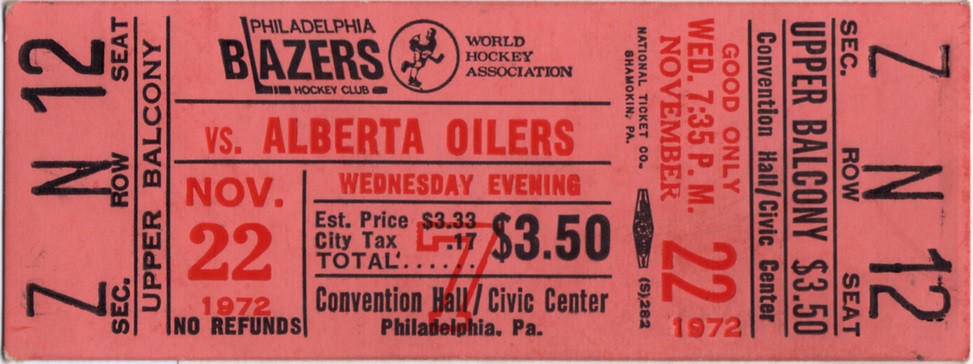
The Philadelphia Blazers played just one season in the World Hockey Association, 1972–73, before moving on. Originally slated to launch as the Miami Screaming Eagles, the franchise was shifted to Philadelphia after financial troubles and a lack of a suitable arena in Florida. The team played its home games at the Philadelphia Convention Hall and Civic Center.
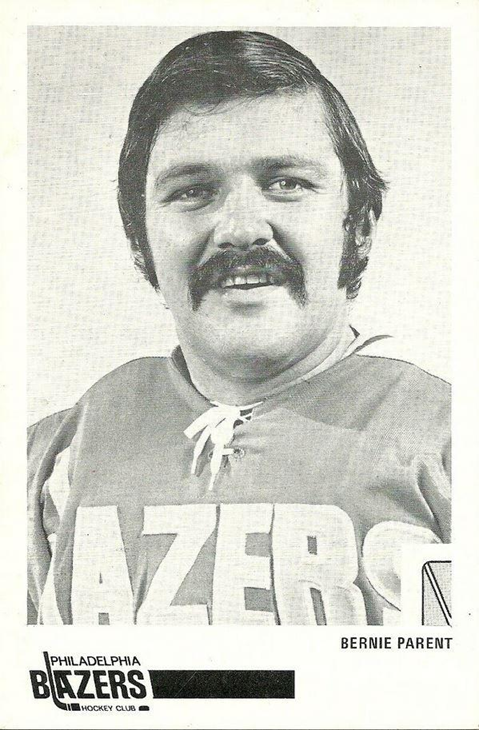
The roster was built around a few big names. Businessmen Bernard Brown and James Cooper acquired the Miami franchise—and its contracted players, including goaltender Bernie Parent—from Herb Martin in June 1972. They moved the team to Philadelphia and renamed it the Blazers. They then signed Derek Sanderson to a five-year, $2.6 million contract, then the richest deal in professional sports. The signing drew major publicity but also criticism, as many hockey observers felt Sanderson’s track record didn’t justify the salary.
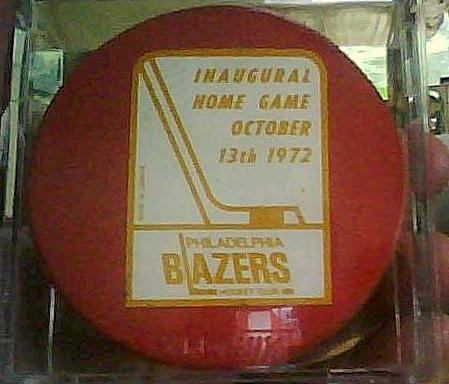
The Blazers entered their first season with high expectations, featuring Parent, Sanderson, and player-coach John McKenzie. But injuries quickly derailed them: McKenzie was hurt in a preseason game, and both Parent and Sanderson got banged up. The team’s first home game on October 13, 1972, was a fiasco—the Zamboni arrived late, and when it drove onto the ice, the poorly made surface cracked under its weight, forcing a reschedule. The Blazers lost 16 of their first 20 games before Parent and McKenzie returned. During that stretch, McKenzie was replaced as coach by Phil Watson. Sanderson played only eight games (three goals, three assists) before the owners paid him $500,000 to void his contract amid controversy, and he returned to the Boston Bruins.
The team improved as the season wore on. Andre Lacroix led the WHA in points, Danny Lawson scored 61 goals, and Parent provided solid goaltending. The Blazers finished with a 38–40 record and made the playoffs. But after the first playoff game—a 3–2 loss to the Cleveland Crusaders—Parent left the team. His agent claimed the team had withdrawn money from an escrow account meant to guarantee his contract, that Parent wasn’t getting his regular salary, and that medical expenses weren’t being paid. Parent never returned, leaving the netminding to backup Marcel Paille (over 40 and out of the NHL for nearly eight years) and 20-year-old Yves Archambault, who had only 30 games of experience above juniors. The Blazers were swept in four games.
- League
- World Hockey Association (WHA)
- Seasons played
- 1972–73
- Home arena
- Philadelphia Convention Hall and Civic Center
- Record
- 38 wins, 40 losses
- Playoff result
- Lost in first round (swept in four games)
- Key players
- Bernie Parent, Derek Sanderson, John McKenzie, Andre Lacroix, Danny Lawson
- Owners
- Bernard Brown and James Cooper
Lore & Background
The franchise was originally intended to be based in Miami, Florida, and called the Screaming Eagles, but due to money problems and a lack of a suitable arena, it moved to Philadelphia. In June 1972, businessmen Bernard Brown and James Cooper were granted the rights to the Miami Screaming Eagles, along with players under contract including goaltender Bernie Parent, from businessman Herb Martin. They moved the franchise to Philadelphia and renamed it the Blazers. They also signed Derek Sanderson to a five-year contract for $2.6 million, at the time the highest salary ever paid to a professional sports player, which produced great publicity but was controversial as many pundits felt his prior career did not warrant such a salary.
The Blazers had high hopes with stars Parent, Sanderson, and John McKenzie as player-coach, but injuries to all three dashed those hopes. The first home game on October 13, 1972, was a disaster: the Zamboni arrived late, and the improperly-made ice cracked under its weight, forcing the game to be rescheduled. The team lost 16 of its first 20 games. McKenzie was replaced as coach by Phil Watson. Sanderson left after only eight games (three goals, three assists); the owners paid him $500,000 to void his contract, and he returned to the Boston Bruins.
The team improved, with Andre Lacroix leading the league in points and Danny Lawson scoring 61 goals. They made the playoffs with a 38–40 record. However, Parent left after the first playoff game (a 3–2 loss to the Cleveland Crusaders), citing issues with an escrow account and salary. The Blazers were swept in four games.
Reader's Guide
The Philadelphia Blazers' significance lies in their role as a cautionary tale of the WHA's early struggles to compete with the established NHL. Despite assembling notable talent—including Bernie Parent, Derek Sanderson, and future WHA stars Andre Lacroix and Danny Lawson—the team was undermined by injuries, financial disputes, and poor attendance. Competing directly with the Philadelphia Flyers of the NHL, who played at the then-state-of-the-art Spectrum and were becoming competitive, the Blazers averaged less than 50% capacity at the Civic Center. After only one season, owners Brown and Cooper sold the team to Jim Pattison, who moved it to Vancouver, where it became the Vancouver Blazers. The franchise later moved to Calgary as the Calgary Cowboys before folding in 1977. The Blazers' brief existence highlights the financial instability and organizational challenges that plagued many WHA franchises, as well as the league's difficulty in establishing a foothold in markets already served by the NHL. The last active Blazers player in major professional hockey was Dave Hutchinson, who retired after the 1983–84 NHL season; the last active Blazer at any level was Ron Plumb, who played in England until 1986.
Did You Know?
- The franchise was originally to be called the Miami Screaming Eagles before moving to Philadelphia.
- Derek Sanderson's five-year, $2.6 million contract was the highest salary ever paid to a professional sports player at the time.
- The team's first home game was rescheduled after the Zamboni cracked the improperly-made ice.
- Bernie Parent left the team after the first playoff game due to disputes over an escrow account and salary.
Birth from a Franchise's Collapse
The Philadelphia Blazers entered the World Hockey Association not as an original charter member but as a stopgap solution to a folding franchise. When the league's promoters formally announced twelve teams on November 1, 1971, the Calgary Broncos were among them. However, before the inaugural 1972 season even tipped off, the Broncos ceased to exist, and the Blazers stepped into the vacancy alongside the Cleveland Crusaders, who replaced the Miami Screaming Eagles. This origin story placed the Blazers in a league that was, from its very first roster, a patchwork of new and replaced identities. The WHA itself had been conceived in 1971 by Dennis Murphy and Gary Davidson, both veterans of the American Basketball Association, who recruited Bill Hunter of the Western Canada Hockey League to help assemble the venture. By September 1971, ten franchises had been secured at a $25,000 entry fee, and the league set its sights on a 1972 debut. For the Blazers, that debut came in a league already reshaping itself before a single puck dropped.
A League Built on Defiance
The competitive environment the Philadelphia Blazers entered was one deliberately engineered to upend the National Hockey League's decades-long dominance. The WHA, operating from 1972 to 1979, was the first major professional hockey league to challenge the NHL since the Western Hockey League's collapse in 1926, and it proved far more successful than any prior attempt in the modern era. Its strategy was twofold: target major American and mid-level Canadian cities that lacked NHL representation, and outbid the NHL for talent. The average NHL salary in 1972 stood at just $25,000, the lowest among the four major North American sports, and every player was locked in by a reserve clause that auto-extended contracts indefinitely. The WHA rejected that clause outright, promising players both greater pay and genuine freedom of movement. By the league's opening, sixty-seven former NHL players had already signed, and the arrival of Bobby Hull on a record ten-year, $2.75 million deal with the Winnipeg Jets gave the entire venture, including newcomers like the Blazers, a credibility it had not possessed a season earlier.
Legal Wars and Player Freedom
The Blazers' existence was inextricable from the legal warfare that defined the WHA's relationship with the NHL. When the new league signed players still bound by NHL contracts, the established league responded with restraining orders. The Boston Bruins tried to block Bernie Parent and Gerry Cheevers from joining the WHA, and the Chicago Black Hawks sought to restrain Bobby Hull. In November 1972, Judge A. Leon Higginbotham Jr. of the U.S. District Court in Philadelphia issued an injunction against the NHL, stopping it from upholding the reserve clause and freeing all players under restraining orders to suit up for their WHA clubs. That ruling, handed down in the very city where the Blazers were playing, effectively shattered the NHL's monopoly on major-league talent. The WHA also exploited a gap in the NHL amateur draft, which at the time required players to be at least twenty to be selected, allowing the challenger league to sign younger prospects. The NHL briefly lowered its draft age to eighteen in 1974 to compete, a concession that underscored how seriously the WHA's model was disrupting the status quo.
The Short Life of a Challenger League
The Philadelphia Blazers played in a league whose very instability was its defining characteristic. The WHA was chronically fragile, with franchises relocating or folding mid-season, and its acrimonious relationship with the NHL produced a steady stream of legal battles over players and markets. Despite this turbulence, merger discussions began almost immediately after the league's founding. In 1977, NHL owners voted down a plan that would have absorbed six WHA clubs, including the Houston Aeros and Winnipeg Jets. A full merger was finally approved in 1979, and the WHA's final game came on May 20 of that year, when the Jets defeated the Edmonton Oilers to claim their third Avco World Trophy. The league ceased operations, and four teams—the Oilers, the New England Whalers (soon renamed Hartford), the Quebec Nordiques, and the Jets—entered the NHL for the 1979–80 season. Of those four, only the Oilers retained both their original city and nickname. The Blazers, like so many WHA franchises, were ultimately absorbed into a larger story, their brief existence a footnote in the league's seven-season run.
Gallery
Frequently Asked Questions
Why did the Philadelphia Blazers only last one season in the WHA?
The franchise was essentially a temporary home for a Miami-based club that had run into money problems and couldn't secure a proper arena in Florida. After the 1972-73 campaign wrapped up, the team departed Philadelphia and ultimately settled in Vancouver.
Who were the key players on the 1972-73 Philadelphia Blazers?
The lineup leaned heavily on goaltender Bernie Parent, defenseman Derek Sanderson, and forwards John McKenzie, Andre Lacroix, and Danny Lawson. These contracted athletes came with the franchise when Bernard Brown and James Cooper bought it from Herb Martin in the summer of 1972.
What was the Philadelphia Blazers' record and playoff result in their only season?
The Blazers went 38-40 over the 1972-73 regular season. They did reach the postseason but were eliminated in the first round, getting swept in four straight games.
Where did the Philadelphia Blazers play their home games?
The team used the Philadelphia Convention Hall and Civic Center as its home venue for the entirety of its single 1972-73 WHA campaign.
How did the Philadelphia Blazers franchise come into existence?
The club was originally supposed to debut as the Miami Screaming Eagles, but financial difficulties and the absence of a workable arena in Florida derailed that plan. Owners Bernard Brown and James Cooper purchased the package from Herb Martin in June 1972 and relocated the operation to the East Coast, where it briefly became the Blazers.
More in Defunct Ice Hockey Teams, Part 2 1-24
Spotted an error? Know more?
Reader corrections go straight into our review queue. Suggest an edit · How this site is sourced