Theseion
A Greek temple long misidentified as the shrine of Theseus.
Last updated
Where it is
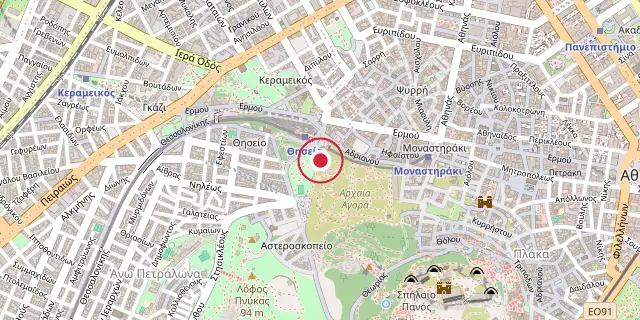
Coordinates: 37°58′34″N 23°43′16″E (37.9760, 23.7210) · Open in OpenStreetMap
Coordinates and connected clubs: the infobox of Wikipedia: Temple of Hephaestus (CC BY-SA 4.0). Map: drawn by Codexery from OpenStreetMap tiles.
The Theseion is a former name for the Temple of Hephaestus, a well-preserved Doric peripteral Greek temple located on the Agoraios Kolonos hill at the north-west side of the Agora of Athens. It was mistakenly called the Theseion in modern times because its sculpted metopes depict the deeds of the hero Theseus, leading early travelers to assume it housed his remains. The temple remains standing largely intact today.
Construction
After the Battle of Plataea, the Greeks swore not to rebuild sanctuaries destroyed by the Persians, leaving them as reminders of the war. Athens instead focused on rebuilding its economy and strengthening its influence in the Delian League. Construction of the temple began in 449 BC, though some scholars believe it took about three decades to complete, with funds and workers sometimes redirected to the Parthenon. The western frieze was finished between 445–440 BC, when a statue of Athena Hephaistia was added beside the cult statue of Hephaestus.
The eastern frieze, western pediment, and interior changes are dated to 435–430 BC on stylistic grounds. The roof and cult images were installed during the Peace of Nicias (421–415 BC). Photogrammetric analysis of the north cella side revealed a minute architrave leveling discrepancy, suggesting builders adjusted the slope for bedrock subsidence.
Description
The architect is unknown and is referred to as the Hephaisteion Master. The temple is built of marble from nearby Mt. Penteli, except the bottom step of the krepis. Architectural sculpture uses both Pentelic and Parian marble. The temple measures 13.71 m north to south and 31.78 m east to west, with six columns on the short east and west sides and thirteen on the long north and south sides (corner columns counted twice).
It has a pronaos, a central cella for cult images, and an opisthodomos. The alignment of the pronaos antae with the third flank columns of the peristyle is unique to the mid-5th century BC. An inner Doric colonnade has five columns on the north and south sides and three across the end. The pronaos and opisthodomos have continuous Ionic friezes instead of Doric triglyphs.
The pediments show the Birth of Athena (east) and the Return of Hephaistos to Olympos (west); akroteria include the Nereids Thetis and Eurynome (west) with Nikai, dated to ca. 430 and ca. 420–413 BC. The pronaos frieze depicts Theseus battling the Pallantides in the presence of gods; the opisthodomos frieze shows Centaurs and Lapiths. Only 18 of 68 metopes were sculpted, concentrated on the east side; the rest were likely painted. The ten east metopes depict the Labours of Heracles; the four easternmost metopes on the north and south sides show the Labours of Theseus.
According to Pausanias, the temple housed bronze statues of Athena and Hephaestus; an inscription records payments for two bronze statues between 421–415 BC, but does not name the sculptor, though tradition attributes them to Alcamenes.
Cult and festivals
The temple’s decorative program promoted Athenian civic values by pairing the hero Theseus with Heracles. Of the 68 external metopes, only 18 were carved: ten on the east front depicted Heracles’ labors, while the four corner metopes on the north and south sides showed deeds of Theseus. These scenes honored Athens’ legendary founder, and later the structure was incorrectly called the Theseion. According to Plutarch, in 475 BC the general Kimon recovered what were thought to be Theseus’s bones and reburied them near the gymnasium with processions and sacrifices; afterward, the tomb became a sanctuary and refuge.
Eighteenth-century travelers, seeing the Theseus-themed metopes, believed the temple was his tomb. The Chalkeia festival, shared by Hephaestus and Athena, occurred on the final day of Pyanepsion. Its name means “Bronze Workers’ Festival,” originating as an event for metal-smiths. Initially a widespread public celebration, it later centered on craftsmen.
During the Chalkeia, artisans shut their workshops and processed with grain offerings and animal sacrifices, honoring Hephaestus as the divine blacksmith and Athena as the patron of craft and weaving. A key ritual involved setting up the loom for weaving Athena’s new peplos; the priestesses of Athena Polias and the young Arrephoroi began preparing this sacred robe, which would be presented at the Great Panathenaia nine months later. Some Athenians called the festival the Athenaia or Pandemos, but the antiquarian Phanodemus maintained it was celebrated for Hephaestus, not Athena.
Church
Around AD 700, the temple was converted into a Christian church dedicated to Saint George, though the exact date of conversion is unknown; some assume it occurred in the 7th century. The characterization as Saint George 'Akamates' has several explanations: it may derive from Akamantas, son of Theseus and Pheadra; from the literal sense of akamates meaning flaneur or loiterer, because during the Ottoman Era the temple was used only once a year on the feast of St. George; or from Archbishop of Athens Michael Akominatos, who might have first celebrated a Divine Liturgy there. The last Divine Liturgy in the temple took place on 21 February 1833, during celebrations for the arrival of Otto of Greece, with Bishop Neophytos Talantiou of Atalante giving a speech.
Did You Know?
- The temple was used as a burial place for non-Orthodox Europeans in the 19th century, including philhellenes who died in the Greek War of Independence.
- Among those buried at the site was John Tweddel, a friend of Lord Elgin, and excavations revealed a slab from the grave of George Watson with a Latin epitaph by Lord Byron.
- When Athens became the official capital of Greece in 1834, the royal edict was published in this temple.
More in Cultural Depictions of Theseus
Sources
Compiled from Wikipedia and the sources listed below. Text from Wikipedia is available under CC BY-SA 4.0; this entry is adapted from it.
- Wikipedia: Temple of Hephaestus (CC BY-SA 4.0).
Spotted an error? Know more?
Reader corrections go straight into our review queue. Suggest an edit · How this site is sourced