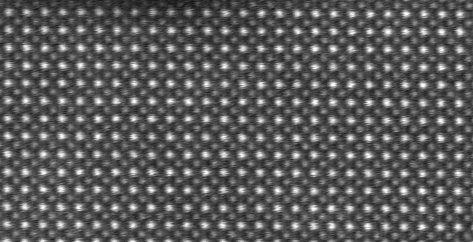
Crystallographic defect
Imperfections in the regular atomic arrangement of crystalline solids.

A crystallographic defect is any disruption in the regular atomic or molecular arrangement of a crystalline solid. While crystals ideally have a periodic structure with particles repeating at fixed distances based on unit cell parameters, this order is usually imperfect. Common categories of defects include point defects, line defects, planar defects, and bulk defects. A mathematical method for characterizing these defects involves topological homotopy.
Point defects occur at or near a single lattice point and do not extend in any spatial dimension. There is no strict definition of their maximum size, but they typically involve only a few extra or missing atoms; larger disruptions are usually considered dislocation loops. Historically, many point defects, especially in ionic crystals, are called centers—for instance, a vacancy in an ionic solid may be termed a luminescence center, color center, or F-center. These dislocations enable ionic transport through crystals, facilitating electrochemical reactions, and are often described using Kröger–Vink notation.
Vacancy defects are lattice sites that would be occupied in a perfect crystal but are empty. If a neighboring atom moves into the vacant site, the vacancy shifts in the opposite direction. The surrounding crystal structure remains stable, preventing neighboring atoms from collapsing into the vacancy; in some materials, neighboring atoms actually move away from a vacancy due to attraction from atoms farther away. A vacancy (or a pair in an ionic solid) is sometimes called a Schottky defect.
Interstitial defects occur when an atom occupies a site that normally has no atom. These configurations are generally high-energy, though small impurity atoms in some crystals, like hydrogen in palladium, can occupy interstices without high energy.
A nearby pair of a vacancy and an interstitial is often called a Frenkel defect or Frenkel pair, created when an ion moves into an interstitial site and leaves a vacancy behind.
Because materials can never be 100% pure, impurities inevitably introduce defects. An impurity atom is often incorporated at a regular atomic site, creating a substitutional defect—neither a vacancy nor an interstitial. If the substituting atom or ion is much smaller than the one it replaces, its equilibrium position may shift away from the lattice site, forming an off-center ion. Substitutional defects come in two types: isovalent substitution, where the substituting ion has the same oxidation state as the original, and aliovalent substitution, where the oxidation state differs. Aliovalent substitutions alter the overall charge of an ionic compound, requiring charge compensation—either partial oxidation or reduction of a metal, or creation of ion vacancies.
Antisite defects occur in ordered alloys or compounds when atoms of different types exchange positions. For example, in a regular structure where type A atoms occupy corners and type B atoms occupy cube centers, if a cube center holds an A atom instead of a B atom, that is an antisite defect—not a vacancy, interstitial, or impurity.
Topological defects are regions where the chemical bonding environment differs topologically from the surroundings. In a perfect graphene sheet, all atoms are in six-membered rings. If a sheet contains rings with a different number of atoms while the total atom count remains the same, a topological defect forms. An example is the Stone Wales defect in nanotubes, which consists of two adjacent five-membered and two adjacent seven-membered rings.
Amorphous solids can also contain defects, though they are harder to define. In ideally bonded amorphous silica, every silicon atom bonds to four oxygen atoms and every oxygen atom bonds to two silicon atoms. An oxygen atom with only one silicon bond (a dangling bond) is considered a defect. Defects in amorphous solids can also be defined based on empty or densely packed local atomic neighborhoods, and these behave similarly to vacancies and interstitials in crystals.
Complexes can form between different point defects. For instance, if a vacancy encounters an impurity that is too large for the lattice, the two may bind together. Interstitials can form a 'split interstitial' or 'dumbbell' structure.
- field
- Crystallography, Materials Science
- known_for
- Classification of point, line, planar, and bulk defects in crystals
Lore & Background
Point defects occur only at or around a single lattice point and are not extended in space. They include vacancy defects, where a lattice site is vacant; interstitial defects, where an atom occupies a normally unoccupied site; and substitutional defects, where an impurity atom replaces a regular atom. A nearby pair of a vacancy and an interstitial is called a Frenkel defect. Antisite defects occur in ordered alloys when atoms of different types exchange positions. Topological defects are regions where the normal chemical bonding environment is topologically different from the surroundings, such as Stone Wales defects in nanotubes.
Reader's Guide
Line defects include dislocations, which are linear defects around which atoms are misaligned. Edge dislocations are caused by the termination of a plane of atoms, while screw dislocations involve a helical path traced around the defect. The presence of dislocations results in lattice strain expressed by a Burgers vector. Dislocations can move, leading to the characteristic malleability of metallic materials. Planar defects include grain boundaries, where crystallographic direction abruptly changes; antiphase boundaries in ordered alloys; stacking faults in close-packed structures; and twin boundaries, which introduce a plane of mirror symmetry. These defects influence mechanical, electrical, and optical properties of materials.
Did You Know?
- Vacancy defects are lattice sites that would be occupied in a perfect crystal but are vacant.
- A Frenkel defect is a nearby pair of a vacancy and an interstitial, caused when an ion moves into an interstitial site.
- Dislocations can be observed using transmission electron microscopy, field ion microscopy, and atom probe techniques.
- Antisite defects occur in ordered alloys when atoms of different type exchange positions.
More in Crystallography 1-20
Spotted an error? Know more?
This is a living reference — every entry is fact-audited, and reader corrections feed straight into our audit queue. Suggest an edit · See this site's audit record