Raja Ampat Islands
Last updated
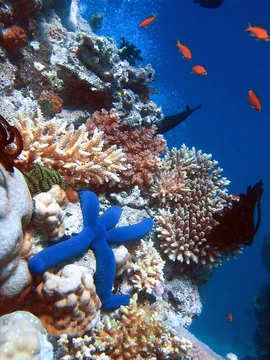
Endangered marine mammals such as dugongs, blue whales, and orcas occur here, and whale sharks also thrive in this region.[1] The Raja Ampat archipelago is widely regarded as the planet's foremost location for tropical marine life, earning the nickname "The Crown Jewel" within the Bird's Head Seascape, a region that also encompasses Cenderawasih Bay and Triton Bay.[1] Surveys have documented over 600 hard coral species in the area, representing roughly three-quarters of all known hard corals globally, alongside more than 1,700 reef fish species found on both shallow and mesophotic reefs.[1]
Biology and range
These islands belong to the Vogelkop-Aru lowland rain forests ecoregion, where the forest cover provides living spaces for numerous bird, mammal, reptile, and insect species.[2] A palm species named Wallaceodoxa raja-ampat, which was recently discovered, occurs nowhere else except on the Raja Ampat Islands.[3] Because of its coral variety, its ability to withstand disturbances, and its function as a supplier of larvae to other areas, Raja Ampat is considered a worldwide conservation priority for marine environments.[4] The presence of very large coral formations and the region's comparatively warm surface water temperatures indicate that these reefs might be more able to withstand stresses such as coral bleaching and disease than other reef systems.[5]
In the Misool area, there exist a minimum of three ponds that contain jellyfish which do not sting.[6] On the northeastern part of Waigeo Island, residents from nearby villages participate in turtle protection efforts by safeguarding nests or moving the eggs of leatherback, olive ridley, and hawksbill turtles.[7] A program to breed and reintroduce zebra sharks was launched in 2022, with a target of releasing 500 of these sharks into the wild by the year 2032.[8] Corals in Raja Ampat are consumed by the crown-of-thorns starfish, and the damage this starfish inflicts on the reefs has become a problem for the tourism industry.[9]
What the specialist sources record
The X-Ray Mag account states that surveys have identified over 600 species of hard coral and over 1,700 species of reef fish in Raja Ampat.[10] The same source notes that in February 2013, the local government declared four million hectares of coastal and marine waters as a sanctuary for sharks, manta rays, dugongs, whales, dolphins, and turtles.[10] The Guardian report describes the Caledonian Sky cruise ship as damaging approximately 1,600 square meters of coral at a dive site known as Crossover Reef.[11] The X-Ray Mag account explains that the strong currents carry nutrients from the Pacific Ocean and have helped create what are considered the finest coral reef ecosystems in the world.[10]
References
- Wikipedia, "Raja Ampat Islands" (CC BY-SA 4.0), which cites: Allen, "Reef fishes of the Bird's Head Peninsula, West Papua, Indonesia", Check List, 2009-01-09, p. 587–628; Andradi-Brown, "Highly diverse mesophotic reef fish communities in Raja Ampat, West Papua", Coral Reefs, 2020-10-29, p. 111–130; Silcock D.. 2013. Indonesia's Raja Ampat. X-Ray Mag | International Dive Magazine. Retrieved on September 25, 2017; Ogata J. M.. 2017. Ambon – Banda Islands – Raja Ampat . Mermaid Liveaboards. Retrieved on September 25, 2017; Lindbloom A.. 2017. Omura’s Whale . Mermaid Liveaboards. Retrieved on Sept en.wikipedia.org
- Wikipedia, "Raja Ampat Islands" (CC BY-SA 4.0) en.wikipedia.org
- Wikipedia, "Raja Ampat Islands" (CC BY-SA 4.0), which cites: Heatubun, "Three new genera of arecoid palm (Arecaceae) from eastern Malesia", Kew Bulletin, 2014, p. 9525 (original not read by us) en.wikipedia.org
- Wikipedia, "Raja Ampat Islands" (CC BY-SA 4.0), which cites: Asaad, "Delineating priority areas for marine biodiversity conservation in the Coral Triangle", Biological Conservation, June 2018, p. 198–211 (original not read by us) en.wikipedia.org
- Wikipedia, "Raja Ampat Islands" (CC BY-SA 4.0), which cites: Doubilet, David, "Ultra Marine: In far eastern Indonesia, the Raja Ampat islands embrace a phenomenal coral wilderness", National Geographic, September 2007 (original not read by us) en.wikipedia.org
- Wikipedia, "Raja Ampat Islands" (CC BY-SA 4.0), which cites: Kakaban, "Tujuh Danau Ubur-Ubur Unik di Indonesia", 2013-08-07 (original not read by us) en.wikipedia.org
- Wikipedia, "Raja Ampat Islands" (CC BY-SA 4.0), which cites: Leo R. 2019 (original not read by us) en.wikipedia.org
- Wikipedia, "Raja Ampat Islands" (CC BY-SA 4.0), which cites: Hans Nicholas Jong, "Conservationists upbeat as zebra shark reintroduction in Raja Ampat gathers pace", Mongabay, 18 June 2024 (original not read by us) en.wikipedia.org
- Wikipedia, "Raja Ampat Islands" (CC BY-SA 4.0), which cites: Kelly, "D.C.-area scuba divers dig out their old snorkels and fins to combat a coral eater", The Washington Post, 2019-06-23; Kelly, "D.C.-area scuba divers dig out their old snorkels and fins to combat a coral eater", The Washington Post, 2019-06-23 (original not read by us) en.wikipedia.org
- Silcock D.. 2013. Indonesia's Raja Ampat. X-Ray Mag | International Dive Magazine. Retrieved on September 25, 2017. facts only, no text reused. xray-mag.com
- Gokkon, "British-owned cruise ship wrecks one of Indonesia's best coral reefs", Guardian, 10 March 2017. facts only, no text reused. theguardian.com
Each numbered sentence above was checked against the source it cites before publication. Sentences citing Wikipedia adapt text from the English Wikipedia article Raja Ampat Islands (contributors), used under CC BY-SA 4.0; this entry is available under the same licence. Other sources were used for facts only; no text or images are copied from them.
More in Coral Reefs
Sources
Compiled from Wikipedia and the sources listed below. Text from Wikipedia is available under CC BY-SA 4.0; this entry is adapted from it.
- Wikipedia: Raja Ampat Islands (CC BY-SA 4.0).
Spotted an error? Know more?
Reader corrections go straight into our review queue. Suggest an edit · How this site is sourced