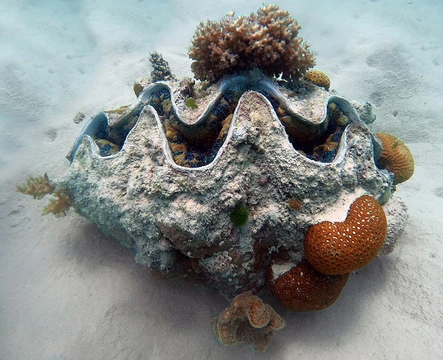
Maxima clam
A small, colorful giant clam popular in the aquarium trade.

The maxima clam, also known as the small giant clam (Tridacna maxima), is a species of bivalve mollusc found throughout the Indo-Pacific region. It is much sought after in the aquarium trade for its often striking coloration, which mimics that of the true giant clam, while maintaining a manageable size, with shells of large specimens typically not exceeding 20 centimetres (7.9 in) in length.
Quick Facts
- Taxon
- Tridacna maxima
Facts from the source article.
Lore & Background
The small giant clam has the widest range of all giant clam species, found in oceans surrounding East Africa, India, China, Australia, Southeast Asia, the Red Sea, and Pacific islands. It lives on the surface of reefs or sand, or partly embedded in coral, occupying well-lit areas due to its symbiotic relationship with photosynthetic algae. Adults develop a large shell that adheres to the substrate by its byssus, a tuft of long, tough filaments protruding from a hole next to the hinge. When open, the bright blue, green or brown mantle is exposed and obscures the edges of the shell, which have prominent, distinctive furrows. The attractive colors result from crystalline pigment cells, thought to protect the clam from intense sunlight or bundle light to enhance algal photosynthesis. Maxima produce white in their mantle by clustering red, blue, and green cells.
Reader's Guide
The maxima clam is notable for its wide distribution and its role in the aquarium trade, where its striking coloration and manageable size make it a sought-after species. It is a sessile mollusc that attaches to rocks or dead coral and siphons water for filter-feeding, though it obtains most nutrients from symbiotic zooxanthellae algae. Its life cycle begins as a fertilized egg, hatching within 12 hours into a free-swimming larva, which develops through stages to become a juvenile after eight to ten days. The juvenile matures into a male after two or three years, becoming a hermaphrodite at around 15 centimetres in length. Reproduction is stimulated by the lunar cycle, time of day, and presence of other eggs and sperm; hermaphroditic clams release sperm first, then eggs, to avoid self-fertilisation. The species is protected under Appendix II of CITES, requiring permits for international trade of all parts and derivatives.
Did You Know?
- The maxima clam is less than one-third the size of the true giant clam (Tridacna gigas).
- Its mantle produces white color by clustering red, blue, and green crystalline pigment cells.
- The clam becomes a hermaphrodite when it reaches about 15 centimetres in length.
- It has the widest range of all giant clam species, spanning from East Africa to Pacific islands.
More in Giant Clams and Marine Bivalves 1-24
Spotted an error? Know more?
Reader corrections go straight into our review queue. Suggest an edit · How this site is sourced