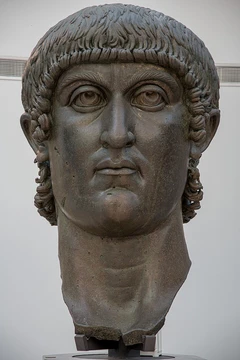
German and Sarmatian campaigns of Constantine
Constantine's campaigns secured the northern frontiers and expanded Roman control.
Last updated
The German and Sarmatian campaigns of Constantine were a series of military operations conducted by the Roman emperor Constantine I between 306 and 336. They were fought along the entire northern defensive system, from the Rhine to the Danube, against Germanic peoples such as the Franks, Alemanni, and Goths, as well as the Sarmatian Iazyges. These campaigns secured the empire's borders and accompanied Constantine's rise from ruler of the western provinces to sole Roman emperor.
Historical context
After the death of Emperor Numerian in November 284, the general Diocletian was proclaimed emperor and, following a civil war, established a diarchy with Maximian in 285. This division of imperial authority was extended in 293 when Diocletian and Maximian each appointed a Caesar, forming the Tetrarchy. The system collapsed after the abdication of the two Augusti in 305, triggering a new civil war that lasted until 324.
During this period, breaches along the Roman external border allowed populations to attempt settlement within the empire. Constantine, after becoming sole Augustus of the West in 312 and defeating Licinius in 324, reunified the empire and restored adequate defense of the northern frontiers. He is credited with perfecting Diocletian's military reforms and reconquering or vassalising all territory that Trajan had controlled.
Forces in the field
Under Diocletian's Tetrarchy reforms, the total number of Roman legions reached 55 or 56 by the year 300. Constantine's accession and the return of dynastic monarchy led to a further increase, bringing the number of legions to 62 or 64 around 330. Along the Rhine limes, the Franks and Saxons pressed on Gaul and Britannia, while the Alemanni also made incursions, though their main attacks targeted Northern Italy via Pannonia. Major clashes occurred along the Lower Danube in the Balkan provinces, where the Marcomanni, Quadi, Sarmatians, and especially the Goths (Tervingi and Greutungi) concentrated their attacks.
Phases of the conflict
In 306, Constantine escaped the court of Galerius and joined his father Constantius Chlorus in Britannia for a campaign against the Picts and Scotti. After his father's death, Constantine was proclaimed Augustus of the West at Eboracum on 25 July. Galerius recognised him only as Caesar, and Constantine accepted, returning to Augusta Treverorum in autumn to monitor the Gallic frontier menaced by the Franks. He made Trier his capital, reinforcing defences and augmenting his forces with new legions over the next six years.
After defeating Maxentius in 312, Constantine allied with Licinius in February 313, but conflict erupted in 316, resulting in Constantine gaining Illyricum. From 317 he focused on the Danubian Limes against the Sarmatians, residing at Sirmium until 324. In 323, when Goths crossed the Danube into Licinius's territory, Constantine marched against them, trespassing into Licinius's domain and triggering the final civil war, which ended with Constantine as sole emperor.
Results
Constantine's focus then turned east for a planned campaign against the Sassanids, which was never carried out due to his death in May 337. For the next twenty-five years, Roman armies under Constantius II and Julian fought the Sassanids with varying success, while the Lower Danube and Eastern borders stayed practically unchanged for almost thirty years.
More in Constantine the Great
Sources
Compiled from Wikipedia and the sources listed below. Text from Wikipedia is available under CC BY-SA 4.0; this entry is adapted from it.
- Wikipedia: German and Sarmatian campaigns of Constantine (CC BY-SA 4.0).
Spotted an error? Know more?
Reader corrections go straight into our review queue. Suggest an edit · How this site is sourced