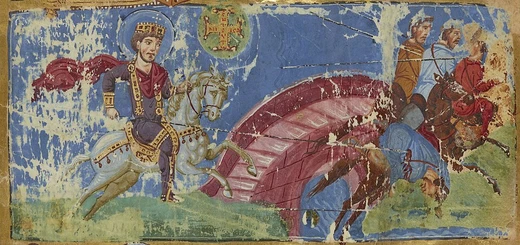
Old St. Peter's Basilica
Constantine's basilica over Saint Peter's grave, a pilgrimage center for centuries.
Last updated
Where it is
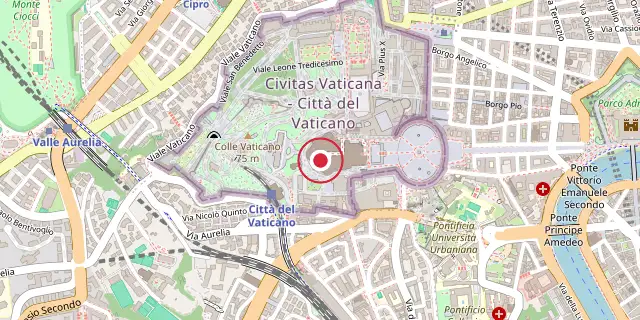
Coordinates: 41°54′07″N 12°27′11″E (41.9020, 12.4530) · Open in OpenStreetMap
Coordinates and connected clubs: the infobox of Wikipedia: Old St. Peter's Basilica (CC BY-SA 4.0). Map: drawn by Codexery from OpenStreetMap tiles.
Old St. Peter's Basilica was the church building that stood on the site of the current St. Peter's Basilica in Vatican City from the 4th to the 16th centuries. Its construction began under Roman Emperor Constantine I, and it was built over the historical site of the Circus of Nero. The name distinguishes it from the later basilica that replaced it.
History
Construction of the basilica was ordered by Roman Emperor Constantine I between 318 and 322, following his conversion to Christianity, and took roughly forty years to finish. Over the next twelve centuries, the church grew in importance, becoming a major pilgrimage destination in Rome. Papal coronations were held there, and in 800 Charlemagne was crowned emperor of the Carolingian Empire within its walls. In 846, Saracens sacked and damaged the basilica, which lay outside the Aurelian Walls and was an easy target; they destroyed Saint Peter's tomb and pillaged the shrine.
Pope Leo IV responded by building the Leonine wall and rebuilding the damaged parts. By the 15th century, the church was falling into ruin. After the pope's return from Avignon, discussions on repairs began, involving Leon Battista Alberti and Bernardo Rossellino, who improved the apse and added a multi-story benediction loggia. Alberti called the basilica a structural abomination.
Pope Julius II initially intended to preserve the old building but soon decided to tear it down and build anew, shocking many who saw it as a symbol of papal continuity. The church was gradually demolished over a hundred years, with the last original part removed in 1605; construction of the new basilica began the following year.
Design
The basilica followed a typical basilica form, with its plan and elevation resembling Roman basilicas and audience halls such as the Basilica Ulpia and Constantine's own Aula Palatina at Trier, rather than Greco-Roman temples. The design may have been derived from the description of Solomon's Temple in 1 Kings 6. Constantine took great care to build on the site he and Pope Sylvester I believed to be Saint Peter's grave, marked since at least the second century.
This influenced the layout, as the building was erected on the sloped Vatican Hill on the west bank of the Tiber River. Because the site was outside the ancient city boundaries, the apse with the altar was placed in the west, so the façade could be approached from Rome to the east. The exterior was not lavishly decorated, unlike earlier pagan temples. The church could hold 3,000 to 4,000 worshipers and had five aisles: a wide central nave and two smaller aisles on each side, divided by 21 marble columns taken from earlier pagan buildings.
It was over 350 feet long, built in the shape of a Latin cross, with a gabled timbered roof standing over 100 feet at the center. In the 6th century, an atrium called the Garden of Paradise was added at the entrance, with five doors leading into the church. The altar used several Solomonic columns; tradition held that Constantine took them from the Temple of Solomon, but they likely came from an Eastern church. Gian Lorenzo Bernini later drew from their twisted design for his baldacchino over the new St. Peter's altar, and eight of the original columns were moved to the piers of the new basilica.
Mosaics
The great Navicella mosaic by Giotto, commissioned by Cardinal Jacopo Stefaneschi, occupied the wall above the entrance arcade in the atrium, depicting Saint Peter walking on the waters; it was mostly destroyed during construction of the new St. Peter's in the 16th century, though fragments survived.
Tombs
As the church's prestige grew, it became richly decorated with statues, furnishings, and chandeliers, and side tombs and altars were continuously added. The structure was filled with tombs and bodies of saints and popes; bones continued to be found during construction as late as February 1544. Most of these tombs were destroyed during the demolition of Old St. Peter's in the 16th and 17th centuries, except one lost in the Saracen sack of 846. The remainder were transferred, mostly just the sarcophagi or coffins and their contents, to the modern St. Peter's Basilica and a few other Roman churches.
The only papal tombs to survive demolition and be properly reconstructed in the present St. Peter's are those of Pope Innocent VIII and Pope Sixtus IV from the 1490s by Antonio del Pollaiuolo, featuring bronze effigies. The rebuilding of St. Peter's, along with translations from the Catacombs and fires at the Archbasilica of Saint John Lateran, destroyed about half of all papal tombs, leading to Donato Bramante being remembered as Maestro Ruinante.
Stefaneschi Triptych
The Stefaneschi Altarpiece, a triptych by the medieval Italian painter Giotto, was ordered by Cardinal Giacomo Gaetani Stefaneschi for an altar in Old St. Peter’s Basilica. This work is one of the few commissions in Giotto’s career with clear documentation, and it bears his signature.
However, its exact creation date remains uncertain, and many experts think Giotto’s workshop actually painted it. Originally believed to be for the main altar, newer findings indicate it stood on the canon’s altar in the nave. Today, it is kept in the Pinacoteca Vaticana in Rome.
More in Constantine the Great and Christianity
Sources
Compiled from Wikipedia and the sources listed below. Text from Wikipedia is available under CC BY-SA 4.0; this entry is adapted from it.
- Wikipedia: Old St. Peter's Basilica (CC BY-SA 4.0).
Spotted an error? Know more?
Reader corrections go straight into our review queue. Suggest an edit · How this site is sourced