Donation of Constantine
Forged decree transferring imperial authority to the papacy.
Last updated
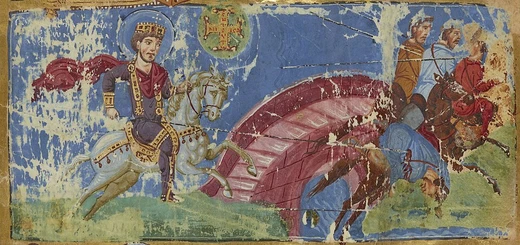
The Donation of Constantine is a forged Roman imperial decree that purportedly transferred authority over Rome and the western Roman Empire to the Pope. Composed probably in the 8th century, it was used especially in the 13th century to support papal claims of political authority. Lorenzo Valla first exposed the forgery with solid philological arguments in 1439–1440, though its authenticity had been contested since 1001.
Quick Facts
- Title in oldest manuscripts
- Constitutum domini Constantini imperatoris
- Earliest known allusion
- Letter of 778 by Pope Hadrian I
- Included in collection
- Pseudo-Isidorean decretals, 9th century
Facts from the source article.
Content
The document purports to be a decree from Constantine I, dated March 30 without a stated year, but it incorrectly names Gallicanus as co-consul with Constantine in his fourth term (315), whereas historical records show these two never served together as consuls—evidence of forgery. The decree states that Constantine professes Christianity and grants Pope Sylvester I imperial insignia, privileges, the Lateran Palace, and authority over Rome, Italy, and the western provinces.
The narrative, based on the 5th-century Acts of Sylvester, recounts Sylvester rescuing Romans from a dragon and curing Constantine's leprosy through baptism. In gratitude, Constantine bestows on the seat of Peter supremacy over the four principal sees of Alexandria, Antioch, Jerusalem, and Constantinople, as well as all churches worldwide, and grants landed estates in Judea, Greece, Asia, Thrace, Africa, Italy, and various islands. The Donation also gives Sylvester and his successors the tiara and imperial insignia.
The document implicitly asserts papal supremacy and the right to transfer the imperial seat, suggesting the papacy had consented to the translatio imperii to Byzantium and could reclaim authority.
Origin
Alternatively, the forgery may have originated in the chancery of Stephen's successor Paul I. Another interpretation suggests it was a ploy in Roman ecclesiastical politics to bolster the Lateran's status against the rising Vatican, possibly composed by a Greek monk in a Roman monastery. One study dates the forgery to the 9th century at Corbie Abbey in northern France. Johannes Fried distinguishes the Donation from an earlier forged version, the Constitutum Constantini, included in the False Decretals, arguing the Donation is a later expansion of the shorter Constitutum, whose mention of 'the western regions' referred to Lombardy, Veneto, and Istria.
Medieval use and reception
The first clear reference to the Donation of Constantine comes from a 778 letter, where Pope Hadrian I asked Charlemagne to follow Constantine’s lead and give land to the church. Otto III’s officials later declared the document fake. During the 11th and 12th centuries, it was used in the investiture disputes between popes and secular rulers. The Donation clashed with the Byzantine idea that Constantine had moved imperial power to Constantinople, so it became a weapon in the fight over church leadership between Rome and the East.
Cardinal Humbert of Silva Candida produced his own version to back papal authority against the eastern emperor. By the 1100s, a Greek translation existed, and Byzantine authors like John Kinnamos and Theodore Balsamon employed it in their arguments. In 1248, frescoes in the Chapel of St Sylvester at Santi Quattro Coronati showed the baptism and Donation. Dante Alighieri also mentioned it in his Divine Comedy.
Investigation
During the Middle Ages, the Donation was widely accepted as authentic, though Holy Roman Emperor Otto III may have raised suspicions. Not until the mid-15th century, with the revival of Classical scholarship, did humanists begin to recognize the document as a forgery. Cardinal Nicholas of Cusa declared it apocryphal. Lorenzo Valla, in his philological study, argued the language could not date to the 4th century and likely originated in the 8th; he believed the forgery so obvious that the Church must have known it was inauthentic, and he claimed papal usurpation of temporal power had corrupted the church and caused wars in Italy.
Independently, Reginald Pecocke, Bishop of Chichester, reached a similar conclusion. Indications of forgery include anachronistic terms such as 'fief' and the inconsistent date referencing both Constantine's fourth consulate (315) and the consulate of Gallicanus (317). Pope Pius II wrote a tract in 1453, before becoming pope, arguing that though the Donation was a forgery, the papacy owed its lands to Charlemagne and its powers to Peter; he did not publish it.
More in Constantine the Great and Christianity
Sources
Compiled from Wikipedia and the sources listed below. Text from Wikipedia is available under CC BY-SA 4.0; this entry is adapted from it.
- Wikipedia: Donation of Constantine (CC BY-SA 4.0).
Spotted an error? Know more?
Reader corrections go straight into our review queue. Suggest an edit · How this site is sourced