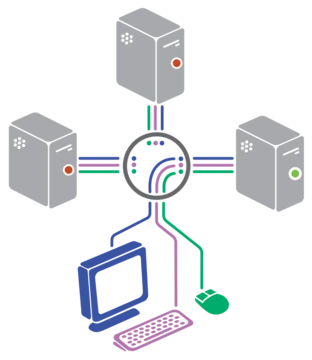
Computer monitor
An output device displaying pictorial or textual information from a computer.
Last updated
By the 2010s, CCFL backlit LCDs had been replaced in modern monitors by LCDs with LED backlighting.[1] Cathode ray tube (CRT) technology was the image output method for the majority of monitors prior to the mid-2000s.[1]
Quick Facts
- Common aspect ratios
- 4:3, 5:4, 16:10, 16:9
- Typical connectors
- DisplayPort
- HDMI
- USB-C
- DVI
- VGA
- Former dominant technology
- Cathode ray tube (CRT)
- Year lcds outsold crts
- 2003
Facts from the source article.
How it changed
Early electronic computer front panels used light bulbs to indicate register bit states, and this panel of lights became known as the "monitor".[2] Early monitors displayed very limited information and were rarely used for program output, with line printers serving as the primary output device.[2] Prior to the late 1970s, video display terminals using CRTs were often physically integrated with a keyboard in a single chassis.[3] High-resolution CRT displays were developed for specialized military and industrial uses but were too costly for general use until the Tektronix 4010 terminal in 1972.[3]
By the end of the 1980s, color progressive scan CRT monitors were widely available and increasingly affordable.[4] Since 2010, the typical display aspect ratio changed from 4:3 to 16:9.[1] CRTs were the display technology used in the earliest computer monitors.[3]
What the maker and period sources say
A 1990s-era source notes that an "average" circa 1990s consumer CRT monitor is closest to the sRGB color space.[5] A PCTechGuide.Com article states that CRT monitors are heavy, bulky, and power hungry, typically consuming 150W for a 17in model.[6] That article also reports that Philips Electronics agreed to merge its CRT business with LG Electronics, and Hitachi closed its CRT operation, proclaiming no prospects for growth.[6] The PCTechGuide.Com article notes that CRT monitor revenues peaked at nearly $20 billion in 1999 and were forecast to halve by 2007.[6]
Eight bits per primary color is the typical encoding method for colors, according to the same source.[7] A source on color spaces notes that many monitors capable of showing the sRGB color space are not correctly calibrated for it, either at the factory or by the user.[8]
References
- Wikipedia, "Computer monitor" (CC BY-SA 4.0), which cites: "LCD monitors outsold CRTs in Q3, says DisplaySearch", Electronic Engineering Times, 9 December 2004 (original not read by us) en.wikipedia.org
- Wikipedia, "Computer monitor" (CC BY-SA 4.0), which cites: "How Computers Work: Input and Output", homepage.cs.uri.edu (we also read that source) en.wikipedia.org
- Wikipedia, "Computer monitor" (CC BY-SA 4.0), which cites: On Guard! The Story of SAGE (1956) IBM Corporation short film at Internet Archive, display scope for Semi-Automatic Ground Environment (original not read by us) en.wikipedia.org
- Wikipedia, "Computer monitor" (CC BY-SA 4.0), which cites: "CRT Monitors", PCTechGuide.Com (we also read that source) en.wikipedia.org
- Friedl, "Digital-Image Color Spaces, Page 2: Test Images". facts only, no text reused. regex.info
- "CRT Monitors", PCTechGuide.Com. facts only, no text reused. pctechguide.com
- Wikipedia, "Computer monitor" (CC BY-SA 4.0), which cites: Friedl, "Digital-Image Color Spaces, Page 2: Test Images" (we also read that source) en.wikipedia.org
- Wikipedia, "Computer monitor" (CC BY-SA 4.0), which cites: Koren, "Gamut mapping" (original not read by us) en.wikipedia.org
Each numbered sentence above was checked against the source it cites before publication. Sentences citing Wikipedia adapt text from the English Wikipedia article Computer monitor (contributors), used under CC BY-SA 4.0; this entry is available under the same licence. Other sources were used for facts only; no text or images are copied from them.
More in Computer Mice and Monitors
Sources
Compiled from Wikipedia and the sources listed below. Text from Wikipedia is available under CC BY-SA 4.0; this entry is adapted from it.
- Wikipedia: Computer monitor (CC BY-SA 4.0).
Spotted an error? Know more?
Reader corrections go straight into our review queue. Suggest an edit · How this site is sourced