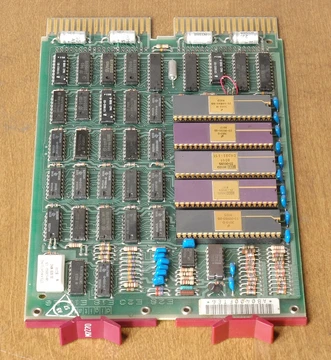
Gravis UltraSound
Sample-based synthesis card that brought wavetable sound to the PC.
Last updated
The Gravis UltraSound (GUS) is a sound card for IBM PC compatibles manufactured by Canada-based Advanced Gravis Computer Technology. Launched in 1992, it was notable for bringing sample-based music synthesis (marketed as "wavetable") to the IBM PC platform, using real-world sound recordings instead of artificial computer-generated waveforms. With up to 32 hardware audio channels and the ability to store instrument patches in its own RAM, the GUS offered high-quality MIDI playback at a price only slightly higher than Creative cards, undercutting many professional musician-oriented cards.
Quick Facts
- Manufacturer
- Advanced Gravis Computer Technology (Canada)
- Release year
- 1992
- Chip
- GF1 (co-developed with Forte Technologies, produced by Integrated Circuit Systems as ICS11614)
- Polyphony
- 32 oscillators (up to 32 mono or 16 stereo samples)
- Sample rate
- 44.1 kHz at up to 14-voice polyphony, deteriorating to 19.2 kHz at 32-voice polyphony
- Pcb color
- Red
Facts from the source article.
Background
The GF1 chip was derived from the Ensoniq OTTO (ES5506) chip, a next-generation version of the synthesizer chip found in the Ensoniq VFX and its successors. The GF1 is purely a sample-based synthesis chip with no built-in codec; sounds must be downloaded to onboard RAM before playback.
It does not support hardware compression like IMA ADPCM, so compressed samples must be decompressed prior to loading. The sound quality depends on the selected polyphony level, which is software-programmable, allowing programmers to balance quality and voice count. Advanced effects such as reverberation and chorus are not supported in hardware, though software simulation is possible.
The UltraSound offered MIDI playback by loading instrument patches into adapter RAM, similar to how instruments are stored in ROM on other wavetable cards. The card came with a 5.6 MB set of instrument patch files (*.PAT), most sampled at 16-bit resolution and looped to save space. Support programs used .INI files to describe patch loading for each program change event, allowing Gravis to incorporate a General MIDI-compatible mapping scheme. Windows 95 and 98 drivers used UltraSound.INI to load patches on demand; in DOS, patch loading could be configured separately.
Did You Know?
- The PicoGUS, an open-source design started in 2022, uses a Raspberry Pi RP2040 microcontroller to emulate the GUS and also supports Tandy 3 Voice, Game Blaster, and Sound Blaster 2.0.
Frequently Asked Questions
Who is Gravis UltraSound?
The Gravis UltraSound is a sound card for IBM PC compatibles built by Advanced Gravis Computer Technology, a Canadian company, and it launched in 1992. It is best remembered as the card that first delivered sample-based, or 'wavetable,' music synthesis to the mainstream PC platform.
What chip does Gravis UltraSound use and what are its limits?
The GUS is built around the GF1 synthesizer chip, co-developed with Forte Technologies and manufactured by Integrated Circuit Systems as the ICS11614. It supported up to 32 oscillators and ran at 44.1 kHz with up to 14 active voices, with the sample rate dropping to 19.2 kHz once all 32 channels were engaged.
More in Computer Cooling and Sound Cards
Sources
Compiled from Wikipedia and the sources listed below. Text from Wikipedia is available under CC BY-SA 4.0; this entry is adapted from it.
- Wikipedia: Gravis UltraSound (CC BY-SA 4.0).
Spotted an error? Know more?
Reader corrections go straight into our review queue. Suggest an edit · How this site is sourced