Computer fan
Active cooling component for drawing air through computer cases and over heatsinks.
Last updated

Raquelaa54 · CC BY 4.0
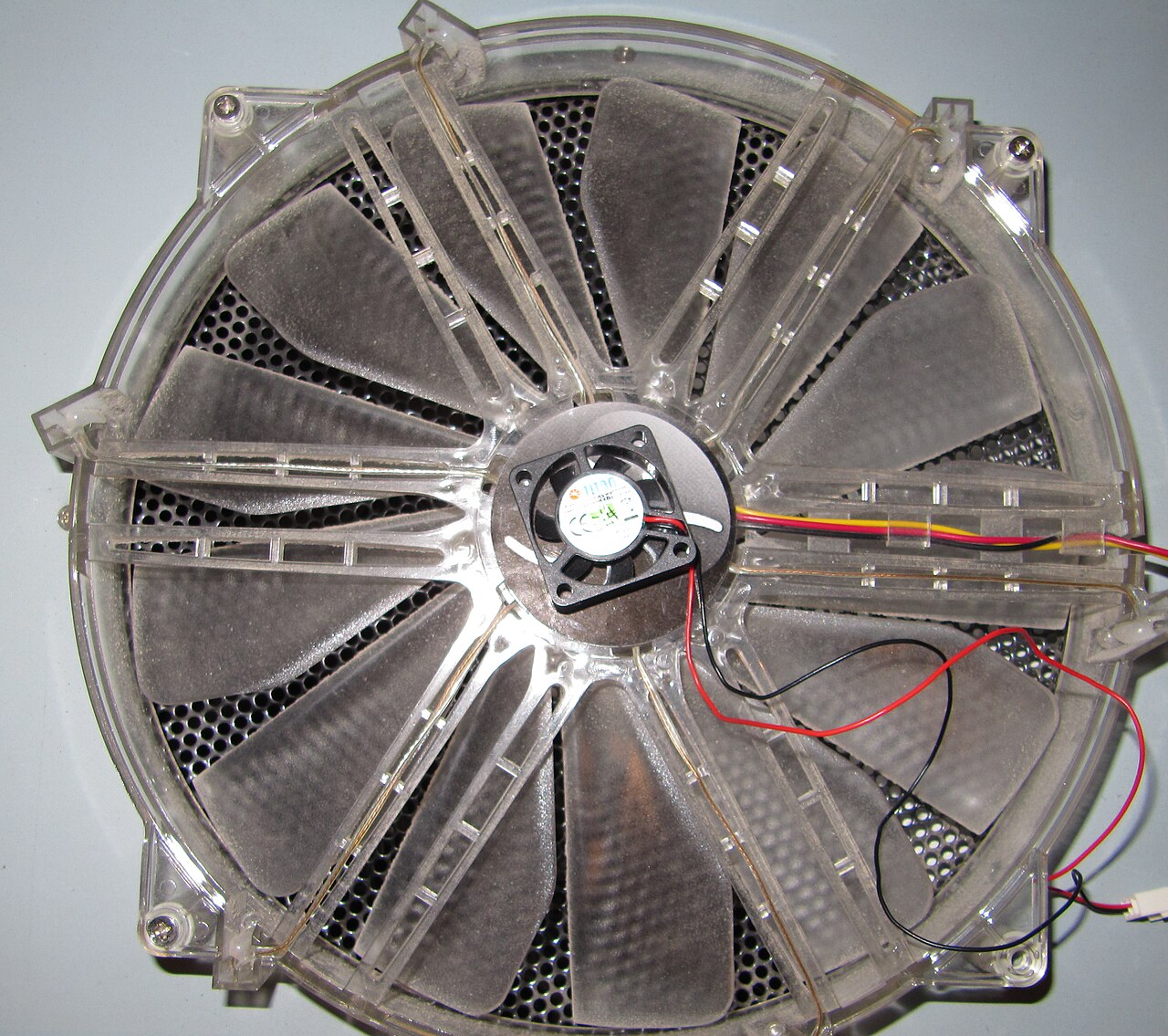
Most computer fans are of the axial flow type, creating low-pressure, high-volume air flows.[1] Fans serve as active cooling mechanisms by expelling warm air from components while pulling in cooler air.[2] To boost cooling effectiveness, fans are often paired with a heat sink, which enlarges the warm surface area exposed to air.[2]
Quick Facts
- Fan connector types
- 3-pin or 4-pin
- Typical fan dimension example
- 80 mm / 3.15 in × 80 mm / 3.15 in × 25 mm / 0.984 in
Facts from the source article.
How it changed
Early personal computers could cool most components using natural convection alone.[2] Active cooling on CPUs began appearing with the Intel 80486 processor.[3] By 1997, active cooling was standard on all desktop processors.[3] Chassis fans became common with the arrival of the Pentium 4 in late 2000.[3]
Some high-powered graphics cards can dissipate up to 350 watts, producing more heat than the CPU.[4] Contemporary graphics processing units, especially those used for 3D rendering and gaming, require their own separate cooling fans.[4] The built-in fan system's rotational speed can be managed by the computer's BIOS.[2] Individuals may add extra cooling parts or attach a manual controller featuring knobs for adjusting fan speeds.[2]
Automatic fan control is not universally implemented.[2]
What the maker and period sources say
Gordon's 2017 guide notes that a good set of fans can prevent overheating but can also make a computer sound like a wind tunnel.[5] The same source states that many off-the-shelf computers automatically control their fans to some extent.[5] Gordon explains that fans can get power from the motherboard or directly from the computer's power supply.[5] The guide advises checking for dust buildup and ensuring good ventilation before adjusting fan controls.[5]
EVERCOOL's product pages state the company has more than 30 years of experience in designing and manufacturing DC fans, AC fans, and heatsinks.[6][7][8] The EVERCOOL retail package series pages mention that the company develops various types of products to meet market demand.[7][8]
References
- Wikipedia, "Computer fan" (CC BY-SA 4.0), which cites: Pelonis, "Axial Vs. Centrifugal Fans", Pelonis Technologies, 2015-11-04; Acosta, "High Airflow vs Static Pressure Fans", Games and Gears Elite; Lee, Hsiao Mun & Lim, Kian & Lee, Hp. (2018). Reduction of Ceiling Fan Noise by Serrated Trailing Edge. Fluctuation and Noise Letters. 17. 1850026. 10.1142/S021 (original not read by us) en.wikipedia.org
- Wikipedia, "Computer fan" (CC BY-SA 4.0), which cites: Gordon, "How to Auto-Control Your PC's Fans for Cool, Quiet Operation", 2017-07-03 (we also read that source) en.wikipedia.org
- Wikipedia, "Computer fan" (CC BY-SA 4.0), which cites: Mueller, Scott 2005. Upgrading and Repairing PCs. Que Publishing. 16th edition. pp 1274–1280; Mueller, Scott 2005. Upgrading and Repairing PCs. Que Publishing. 16th edition. pp 1274–1280 (original not read by us) en.wikipedia.org
- Wikipedia, "Computer fan" (CC BY-SA 4.0), which cites: "Nvidia's New RTX 3090 Is a $1,499 Monster GPU Designed for 8K Gaming", The Verge, September 2020 (original not read by us) en.wikipedia.org
- Gordon, "How to Auto-Control Your PC's Fans for Cool, Quiet Operation", 2017-07-03. facts only, no text reused. howtogeek.com
- "EC 1708 fan series", evercool.com.tw. facts only, no text reused. evercool.com.tw
- "RETAIL PACKAGE 3010 SERIES – EVERCOOL", evercool.com.tw. facts only, no text reused. evercool.com.tw
- "RETAIL PACKAGE 3510 SERIES – EVERCOOL", evercool.com.tw. facts only, no text reused. evercool.com.tw
Each numbered sentence above was checked against the source it cites before publication. Sentences citing Wikipedia adapt text from the English Wikipedia article Computer fan (contributors), used under CC BY-SA 4.0; this entry is available under the same licence. Other sources were used for facts only; no text or images are copied from them.
More in Computer Cooling and Sound Cards
Sources
Compiled from Wikipedia and the sources listed below. Text from Wikipedia is available under CC BY-SA 4.0; this entry is adapted from it.
- Wikipedia: Computer fan (CC BY-SA 4.0).
Spotted an error? Know more?
Reader corrections go straight into our review queue. Suggest an edit · How this site is sourced