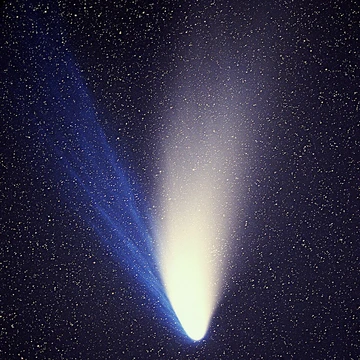
Coma (comet)
The diffuse gas-and-dust envelope surrounding a comet's nucleus.
The coma is the nebulous envelope around a comet's nucleus, formed when the comet nears the Sun in its highly elliptical orbit. As the comet warms, parts of it sublimate, giving it a diffuse appearance that distinguishes it from stars. The word comes from the Greek for "hair," which is also the origin of the word comet.
Quick Facts
- Water percentage in volatiles
- up to 90%
- Distance for water sublimation
- within 3–4 au from the Sun
- Coma size comparable to
- diameter of Jupiter
Facts from the source article.
Did You Know?
- The four top gases in 67P's halo were water, carbon dioxide, carbon monoxide, and oxygen.
- The ratio of oxygen to water coming off comet 67P remained constant for several months.
Size
As a comet nears the sun, its coma usually swells, sometimes reaching Jupiter’s width despite being incredibly thin. In October 2007, after an outburst, comet 17P/Holmes briefly had a dusty haze bigger than the sun. The Great Comet of 1811 also had a coma about as wide as the sun. However, around the time a comet passes Mars’ orbit, roughly 1.5 AU from the sun, the coma can actually shrink. At that point, the solar wind is strong enough to push gas and dust away, feeding the tail instead.
X-rays
Comets were found to emit X-rays in late March 1996, surprising researchers because X-ray emission usually comes from very high-temperature bodies. Thomas E. Cravens first proposed an explanation in early 1997: highly charged ions in the solar wind fly through a cometary atmosphere and collide with cometary atoms and molecules, ripping off one or more electrons. This process generates X-rays and far ultraviolet photons.
Observation
To figure out a coma’s size from a ground-based telescope, you can use the drift method. You fix the telescope in place and time how long the visible disk takes to cross the field of view. That time, multiplied by the comet’s declination cosine and then by 0.25, gives the coma’s diameter in arcminutes. If you know how far away the comet is, you can find its actual apparent size. In 2015, the Rosetta spacecraft’s ALICE instrument, an ultraviolet spectrograph, spotted hydrogen, oxygen, carbon, and nitrogen in the coma of comet 67P—what scientists call its atmosphere. It also found that UV-light-generated electrons were smashing into and breaking apart water and carbon monoxide molecules.
Hydrogen gas halo
OAO-2 discovered large halos of hydrogen gas around comets. This led NASA to point the Pioneer Venus mission at the comet, determining it emitted 12 tons of water per second. Hydrogen gas emission is not detectable from Earth's surface because those wavelengths are blocked by the atmosphere. Skylab detected a hydrogen gas halo three times the size of the Sun around Comet Kohoutek in the 1970s. SOHO observed a hydrogen gas halo larger than 1 AU in radius around Comet Hale–Bopp. Water emitted by the comet is broken up by sunlight, and the hydrogen emits ultraviolet light. These halos can be ten billion meters across, many times larger than the Sun. Hydrogen atoms are very light and travel long distances before being ionized by the Sun, after which they are swept away by the solar wind.
More in Comets
Spotted an error? Know more?
Reader corrections go straight into our review queue. Suggest an edit · How this site is sourced