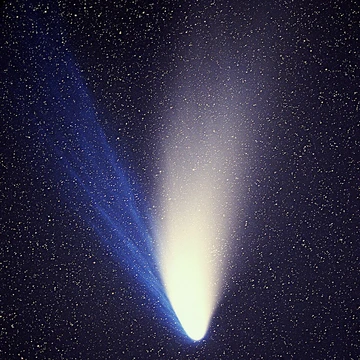
Extinct comet
A comet depleted of volatiles, resembling an asteroid.
An extinct comet has lost nearly all its volatile ices, leaving it unable to produce a tail or coma. A dormant comet, however, still contains some volatile material, but it is trapped beneath a dead surface layer. Without a visible coma or tail, both types can easily be mistaken for asteroids, blurring the line between these two kinds of small Solar System bodies. Once all volatile substances like water, nitrogen, and methane have evaporated, only an inert rock or rubble pile remains. A comet may pass through a transitional stage before becoming fully extinct.
Nature of extinct comets
A comet's nucleus loses its volatile materials over time, eventually becoming a small, dark, inert rock or rubble pile that can look like an asteroid. Related types include transition comets, which are nearly extinct; the Hubble Space Telescope searched for these. Objects like C/2001 OG108 (LONEOS) may represent a bridge between extinct comets and typical Halley-type comets (with periods of 20 to 200 years) or long-period comets (periods over 200 years).
Minor planets in the damocloid group are studied as possible extinct comet candidates because their orbital paths resemble those of Halley-type comets. Dormant comets have inactive surfaces but may still contain sealed volatiles. For instance, 14827 Hypnos might be the nucleus of an extinct comet, covered by a crust several centimeters thick that blocks any remaining gases from escaping. The term dormant comet also applies to comets that could become active but are not currently outgassing.
An example is 60558 Echeclus, which once displayed a cometary coma and received the cometary designation 174P/Echeclus. Additionally, centaur 52872 Okyrhoe brightened significantly after passing perihelion in early 2008.
Distinction between comets and asteroids
Before 2006, astronomers treated asteroids and comets as separate categories, with no single term covering both. That year, the International Astronomical Union introduced "small Solar System body" as a unifying label. The key difference is that a comet develops a fuzzy coma when sunlight vaporizes its near-surface ices. Some objects have been listed twice: first classified as minor planets, then later detected with cometary activity.
On the flip side, comets—possibly all of them—eventually lose their surface volatiles, taking on an asteroid-like appearance. Another clue is orbital shape: comets generally follow more stretched-out paths than most asteroids. Any asteroid with a highly eccentric orbit is likely a dormant or extinct comet. These dead comets are thought to be common among objects that travel close to the Sun. In fact, about six percent of near-Earth asteroids are believed to be extinct comet nuclei that no longer release gas.
More in Comets
Spotted an error? Know more?
Reader corrections go straight into our review queue. Suggest an edit · How this site is sourced