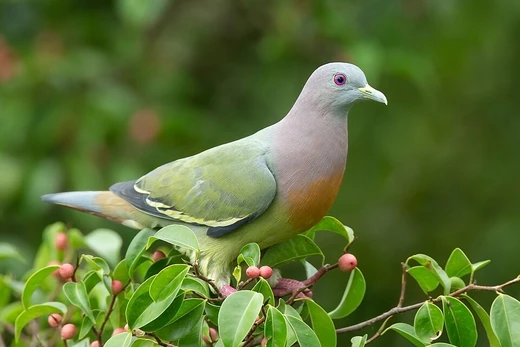
Claravis (bird)
Last updated
The blue ground dove, Claravis pretiosa, is a tropical bird native to the New World. Its breeding range stretches from southeastern Mexico through northwestern Peru and northern Argentina, plus Trinidad.
Scientific classification
- KingdomAnimalia
- PhylumChordata
- ClassAves
- OrderColumbiformes
- FamilyColumbidae
- GenusClaravis
- SpeciesClaravis pretiosa
Named by (Ferrari-Pérez, 1886)
Sources: Wikipedia taxobox: Blue ground dove (CC BY-SA 4.0)
Conservation status
Least Concern (LC)
- LC▲ this species
- NT
- VU
- EN
- CR
- EW
- EX
Source: IUCN Red List assessment · GBIF copy of the Red List category
How big is it?
Largest length in the source, 0.2 m, next to a 1.8 m person.
Diagram: drawn by Codexery, schematic shapes to scale (not a likeness). Length: Wikipedia: Blue ground dove
Where the claravis (bird) has been recorded
Each dot is a place where the species has been observed and reported (58,465 records, half-degree grid) — not a modelled range. 312 inland records left out (institution coordinates).
Map: drawn by Codexery. Data: GBIF occurrence search (records CC0 / CC BY) · Natural Earth basemap (public domain)
Description
The male blue ground dove has blue-grey feathers on its back and head, with lighter grey underneath and a grey-white face. Its wing and tail feathers are blackish, and black spots on the wings often form clear bands. The eye can be red or yellow, surrounded by a green ring, and the legs are flesh-pink. Females show a grey-brown head, neck, and chest, with pale blue-grey underwings and belly.
Their back is ruddy brown, the rump and tail are chestnut, and the wing spots are chestnut-brown. Young birds look like females but have ruddy scaling on the back.
In most areas, the male is not easily confused with other species, though it can be mistaken for birds in the genus Paraclaravis. The female might be confused with the female ruddy ground dove, which is smaller and has blackish wing markings instead of chestnut-brown. In many regions, a blue-grey and a brown bird flying together through trees is likely this species.
Taxonomy
The blue ground dove is the type species for the bird genus Claravis, which was named in 1899 by Harry C. Oberholser. The genus name comes from the Latin words clarus, meaning "distinct" or "clear," and avis, meaning "bird." While the maroon-chested ground dove and purple-winged ground dove were once placed here, they have since been moved to Paraclaravis. This reclassification followed genetic analysis of mitochondrial and nuclear DNA, which showed that the original grouping was not monophyletic. The blue ground dove itself formed a strongly supported clade in that study.
Did You Know?
- The male's song, given from the treetops, is a loud 'boop'.
- It builds a flimsy dish nest of twigs 1–11 m high in a tree.
- Blue ground doves feed mainly on the ground on seeds and small insects, and take grit.
More in Columbidae
Sources
Compiled from Wikipedia and the sources listed below. Text from Wikipedia is available under CC BY-SA 4.0; this entry is adapted from it.
- Wikipedia: Blue ground dove (CC BY-SA 4.0).
- Conservation status: IUCN Red List assessment.
- Occurrence records: GBIF (CC0 / CC BY). Basemap: Natural Earth (public domain).
- Word definitions: the Codexery glossary, each quoted from its Wikipedia article.
Spotted an error? Know more?
Reader corrections go straight into our review queue. Suggest an edit · How this site is sourced