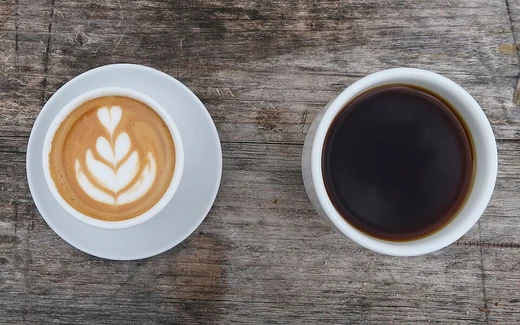
Instant coffee
A quick-dissolving coffee beverage derived from processed brewed beans.

Wikipedia / Wikimedia Commons
Instant coffee is a drink made from brewed coffee that has been processed into a powder or crystals, allowing someone to make a cup simply by adding hot water or milk. It was invented in 1890 in Invercargill, New Zealand. The solid form—also called soluble coffee, coffee extract, or coffee powder—is produced commercially by freeze-drying or spray-drying the brewed coffee, and it can also be sold as a concentrated liquid.
Compared to coffee made from ground beans, instant coffee has several practical benefits: it dissolves quickly in hot water, weighs and ships more compactly for the same number of servings, and lasts a long time on the shelf (though it can spoil if it gets damp). Many people consider the taste and quality of brewed coffee to be better, but instant coffee creates less mess since there are no grounds to dispose of. One study found that, when looking at the entire process of making a single cup, instant coffee has a smaller environmental impact than drip filter coffee or capsule espresso, setting aside differences in taste and appeal.
The global instant coffee market was valued at US$4.16 billion in 2026.
**History**
During the American Civil War, a concentrated mix of coffee, milk, and sugar called Essence of Coffee was made for the Union army. A teaspoon of it was added to hot water, but it had the consistency of axle grease and was so unpopular that production stopped. In 1876, Paterson & Sons Ltd in Scotland began producing Camp Coffee, a liquid essence of coffee and chicory.
The invention of powdered soluble instant coffee was filed on January 28, 1889, and patented in 1890 by David Strang of Invercargill, New Zealand, under patent number 3518. He called it "Strang's Soluble Coffee Powder" and used a "Dry Hot-Air" process. Some modern sources credit French writer Alphonse Allais with the invention instead. Earlier, the invention was often attributed to Satori Kato, a Japanese scientist working in Chicago who introduced a powdered version at the 1901 Pan-American Exposition in Buffalo, New York. Shortly after, George Constant Louis Washington developed his own process and began selling it commercially in 1910, but the product was expensive for its quality and tended to absorb moisture from the air.
In 1938, Nestlé released a more stable, free-flowing instant coffee powder under the Nescafé brand. Spray-drying coffee extract had been difficult because the high levels of sugars and acids made the powder sticky and pasty. Nestlé’s chemist Max Morgenthaler solved this by mixing 50% soluble coffee solids with 50% maltodextrins, which allowed the mixture to be spray-dried into a stable powder. Nescafé became widely known during World War II when it was included in U.S. Army rations. After the war, other companies like Douwe Egberts Moccona began making soluble coffee, and consumption grew quickly.
In the 1950s, General Foods introduced an instant coffee made from 100% coffee solids, without added carbohydrates like maltodextrins. By extracting coffee with water at high temperatures (up to 175°C) and under pressure, larger polysaccharides naturally in the beans were released, making spray-drying possible without additives. This product could be called pure soluble coffee. Early spray-dried powders had very small particles and were dusty. Around 1968, manufacturers began agglomerating the powder into granules.
The first freeze-dried instant coffee was launched in 1963 by General Foods under the Maxwell House brand. Starting in the mid-1960s, manufacturers began capturing aroma compounds from the roasting and extraction process and adding them back to the finished product to improve flavor.
**Use**
A 2009 paper on green coffee stated that nearly 50% of the world’s coffee production (as green coffee) is used to make instant coffee.
**As a beverage**
Instant coffee is sold as a powder or granules in glass or plastic jars, sachets, or tins. Hot water, milk, or even cold water (for iced coffee like the Greek frappé) is added, along with milk and sugar if desired. The strength depends on the ratio of coffee to liquid. In countries like Portugal, Spain, and India, it is often mixed with hot milk instead of water. Instant coffee is also sold pre-mixed with non-dairy creamer and sugar; this is popular in South Korea, where it is called "coffee mix."
**Market**
The global instant coffee market was valued at US$34.16 billion in 2026. In 2025, Asia-Pacific held 39% of the market, Europe 28%, North America 24%, and the Middle East and Africa 9%. A 2014 article reported that instant coffee made up 1% of coffee sales in Italy, 4% in France, 7% in the U.S., and 77% in the UK. The high figure in the UK was attributed to U.S. troops introducing instant coffee there during World War II, as coffee was a novelty to a traditionally tea-drinking nation.
**Non-beverage uses**
Instant coffee is also used as a flavoring in baked goods, candies, ice creams, and savory dishes like stews. It is one of the possible ingredients in Café.
- invented
- 1890
- inventor
- David Strang
- place_of_invention
- Invercargill, Southland, New Zealand
- field
- Food and beverage
- known_for
- Soluble coffee powder
- patent_number
- 3518
Lore & Background
The invention for powdered soluble instant coffee was filed on 28 January 1889 and patented in 1890 by David Strang of Invercargill, New Zealand, under patent number 3518, and sold as 'Strang's Soluble Coffee Powder', citing the patented 'Dry Hot-Air' process. Some modern sources have credited French humorist and writer Alphonse Allais with the invention. The invention was previously attributed to Satori Kato, a Japanese scientist working in Chicago in 1901, who introduced the powdered substance in Buffalo, New York, at the Pan-American Exposition. George Constant Louis Washington developed his own instant coffee process shortly thereafter, first marketing it commercially in 1910.
In 1938 Nestlé produced a more stable, free-flowing instant coffee powder under the Nescafé brand, composed of 50% soluble coffee solids and 50% maltodextrins. Nescafé instant coffee became known world-wide during the Second World War through inclusion in the rations of the US Army. In the 1950s, General Foods introduced an instant coffee product made from 100% coffee solids without added carbohydrates. The first freeze-dried instant coffees were produced in the late 1960s, followed by agglomeration of spray-dried soluble coffee together with aromatisation.
Reader's Guide
Instant coffee has advantages over coffee brewed from ground coffee beans including speed of preparation, lower shipping weight and volume, and long shelf life—though it can spoil if not kept dry. However, the beverage made from ground coffee is considered to have superior quality and taste. Instant coffee also reduces cleanup since there are no coffee grounds. At least one study has found that instant coffee has a lower environmental footprint than drip filter coffee and capsule espresso coffee, on a prepared beverage basis, disregarding quality and appeal. Close to 50% of the world's green coffee is used to produce instant coffee. In some countries, such as Portugal, Spain, and India, instant coffee is commonly mixed with hot milk instead of boiling water. In South Korea, instant coffee commonly comes pre-mixed with non-dairy creamer and sugar and is called 'coffee mix'. Said to have been popularised in the UK by GIs during World War II, instant coffee still accounts for over 75 percent of coffee bought to drink in British homes, as opposed to well under 10 percent in the U.S. and France and one percent in Italy. Instant coffee is also used in non-beverage applications, such as in Caffenol, a home-made black-and-white photographic developer, and as a dye to stain paper to give the impression of aging.
Did You Know?
- Instant coffee was invented in 1890 in Invercargill, Southland, New Zealand, by David Strang.
- Close to 50% of the world's green coffee is used to produce instant coffee.
- Instant coffee has a median caffeine content of 66 mg per cup, compared to 112 mg for drip or filter coffee.
- Instant coffee can be used as a dye to stain paper and give the impression of it being aged.
Frequently Asked Questions
Who is Instant coffee?
Instant coffee is a quick-dissolving beverage made from processed brewed coffee beans, first created by David Strang in 1890 in Invercargill, Southland, New Zealand. It holds patent number 3518 and is best known as a soluble coffee powder in the food-and-beverage field.
What are Instant coffee's powers/role?
Its signature ability is letting anyone produce a hot coffee drink in seconds by simply stirring in hot water or milk. Commercially, the product is made through freeze-drying or spray drying, and it also appears as a concentrated liquid form.
Where was Instant coffee born?
Instant coffee traces its origin to Invercargill, Southland, New Zealand, where David Strang developed the process back in 1890. That small-town setting makes it one of the earliest processed coffee products in recorded history.
How does Instant coffee's story end?
Instant coffee has no dramatic final chapter; it simply became a permanent, shelf-stable staple in kitchens around the world. Its legacy endures as the go-to practical alternative to freshly brewed coffee, available in powder, granule, and liquid formats.
Why is Instant coffee important?
It removed the need for brewing equipment, making a hot coffee drink accessible to virtually anyone with a cup and hot water. Strang's 1890 invention fundamentally changed how everyday people interact with coffee, turning a multi-step ritual into a single pour.
More in Coffee 1-15
Spotted an error? Know more?
This is a living reference — every entry is fact-audited, and reader corrections feed straight into our audit queue. Suggest an edit · See this site's audit record