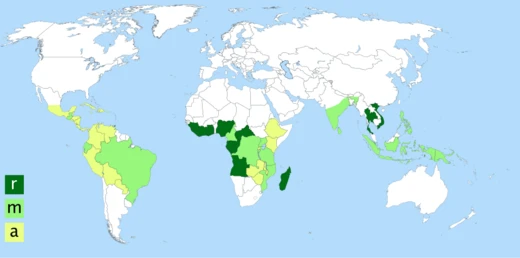
Coffee production in Vietnam
Vietnam is the world's second largest coffee producer.
Last updated
Coffee production has been a major source of income for Vietnam since the early 20th century. After the Vietnam War, production rose again following Đổi mới economic reforms, making coffee second only to rice in value of agricultural exports.
Quick Facts
- Robusta share of output
- 97%
Facts from the source article.
History
Production peaked in the early 20th century as small-scale operations shifted to commercial plantations. In the 1920s, the French opened coffee zones in the Central Highlands, especially Đắk Lắk Province.
The Vietnam War disrupted production in the Buôn Ma Thuột region, which was largely depopulated. After the North Vietnamese victory, the industry was collectivized, limiting private enterprise and resulting in low output. Cooperation among growers, producers, and government led to branding and retail exports.
Impacts of coffee production
In 2023, Vietnam exported 1.62 million tons of coffee, making it the second largest producer globally after Brazil, with Robusta accounting for 97% of output. Coffee farmers have experienced cycles of boom and bust since the 1980s, creating a volatile industry. Importing countries pay steady prices while exporting farmers face daily price fluctuations. The boom had enabled children from low-income households to attend school and families to buy goods, but declining prices reversed this, forcing children to quit school and farmers to seek wage labour.
Steps towards sustainable production
A working group on coffee, one of the first initiatives of the Partnership for Sustainable Agriculture in Vietnam, brought together coffee companies, government, civil society, and farmers to replace aging trees and provide extension and financing services. Research shifted in scale and perspective, mirroring greater government interest. One initiative supported coffee replanting based on a perceived crisis of aging tree stock. Since replanting is a long-term investment—trees take three years to yield and another three to yield fully—smallholder farmers may face income reductions, so the government concurrently developed financing solutions.
Global marketplace
Vietnamese immigrants to Louisiana in the late 20th century adopted New Orleans-style coffee because they could not obtain Vietnamese-grown coffee; the French roast style's coarse grind resembled Vietnamese coffee for traditional brewing. In Vietnam, locally produced coffees are medium roast and contain no chicory. Since Đổi mới, Vietnamese coffee competes internationally with different laws, cultures, tastes, and business practices.
Did You Know?
- Vietnamese coffee is typically brewed in a single-serving filter called a phin, often served table-side while still brewing.
- Sweetened condensed milk is used instead of fresh milk due to its availability and easier storage in a tropical climate.
More in Coffee Production by Country
Sources
Compiled from Wikipedia and the sources listed below. Text from Wikipedia is available under CC BY-SA 4.0; this entry is adapted from it.
- Wikipedia: Coffee production in Vietnam (CC BY-SA 4.0).
Spotted an error? Know more?
Reader corrections go straight into our review queue. Suggest an edit · How this site is sourced