Seabed
The ocean floor, shaped by tectonics and sediment.

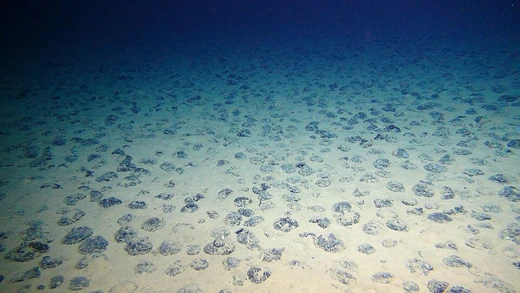
The seabed, also known as the seafloor, ocean floor, or ocean bottom, is the bottom of the ocean. Its structure is governed by plate tectonics, and most of the global ocean's seabed consists of the deep abyssal plain. Seafloor spreading creates mid-ocean ridges along the center of major ocean basins, where the seabed is slightly shallower than the surrounding abyssal plain. From the abyssal plain, the seabed slopes upward toward the continents, becoming in order from deep to shallow the continental rise, slope, and shelf. The depth measured down into the seabed itself, such as through a sediment core, is known as the "depth below seafloor," often expressed in meters below the seafloor (mbsf). The ecological environment of the seabed and the deepest waters, as a habitat for creatures, is collectively called the "benthos."
Most of the world's seabed is covered in layers of marine sediments. These are categorized by origin as terrigenous (from land), biogenous (from biological organisms), hydrogenous (from chemical reactions), or cosmogenous (from space). By size, sediments range from very small particles like clays and silts (known as mud) to larger particles from sand to boulders. The features of the seabed are governed by the physics of sediment transport and by the biology of creatures living in and above it. Sediments often come from erosion on land or rarer sources like volcanic ash. Sea currents, especially in shallow waters, transport and resuspend sediments. Microorganisms within the seabed change its chemistry, while marine organisms like phytoplankton create sediments when their silicate or calcium carbonate shells sink after death.
Human impacts on the seabed are diverse, including exploration, plastic pollution, and exploitation by mining and dredging. Ships use acoustic technology to map water depths. Submersibles help study unique ecosystems like hydrothermal vents. Much of the world's plastic ends up in the ocean, with some sinking to the seabed. Exploitation involves extracting minerals from sulfide deposits via deep sea mining and dredging sand for construction and beach nourishment.
- field
- Oceanography, Geology, Marine Biology
- known_for
- Being the bottom of the ocean, governed by plate tectonics, and covered in marine sediments
- composition
- Terrigenous, biogenous, hydrogenous, and cosmogenous sediments
- depth_zones
- Abyssal zone (to 6,000 m) and hadal zone (6,000–11,000 m)
Lore & Background
The seabed's structure is primarily determined by plate tectonics. Seafloor spreading creates mid-ocean ridges along the center of major ocean basins, where the seabed is shallower than the surrounding abyssal plain. From the abyssal plain, the seabed slopes upward through the continental rise, slope, and shelf toward the continents. Oceanic trenches, deep valleys, occur along tectonic plate edges, and hydrothermal vents release hot water and chemicals in volcanic areas and trenches. Most of the seabed is covered in layers of marine sediments, classified by origin as terrigenous (from land), biogenous (from organisms), hydrogenous (from chemical reactions), and cosmogenous (from space). Sediments also vary by size, from clays and silts (mud) to sand and boulders. The depth within the seabed itself is called 'depth below seafloor,' measured in meters below seafloor (mbsf). Human impacts on the seabed include exploration via acoustic mapping and submersibles, plastic pollution (much of which sinks to the seabed), and exploitation through deep-sea mining and dredging. The ecological environment of the seabed and deepest waters is collectively known as the benthos, a habitat for creatures.
Reader's Guide
The seabed is a fundamental component of Earth's geography and ecology, covering the floor of all the world's oceans. Its structure, governed by plate tectonics, creates distinct zones from continental shelves to abyssal plains and trenches, influencing ocean circulation and marine life. The seabed's sediment layers record Earth's history, including biological productivity, climate changes, and extraterrestrial impacts. Human activities such as mining, dredging, and pollution increasingly affect the seabed, making its study critical for understanding both natural processes and anthropogenic impacts. The benthos, the ecological zone of the seabed, supports diverse organisms adapted to extreme pressures and darkness. Mapping and exploring the seabed continue to reveal new features, such as hydrothermal vents, and inform resource management and conservation efforts.
Did You Know?
- The seabed is also known as the seafloor, ocean floor, or ocean bottom.
- Most of the seabed is covered in layers of marine sediments, with terrigenous sediment being the most abundant.
- The depth below the seafloor is measured in meters below seafloor (mbsf).
- Plastic pollution is a global phenomenon, and much of the world's plastic ends up in the ocean, with some sinking to the seabed.
More in Coastal & Marine Geology 1-21
Spotted an error? Know more?
This is a living reference — every entry is fact-audited, and reader corrections feed straight into our audit queue. Suggest an edit · See this site's audit record