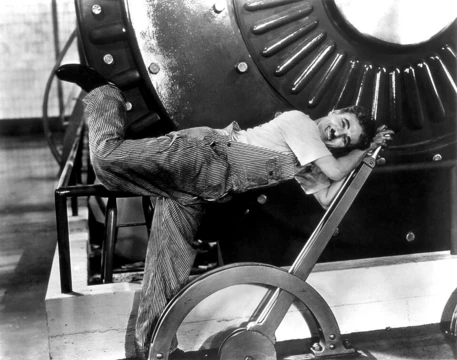
Charlie Chaplin
English comic actor and filmmaker, iconic as the Tramp.

via Wikipedia: Charlie Chaplin · see source
Sir Charles Spencer Chaplin Jr. lived from 16 April 1889 to 25 December 1977. He was an English performer—comic actor, filmmaker, singer, film editor, and composer—who became famous during the silent-film era. His character the Tramp turned him into a global icon, and he is regarded as a major figure in cinema history. His career lasted over 75 years, beginning in his Victorian-era childhood and continuing until just a year before his death.
Chaplin grew up poor and struggling in London. His father was absent, and his mother had money troubles; he was placed in a workhouse twice before turning nine. When he was 14, his mother was sent to a mental asylum. He started performing young, touring music halls and later working as a stage actor and comedian. At 19, he joined the Fred Karno company, which brought him to the United States. In 1914, his films for Keystone Studios made him widely popular. He soon introduced and stuck with the Tramp as his on-screen identity. He began directing his own movies and refined his skills at Essanay Studios, where the Tramp gained emotional depth in *The Tramp* (1915). He built a large following and demanded higher pay as he moved to Mutual and First National. By 1918, he was among the world’s highest-paid and most famous people.
In 1919, Chaplin helped found the distribution company United Artists, giving him full control over his films. His first feature-length movie was *The Kid* (1921), followed by *A Woman of Paris* (1923), *The Gold Rush* (1925), and *The Circus* (1928). He initially refused to switch to sound films in the 1930s, making *City Lights* (1931) and *Modern Times* (1936) without dialogue. His first sound film was *The Great Dictator* (1940), a satire of Adolf Hitler.
The 1940s brought controversy, and Chaplin’s popularity dropped sharply. He was accused of having communist sympathies, and some in the press and public were shocked by his involvement in a paternity suit and his marriages to much younger women. The FBI opened an investigation, and in 1952 Chaplin was forced to leave the United States, settling in Switzerland. He abandoned the Tramp in his later films, including *Monsieur Verdoux* (1947), *Limelight* (1952), *A King in New York* (1957), *The Chaplin Revue* (1959), and *A Countess from Hong Kong* (1967).
Chaplin wrote, directed, produced, edited, and composed the music for most of his films. He was a perfectionist, and his financial independence let him spend years developing and producing a single picture. His films blend slapstick with pathos, especially in the Tramp’s struggles against hardship. Many include social and political themes, along with autobiographical elements. In 1972, he received an Honorary Academy Award for “the incalculable effect he has had in making motion pictures the art form of this century,” part of a renewed appreciation for his work. He remains highly respected, with *The Gold Rush*, *The Circus*, *City Lights*, *Modern Times*, and *The Great Dictator* frequently appearing on lists of the greatest films.
**Life and career**
**1889–1913: early years**
**Background and childhood hardship**
Charles Spencer Chaplin Jr. was born on 16 April 1889 in London to Hannah Chaplin (née Hill) and Charles Chaplin Sr. Some have speculated that his paternal grandmother was Romani, but “without a birth certificate, no one will ever know the truth.” No official birth record exists, though Chaplin believed he was born at East Street, Walworth, in South London.
His parents had married four years earlier, at which point Charles Sr. became the legal guardian of Hannah’s first son, Sydney John Hill. When Chaplin was born, both parents were music-hall entertainers. Hannah, a shoemaker’s daughter, had a brief, unsuccessful career under the stage name “Lily Harley.” Charles Sr., a butcher’s son, was a popular singer. Though they never divorced, the couple was estranged by around 1891. The next year, Hannah gave birth to a third son, George Wheeler Dryden, fathered by music-hall entertainer Leo Dryden. Dryden took the child at six months old, and he did not re-enter Chaplin’s life for about thirty years.
Chaplin’s childhood was defined by poverty and hardship, making his later rise—according to his authorized biographer David Robinson—“the most dramatic of all the rags to riches stories ever told.” He spent his early years with his mother and brother Sydney in the London district of Kennington. Hannah had no income except occasional nursing and dressmaking; Charles Sr. provided no financial support. As conditions worsened, Chaplin was sent to Lambeth Workhouse at age seven. The council housed him at the Central London District School for paupers, which he later recalled as “a forlorn existence.” He was briefly reunited with his mother eighteen months later, but Hannah was forced to readmit the family to the workhouse in July 1898. The boys were then sent to Norwood Schools, another institution for destitute children.
In September 1898, Hannah was committed to Cane Hill mental asylum; she had developed psychosis, apparently triggered by a syphilis infection and malnutrition. During her two-month stay, Chaplin and Sydney lived with their father, whom they barely knew. Charles Sr. was by then severely alcoholic, and conditions were poor enough to prompt a visit from the National Society for the Prevention of Cruelty to Children. He died two years later, aged 38, from cirrhosis of the liver. Hannah entered a period of remission but fell ill again in May 1903. Chaplin, then 14, had to take her to the infirmary, from where she returned to Cane Hill. He lived alone for several days, searching for food and occasion.
- born
- 16 April 1889, London, England
- died
- 25 December 1977
- field
- Comic actor, filmmaker, singer, film editor, composer
- nationality
- English
- known_for
- Screen persona the Tramp; silent film era; co-founder of United Artists
Verified Timeline
Lore & Background
Chaplin's childhood in London was one of poverty and hardship. His father was absent and his mother struggled financially – he was sent to a workhouse twice before the age of nine. When he was 14, his mother was committed to a mental asylum. Chaplin began performing at an early age, touring music halls and later working as a stage actor and comedian. At 19, he was signed to the Fred Karno company, which took him to the United States. In 1914, Chaplin gained widespread popularity through his appearances in Keystone Studios films. He soon introduced and adopted the Tramp as his screen persona. He directed his own films and continued to hone his craft as he moved to Essanay Studios, where the Tramp persona was developed emotionally in The Tramp (1915). He then attracted a large fanbase and demanded more money as he moved to Mutual and First National corporations. By 1918, he was one of the world's best-paid and best-known figures. In 1919, Chaplin co-founded the distribution company United Artists, which gave him complete control over his films. His first feature-length film was The Kid (1921), followed by A Woman of Paris (1923), The Gold Rush (1925), and The Circus (1928). He initially refused to move to sound films in the 1930s, instead producing City Lights (1931) and Modern Times (1936) without dialogue. His first sound film was The Great Dictator (1940), which satirised Adolf Hitler. The 1940s were marked with controversy for Chaplin, and his popularity declined rapidly. He was accused of communist sympathies, and some members of the press and public were scandalised by his involvement in a paternity suit and marriages to much younger women. The Federal Bureau of Investigation opened an investigation, and Chaplin was forced to leave the US in 1952 and settle in Switzerland. He abandoned the Tramp in his later films, which include Monsieur Verdoux (1947), Limelight (1952), A King in New York (1957), The Chaplin Revue (1959), and A Countess from Hong Kong (1967).
Reader's Guide
Chaplin wrote, directed, produced, edited, and composed the music for most of his films. He was a perfectionist, and his financial independence enabled him to spend years on the development and production of a picture. His films are characterised by slapstick combined with pathos, typified in the Tramp's struggles against adversity. Many contain social and political themes, as well as autobiographical elements. He received an Honorary Academy Award for 'the incalculable effect he has had in making motion pictures the art form of this century' in 1972, as part of a renewed appreciation for his work. He continues to be held in high regard, with The Gold Rush, The Circus, City Lights, Modern Times, and The Great Dictator often ranked on lists of the greatest films.
Did You Know?
- Chaplin was sent to Lambeth Workhouse when he was seven years old, and again in July 1898.
- At 14, Chaplin had the task of taking his mother to the infirmary, from where she returned to Cane Hill mental asylum.
- Chaplin made his first amateur stage appearance at age five, taking over from his mother Hannah one night in Aldershot.
- At 16, Chaplin starred in the West End production of Sherlock Holmes at the Duke of York's Theatre from October to December 1905.
- Chaplin was signed to the Fred Karno company at age 19, and Karno initially considered him a 'pale, puny, sullen-looking youngster'.
Frequently Asked Questions
Who is Charlie Chaplin?
Charlie Chaplin was an English performer born in London in 1889 who became one of the most recognizable figures in cinema history. He worked as an actor, director, composer, and editor, building his reputation during the silent film era before passing away in December 1977.
What is the Tramp?
The Tramp is Chaplin's most famous screen character—a disheveled, lovable vagabond in a bowler hat, baggy pants, and a small mustache. The figure became a global symbol of physical comedy and the underdog, appearing across dozens of his films from the 1910s through the 1950s.
What made Chaplin's physical comedy stand out?
Chaplin blended broad slapstick with genuine pathos, letting his Tramp's clumsy shuffles and acrobatic tumbles convey both humor and quiet sadness. His precise choreography of falls, facial expressions, and timing set a benchmark for physical performance that shaped generations of clowns and comedians.
Why is Chaplin considered important to physical comedy and clowning?
He demonstrated that a single performer could carry an entire film through body language and rhythmic timing alone, without relying on dialogue. His co-founding of United Artists in 1919 also gave performers and filmmakers unprecedented creative control, a model that still echoes through the industry today.
How long did Chaplin's career last?
Chaplin's professional life stretched over roughly 75 years, from his childhood stage appearances in Victorian London to his final public work just a year before his death in 1977. That extraordinary span made him one of the longest-running figures in entertainment history.
More in Clowning & Physical Comedy 1-21
Spotted an error? Know more?
This is a living reference — every entry is fact-audited, and reader corrections feed straight into our audit queue. Suggest an edit · See this site's audit record